


Camera lens supplier Largan Precision Co’s (大立光) recent purchase of a plot of land at the Taichung Precision Machinery Science and Technology Innovation Park should ease investors’ concerns about the company’s capacity constraints, CIMB Securities Ltd said in a client note.
Earlier this week, Largan announced it has secured a 45,480m2 plot of land in the industrial park, which is next to its Greater Taichung headquarters, through a government auction. The company has been looking for land to expand its facilities for more than one year as its current plant is fully utilized.
In a filing with the Taiwan Stock Exchange, Largan said it would pay NT$3.1 billion (US$101.7 million) for the land.
With expenditure for plant construction and equipment, the company plans to invest between NT$10 billion and NT$11 billion over the next five years in the industrial park to expand capacity.
CIMB estimated on Tuesday that “Largan’s current capacity for lens modules is about 100 million units per month.”
“We expect the new plant to remove the ceiling on Largan’s capacity, but it will take two years for new capacity to build up, so we do not project any contribution from new capacity before 2017,” CIMB said.
The Greater Taichung Government is scheduled to hold a meeting today to review Largan’s operational plans for the newly acquired land. Both sides are likely to ink an agreement later this month if everything goes well, local media reported, citing Wang Tan-sheng (王誕生), head of the city’s Economic Development Bureau.
Largan, the most expensive stock on the local bourse, rose 1.38 percent to close at NT$2,210 yesterday. The stock has advanced 81.89 percent this year.
The company is a leading lens manufacturer for mobile handsets, with main customers including Nokia Oyj, Motorola Mobility Holdings Inc, Sony Corp, Apple Inc, HTC Corp (宏達電) and BlackBerry Ltd. Based on Daiwa Capital Markets Inc’s estimates, Largan has about a 28 percent share of the global handset-lens market.
However, the company’s shares have pulled back almost 8 percent after Apple’s iPhone 6 and iPhone 6 Plus were released in several countries on Sept. 19, as investors were worried that Largan might lose order allocation to its local peer, Genius Electronic Optical Co (玉晶光), due to the apparently limited megapixel migration for new iPhones.
Some analysts believe investors’ concerns might be overdone, saying the camera functions for the new iPhones have enhanced quality and demand a more complex manufacturing process and therefore higher average selling prices, although the main camera lens resolution for the new iPhones remained at 8 megapixels.
CIMB says the share-price pullback represents a good entry point for Largan, as the brokerage is confident about the sales of the iPhone 6 Plus, while Daiwa says Largan’s industrial position remains solid.
“Our market research indicates that Genius has limited order allocation for the iPhone 6 and iPhone 6 Plus due to poor production-yield rates,” Daiwa said in a separate note. “We continue to forecast Largan to secure a 60 to 70 percent order share for the iPhone 6 and more than 90 percent order share for the 6 Plus.”
Daiwa kept Largan as one of its top picks in the Greater China smartphone space, saying the firm would also benefit from strong sales growth of Chinese handset brands in addition to new iPhones.

SECOND-RATE: Models distilled from US products do not perform the same as the original and undo measures that ensure the systems are neutral, the US’ cable said The US Department of State has ordered a global push to bring attention to what it said are widespread efforts by Chinese companies, including artificial intelligence (AI) start-up DeepSeek (深度求索), to steal intellectual property from US AI labs, according to a diplomatic cable. The cable, dated Friday and sent to diplomatic and consular posts around the world, instructs diplomatic staff to speak to their foreign counterparts about “concerns over adversaries’ extraction and distillation of US AI models.” Distillation is the process of training smaller AI models using output from larger, more expensive ones to lower the costs of training a powerful new
Micron Technology Inc is a driving force pushing the US Congress to pass legislation that would put new export restrictions on equipment its Chinese competitors use to make their chips, according to people familiar with the matter. A US House of Representatives panel yesterday was to vote on the “MATCH Act,” a bill designed to close gaps in restrictions on chipmaking equipment. It would also pressure foreign companies that sell equipment to Chinese chipmaking facilities to align with export curbs on US companies like Lam Research Corp and Applied Materials Inc. The bill targets facilities operated by China’s ChangXin Memory Technologies Inc

Singapore-based ride-hailing and delivery giant Grab Holdings’ planned acquisition of Foodpanda’s Taiwan operations has yet to enter the formal review stage, as regulators await supplementary documents, the Fair Trade Commission (FTC) said yesterday. Acting FTC Chairman Chen Chih-min (陳志民) told the legislature’s Economics Committee that although Grab submitted its application on March 27, the case has not been officially accepted because required materials remain incomplete. Once the filing is finalized, the FTC would launch a formal probe into the deal, focusing on issues such as cross-shareholding and potential restrictions on market competition, Chen told lawmakers. Grab last month announced that it would acquire
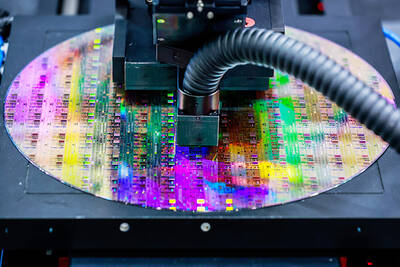
The artificial intelligence (AI) boom has triggered a seismic reshuffling of global equity markets, with Taiwan and South Korea muscling past European nations one by one. With its stock market now valued at nearly US$4.3 trillion, Taiwan surpassed the UK, Europe’s biggest market, earlier this month, data compiled by Bloomberg showed. South Korea is about US$140 billion away from doing the same. The tech-heavy Asian markets have shot past Germany and France in the past seven months. The shift is largely down to massive gains in shares of three companies that provide essential hardware for AI: Taiwan Semiconductor Manufacturing Co (TSMC, 台積電),


 RSS
RSS