


Eyeing the rising global demand for commercial pilots, the nation is to see its first flight training school open next week.
APEX Flight Academy Co Ltd (安捷飛航訓練中心), which has already set up its aircraft parking ground and maintenance hangar near Taitung airport, is set to open for business on Wednesday, following preparations that have taken more than a year.
The flight school, which has NT$160 million (US$5.31 million) in registered capital, is set up to train people who are interested in getting a private pilot’s license (PPL) or a commercial pilot’s license (CPL).
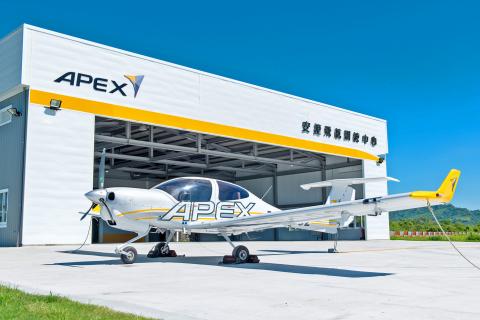
Photo: Lin Chia-chi, Taipei Times
“Taiwan has never owned a domestic flight training school, with interested learners only capable of joining courses abroad,” company general manager J.J. Tsang (臧運國) told a media briefing ahead of the flight school’s official launch ceremony at Taipei International Airport (Songshan airport) on Wednesday.
However, global aviation systems are set to require more than 500,000 new commercial airline pilots over the next 20 years, with 40 percent of them needed by Asian carriers, Tsang said, citing figures from Boeing Co.
The high demand has led APEX management to maintain a bullish outlook for the new business.
The flight school has set the price of the PPL course and CPL course at about NT$600,000 and NT$2.3 million respectively, with the academy expecting to recruit 150 to 200 students for the PPL course and 20 for the CPL course in its first year of operation, Tsang said.
Tsang said entering the aviation industry would be a challenge, with the company setting a modest goal of generating profits in five to eight years at the earliest.
APEX sales and marketing department director Allen Wang (王志仁) said about 100 people had so far contacted the company to express an interest in joining the courses.

Cairo’s new monorail slices across the city skyline, running above the familiar chaos of blaring horns and aging buses’ exhaust fumes that mark rush hour below. The US$4.5 billion monorail, opened this month, is among Egypt’s most prominent new transport projects, part of a debt-funded infrastructure drive criticized for sapping state finances while bringing limited benefits to most of the country’s 109 million people. “It feels like you’re in a different country,” said Ramy Sayed, a restaurant manager, aboard a driverless Innovia 300 train. “No noise, no traffic, we’re not used to this.” The eastern line runs 56km from the bustling middle-class

Taiwanese firms have increased investment in the Philippines in recent years as Manila’s ties with Washington deepen and global supply chains continue to shift away from China, an expert at the Chung-Hua Institution for Economic Research (CIER, 中華經濟研究院) said yesterday. The Philippines had not been among Taiwanese investors’ top choices in Southeast Asia, CIER Taiwan ASEAN Studies Center director Kristy Hsu (徐遵慈) said at a seminar in Taipei. However, Taiwan’s investment in the country has grown significantly since the COVID-19 pandemic, reaching US $257 million last year, a high in recent years, she said. Although Taiwan’s total investment in the Philippines still lags

Intel Corp regards Taiwan Semiconductor Manufacturing Co (TSMC, 台積電) as a longstanding partner, as the US chipmaker would continue outsourcing production of advanced chips to TSMC, Intel chief executive officer Lip-Bu Tan (陳立武) said yesterday. “I don’t look at people as competitors. I look at the collaboration... Nvidia is also, you know, a good friend,” Tan told a news conference following his keynote speech at the Computex trade show in Taipei. “It’s a very trusted partnership for us... We are a big, top customer for them, and we’re going to continue doing that,” he said, referring to TSMC, the world’s largest foundry

Artificial intelligence (AI) agents would supplant smartphones as the center of people’s digital lives, fundamentally reshaping personal devices and driving a major computing upgrade cycle, Qualcomm Inc CEO Cristiano Amon said yesterday. In his keynote speech for this year’s Computex trade show in Taipei, Amon said that the rise of "agentic AI" — AI systems capable of reasoning, planning and carrying out tasks autonomously — would transform how people interact with technology across phones, PCs, vehicles and wearable devices. Describing the technology as the next major evolution in computing, Amon said that "2026 is the year of agents.” For decades, smartphones have sat


 RSS
RSS