


State-controlled oil giant Sinopec Corp (中國石化) on Sunday unveiled a plan to sell a US$17.5 billion stake in its retail business, marking the country’s biggest privatization push since Chinese President Xi Jinping (習近平) came to power almost two years ago.
The sale is a reflection of the government’s drive to restructure the country’s many sprawling state-owned enterprises.
PetroChina (中石油), the nation’s No. 1 energy producer, has divested part of its pipeline business, raising billions of dollars from domestic institutional investors.
The sale also highlights Sinopec’s hope that outside investors would be a catalyst for growth and reform at its currently low-margin retail unit.
However, some analysts say a lack of retail names on the investor list is lowering their expectations of a quick turnaround. The presence of private equity firms also presents a risk in which they may exit the business when Sinopec lists the subsidiary in a couple of years.
Sinopec’s retail unit will issue new shares to a group of 25 largely deep-pocketed financial companies like insurers and funds, and raise 107.1 billion yuan (US$17.5 billion), the company said in a filing with the Hong Kong and Shanghai bourses.
The investors will get a combined 29.99 percent stake in the unit, which comprises a wholesale business, more than 30,000 petrol stations and more than 23,000 convenience stores, as well as oil-product pipelines and storage facilities.
Each investor would not hold a stake exceeding 2.8 percent.
Besides capital, the investors are expected to bring in “strength and vitality” that will help reform and grow the retail unit, Sinopec chairman Fu Chengyu (傅成玉) said in a statement.
Sinopec will use the US$17.5 billion from the sale to optimize its fuel retail business, boost non-fuel sales and pay down debts owed to the parent company, Chai Zhiming (柴志明), deputy chief executive of the retail unit, said in a telephone interview yesterday.
Sinopec is looking for expertise and ideas to boost its non-fuel businesses, which include convenience stores and services such as fast food and car washes.
Unlike the West, where non-fuel revenue can account for more than half of a filling station’s profits, more than 99 percent of Sinopec’s retail sales come from gasoline.
“Definitely, this is an area that has room for growth,” James Roy, associate principal of Shanghai-based business consultancy China Market Research Group, said of Sinopec’s non-fuel business.
Leading investors on the deal include one of China’s biggest asset managers, Harvest Fund Management Co Ltd (嘉實國際資產管理), which will pay 15 billion yuan for a joint stake with its subsidiary Harvest Capital Management. China Life Insurance (中國人壽) and a consortium including People’s Insurance Group of China Co Ltd (中國人保控股) and Tencent Holdings Ltd (騰訊) are each taking 10 billion yuan stakes.
Other investors include Fosun International (復星), China gas supplier ENN Energy Holdings Ltd (新奧能源) and white goods maker Haier Electronics Group Co Ltd (海爾).
Asia private equity firm RRJ Capital, founded by former Goldman Sachs and Hopu Investment Management (厚樸投資管理) dealmaker Richard Ong, is among the foreign investors in the deal, with a 3.6 billion yuan stake.

The domestic unit of the Chinese-owned, Dutch-headquartered chipmaker Nexperia BV will soon be able to produce semiconductors locally within China, according to two company sources. Nexperia is at the center of a global tug-of-war over critical semiconductor technology, with a Dutch court in February ordering a probe into alleged mismanagement at the company. The geopolitical tussle has disrupted supply chains, with some carmakers reportedly forced to cut production due to chip shortages. Local production would allow Nexperia’s domestic arm, Nexperia Semiconductors (China) Ltd (安世半導體中國), to bypass restrictions in place since October on the supply of silicon wafers — etched with tiny components to

Singapore-based ride-hailing and delivery giant Grab Holdings Ltd has applied for regulatory approval to acquire the Taiwan operations of Germany-based Delivery Hero SE's Foodpanda in a deal valued at about US$600 million. Grab submitted the filing to the Fair Trade Commission on Friday last week, with the transaction subject to regulatory review and approval, the company said in a statement yesterday. Its independent governance structure would help foster a healthy and competitive market in Taiwan if the deal is approved, Grab said. Grab, which is listed on the NASDAQ, said in the filing that US-based Uber Technologies Inc holds about 13 percent of

Taiwan Semiconductor Manufacturing Co (TSMC, 台積電) yesterday received government approval to deploy its advanced 3-nanometer (3nm) process at its second fab currently under construction in Japan, the Ministry of Economic Affairs said in a news release. The ministry green-lit the plan for the facility in Kumamoto, which is scheduled to start installing equipment and come online in 2028 with a monthly production capacity of 15,000 12-inch wafers, the ministry said. The Department of Investment Review in June 2024 authorized a US$5.26 billion investment for the facility, slated to manufacture 6- to 12nm chips, significantly less advanced than 3nm process. At a meeting with
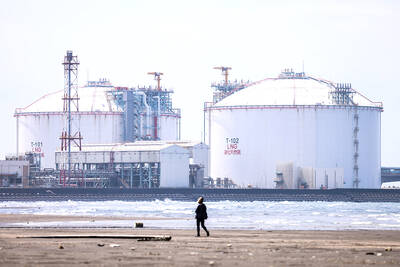
Taiwan is open to joining a global liquefied natural gas (LNG) program if one is created, but on the condition that countries provide delivery even in a scenario where there is a conflict with China, an energy department official said yesterday. While Taiwan’s priority is to have enough LNG at home, the nation is open to exploring potential strategic reserves in other countries such as Japan or South Korea, Energy Administration Deputy Director-General Chen Chung-hsien (陳崇憲) said. While the LNG market does not have a global reserve for emergencies like that of oil, the concept has been raised a few times —


 RSS
RSS