


China’s property industry extended its slump last month as sales and construction dropped and investment growth slowed, threatening to drag on a recovery in the world’s second-biggest economy.
Home sales in the period from January to last month fell 9.2 percent from a year earlier by area, after an 8.6 percent decline in the first four months, China’s National Bureau of Statistics data showed on Friday.
New property construction dropped 18.6 percent this year through last month and residential housing starts fell 21.6 percent by area.
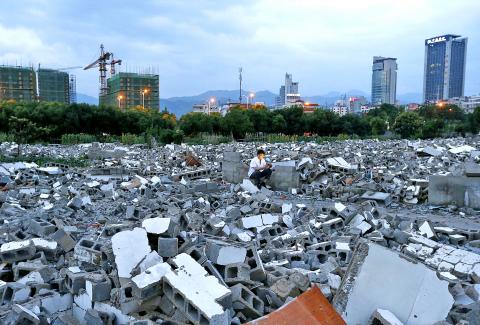
Photo: Reuters
The sinking real-estate market may undermine Chinese Premier Li Keqiang’s (李克強) mini-stimulus policies aimed at arresting a slowdown that has thrown his growth target for this year into question.
The property industry is the biggest downside risk to China’s economy, according to Societe Generale SA.
“The housing downturn is still playing out and has shown no sign of turning around,” Yao Wei (姚煒), China economist at Societe Generale in Hong Kong, said in a note on Friday. “The next few months will still be a tug of war between the housing sector and policy easing.”
UBS AG has estimated the real-estate industry accounts for more than a quarter of final demand in the economy when including property-generated needs for goods including electric machinery and instruments, chemicals and metals.
Growth in real-estate investment slowed to 14.7 percent in the first five months from 16.4 percent in the January-April period, statistics bureau data yesterday showed. That was the weakest increase since a 12.5 percent gain in the first eight months of 2009, according to previously released data.
“This represents a dramatic slowdown,” Dariusz Kowalczyk, senior economist at Credit Agricole SA in Hong Kong, said in an e-mailed note.
“The trend is disconcerting and, if not reversed, could be a drag on this year’s gross domestic product growth of 0.5 to 0.75 percentage point,” he said.
The decline in home purchases has been steeper in the more developed eastern regions of the country, where sales fell 14.4 percent by area in the first five months, according to statistics bureau figures.
Other data released yesterday signal that government measures to stabilize the economy, including speeding up public investment and fiscal spending, are starting to take effect.
Industrial production rose 8.8 percent last month from a year earlier, matching the median estimate in a Bloomberg News survey and up from 8.7 percent in April.
Retail sales growth topped forecasts, accelerating to 12.5 percent from 11.9 percent the previous month.
Property companies from Guangzhou to Beijing have been skirting government requirements on minimum down payments to boost sales, according to state media and statements by government agencies and developers.
Poly Real Estate Group Co (保利房地產) is letting buyers delay full down payments at its Central Park development in southeastern Nanjing city, the official China News Service reported on June 6.
Buyers can pay deposits of 50,000 yuan (US$8,049) and then 15 percent of the home price in three months’ time, the report said.
While the central bank last month called on the nation’s biggest lenders to accelerate the granting of mortgages, the government has refrained from broad-based easing of property restrictions imposed over the last four years to rein in prices.

Nvidia Corp chief executive officer Jensen Huang (黃仁勳) on Monday introduced the company’s latest supercomputer platform, featuring six new chips made by Taiwan Semiconductor Manufacturing Co (TSMC, 台積電), saying that it is now “in full production.” “If Vera Rubin is going to be in time for this year, it must be in production by now, and so, today I can tell you that Vera Rubin is in full production,” Huang said during his keynote speech at CES in Las Vegas. The rollout of six concurrent chips for Vera Rubin — the company’s next-generation artificial intelligence (AI) computing platform — marks a strategic
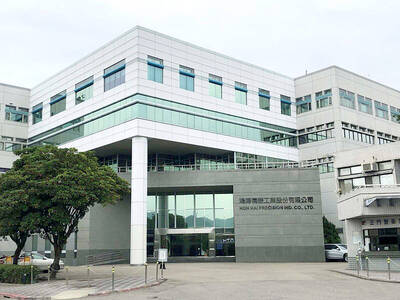
REVENUE PERFORMANCE: Cloud and network products, and electronic components saw strong increases, while smart consumer electronics and computing products fell Hon Hai Precision Industry Co (鴻海精密) yesterday posted 26.51 percent quarterly growth in revenue for last quarter to NT$2.6 trillion (US$82.44 billion), the strongest on record for the period and above expectations, but the company forecast a slight revenue dip this quarter due to seasonal factors. On an annual basis, revenue last quarter grew 22.07 percent, the company said. Analysts on average estimated about NT$2.4 trillion increase. Hon Hai, which assembles servers for Nvidia Corp and iPhones for Apple Inc, is expanding its capacity in the US, adding artificial intelligence (AI) server production in Wisconsin and Texas, where it operates established campuses. This

US President Donald Trump on Friday blocked US photonics firm HieFo Corp’s US$3 million acquisition of assets in New Jersey-based aerospace and defense specialist Emcore Corp, citing national security and China-related concerns. In an order released by the White House, Trump said HieFo was “controlled by a citizen of the People’s Republic of China” and that its 2024 acquisition of Emcore’s businesses led the US president to believe that it might “take action that threatens to impair the national security of the United States.” The order did not name the person or detail Trump’s concerns. “The Transaction is hereby prohibited,”
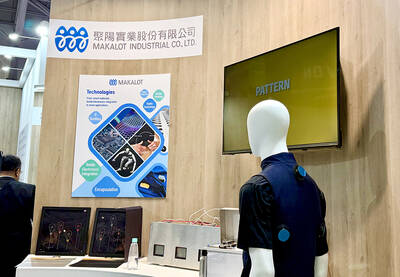
Garment maker Makalot Industrial Co (聚陽) yesterday reported lower-than-expected fourth-quarter revenue of NT$7.93 billion (US$251.44 million), down 9.48 percent from NT$8.76 billion a year earlier. On a quarterly basis, revenue fell 10.83 percent from NT$8.89 billion, company data showed. The figure was also lower than market expectations of NT$8.05 billion, according to data compiled by Yuanta Securities Investment and Consulting Co (元大投顧), which had projected NT$8.22 billion. Makalot’s revenue this quarter would likely increase by a mid-teens percentage as the industry is entering its high season, Yuanta said. Overall, Makalot’s revenue last year totaled NT$34.43 billion, down 3.08 percent from its record NT$35.52


 RSS
RSS