


The number of people using mobile messaging service Line has reached 400 million worldwide, including more than 17 million in Taiwan alone, Line Corp said yesterday.
Line added another 100 million registered users in just 126 days — one day less than it needed to go from 200 million to 300 million users — the company said in a statement.
It has added up to 1.7 million new users a day since hitting the 300-million-user milestone on Nov. 25, the Tokyo-based company said.

Photo: Chu Pei-hsiung, Taipei Times
However, the number of registered users in Taiwan has remained relatively flat since November last year.
Asked if Taiwan’s market is saturated, Line Taiwan said that the number of users has actually continued to grow as the number of mobile devices rises.
“Line will also keep an eye on Taiwan’s market and continue to provide diverse services to meet users’ needs,” the company said.
In addition to Taiwan, Thailand, Japan, India, Indonesia and Spain, the countries that have more than 1 million registered users now include the US, South Korea, Malaysia and Mexico, the company said.
The number of text messages sent via Line per day has reached as many as 10 billion, while more than 12 million free calls using the system are made a day, it said.
Line chief executive officer Akira Morikawa expressed delight at hitting the 400-million-user milestone, and said the company expected to reach 500 million users within this year.
“Line aims to further its growth and become the world’s top communications infrastructure, taking on many new challenges along the way,” he said, adding that the level of competition in the global communications app market has become fiercer than ever.
Launched in June 2011, Line, which allows users to enjoy free calls and messages as well as video calls, needed just 399 days to reach the 50-million-user mark, compared with 1,096 days for Twitter and 1,325 days for Facebook.
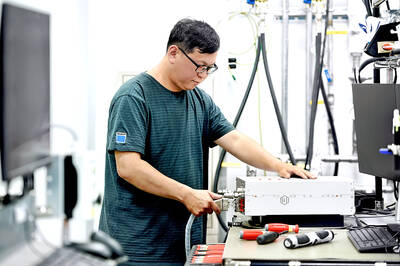
SEMICONDUCTORS: The German laser and plasma generator company will expand its local services as its specialized offerings support Taiwan’s semiconductor industries Trumpf SE + Co KG, a global leader in supplying laser technology and plasma generators used in chip production, is expanding its investments in Taiwan in an effort to deeply integrate into the global semiconductor supply chain in the pursuit of growth. The company, headquartered in Ditzingen, Germany, has invested significantly in a newly inaugurated regional technical center for plasma generators in Taoyuan, its latest expansion in Taiwan after being engaged in various industries for more than 25 years. The center, the first of its kind Trumpf built outside Germany, aims to serve customers from Taiwan, Japan, Southeast Asia and South Korea,
POWERING UP: PSUs for AI servers made up about 50% of Delta’s total server PSU revenue during the first three quarters of last year, the company said Power supply and electronic components maker Delta Electronics Inc (台達電) reported record-high revenue of NT$161.61 billion (US$5.11 billion) for last quarter and said it remains positive about this quarter. Last quarter’s figure was up 7.6 percent from the previous quarter and 41.51 percent higher than a year earlier, and largely in line with Yuanta Securities Investment Consulting Co’s (元大投顧) forecast of NT$160 billion. Delta’s annual revenue last year rose 31.76 percent year-on-year to NT$554.89 billion, also a record high for the company. Its strong performance reflected continued demand for high-performance power solutions and advanced liquid-cooling products used in artificial intelligence (AI) data centers,

Gasoline and diesel prices at domestic fuel stations are to fall NT$0.2 per liter this week, down for a second consecutive week, CPC Corp, Taiwan (台灣中油) and Formosa Petrochemical Corp (台塑石化) announced yesterday. Effective today, gasoline prices at CPC and Formosa stations are to drop to NT$26.4, NT$27.9 and NT$29.9 per liter for 92, 95 and 98-octane unleaded gasoline respectively, the companies said in separate statements. The price of premium diesel is to fall to NT$24.8 per liter at CPC stations and NT$24.6 at Formosa pumps, they said. The price adjustments came even as international crude oil prices rose last week, as traders

SIZE MATTERS: TSMC started phasing out 8-inch wafer production last year, while Samsung is more aggressively retiring 8-inch capacity, TrendForce said Chipmakers are expected to raise prices of 8-inch wafers by up to 20 percent this year on concern over supply constraints as major contract chipmakers Taiwan Semiconductor Manufacturing Co (TSMC, 台積電) and Samsung Electronics Co gradually retire less advanced wafer capacity, TrendForce Corp (集邦科技) said yesterday. It is the first significant across-the-board price hike since a global semiconductor correction in 2023, the Taipei-based market researcher said in a report. Global 8-inch wafer capacity slid 0.3 percent year-on-year last year, although 8-inch wafer prices still hovered at relatively stable levels throughout the year, TrendForce said. The downward trend is expected to continue this year,


 RSS
RSS