


From a basket hoisted on the back of his trawler, fisherman Freddy Gutmann proudly picks up a giant geoduck clam fresh from the frigid waters off the northwestern Canadian coast.
“This one is a great specimen,” Gutmann says, as sea water gushes from the massive mollusk that measures an impressive 20cm.
Gutmann has good reason to be in high spirits, since within 24 hours, the super-sized shellfish — shunned by Western chefs — will be served at top restaurants in Hong Kong, Beijing or Tokyo for a steep price.
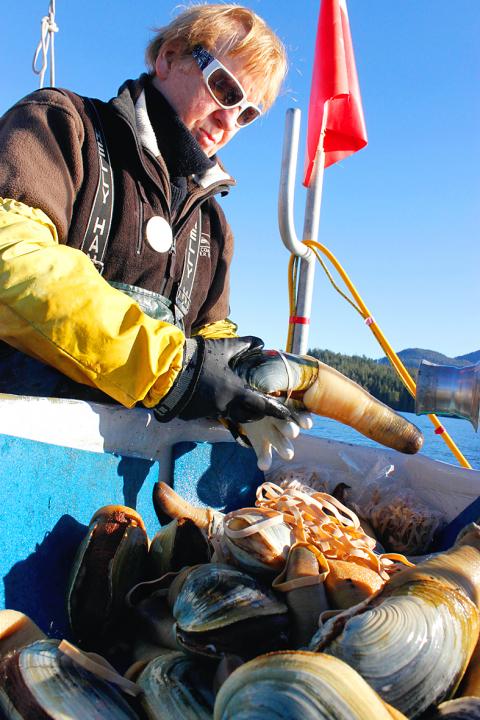
Photo: AFP
Without missing a beat, the 35-year veteran of the Pacific waters off northwest Canada swiftly fills three orange cases with his sorted and cleaned catch so they can be rushed to the airport in Vancouver — and on to Asia.
While a kilo of geoducks goes for about C$30 (US$27) these days — six times less than what top Asian eateries will ask their patrons to fork over — that was not always the case, Gutmann said.
“Fifteen years ago, its price was around C$0.30 per pound [0.45kg] maximum,” he said.
What’s more, licenses to harvest such clams were once available for a pittance.
“License owners got them for a couple bucks. Sometimes they were given by the government,” said the native of Tofino, a small seaside town in the province of British Columbia popular with surfers and aging hippies.
Today, however, “they’re worth C$4 to C$5 million,” he said.
In the port of Tofino, flanked by rugged, snow-capped mountains, mariners talk of astronomically high fees of C$50 million per permit and annual salaries of C$200,000 — all difficult to believe and verify.
However, just 55 fishing permits have been issued by Canadian authorities who are not planning to increase that quota — even though environmentalists say the geoduck population is overabundant.
The conspicuous clams can be found all the way from Mexico’s Baja California peninsula to Alaska, but they are particularly present off the shores of the US state of Washington and in neighboring British Columbia.
However, harvesting the shellfish is no easy task and, except for slightly more modern equipment, the task has not changed much since Gutmann started his career more than three decades ago.
It takes two divers weighed down by 30kg belts and taking turns over 12 hours to plunge 15m to 20m into the dark waters to wrest the geoducks from their perch on the sandy Pacific floor.
Dressed in thick wetsuits and attached to a boat by a 300m-long air hose, the divers scour the sea floor for tiny holes that suggest the presence of a clam, often buried under a meter of sand.
“You’ve got your ears against the sand — you hold it, but it’s fighting to leave,” said David Thomas, who has spent 27 of his 48 years searching for geoducks.
“It’s really hard to catch, especially for young divers,” he said.
Boasting the build of a US football player, Thomas — who works with Gutmann — swears this season will be his last.
Sometimes, the underwater current is so strong that it plasters you to the sea floor, said the family man, adding that he has even come face-to-face with a sea lion.
Interest in geoducks is so strong that once the Tofino fishing season ends, the modest local fleet of 30 trawlers heads further north to the Alaska border.
“There’s nothing out there — you go from one bay to another and you don’t see anybody,” Thomas said, as he pointed to a map on board the trawler known as the Hideaway II. “It’s all white here.”
But oddly, despite having spent so many years in pursuit of geoducks, neither Thomas, Gutmann or the boat’s third crew member have become culinary fans of the clams.

Singapore-based ride-hailing and delivery giant Grab Holdings Ltd has applied for regulatory approval to acquire the Taiwan operations of Germany-based Delivery Hero SE's Foodpanda in a deal valued at about US$600 million. Grab submitted the filing to the Fair Trade Commission on Friday last week, with the transaction subject to regulatory review and approval, the company said in a statement yesterday. Its independent governance structure would help foster a healthy and competitive market in Taiwan if the deal is approved, Grab said. Grab, which is listed on the NASDAQ, said in the filing that US-based Uber Technologies Inc holds about 13 percent of

The domestic unit of the Chinese-owned, Dutch-headquartered chipmaker Nexperia BV will soon be able to produce semiconductors locally within China, according to two company sources. Nexperia is at the center of a global tug-of-war over critical semiconductor technology, with a Dutch court in February ordering a probe into alleged mismanagement at the company. The geopolitical tussle has disrupted supply chains, with some carmakers reportedly forced to cut production due to chip shortages. Local production would allow Nexperia’s domestic arm, Nexperia Semiconductors (China) Ltd (安世半導體中國), to bypass restrictions in place since October on the supply of silicon wafers — etched with tiny components to

Taiwan Semiconductor Manufacturing Co (TSMC, 台積電) yesterday received government approval to deploy its advanced 3-nanometer (3nm) process at its second fab currently under construction in Japan, the Ministry of Economic Affairs said in a news release. The ministry green-lit the plan for the facility in Kumamoto, which is scheduled to start installing equipment and come online in 2028 with a monthly production capacity of 15,000 12-inch wafers, the ministry said. The Department of Investment Review in June 2024 authorized a US$5.26 billion investment for the facility, slated to manufacture 6- to 12nm chips, significantly less advanced than 3nm process. At a meeting with

Taiwan’s food delivery market could undergo a major shift if Singapore-based Grab Holdings Ltd completes its planned acquisition of Delivery Hero SE’s Foodpanda business in Taiwan, industry experts said. Grab on Monday last week announced it would acquire Foodpanda’s Taiwan operations for US$600 million. The deal is expected to be finalized in the second half of this year, with Grab aiming to complete user migration to its platform by the first half of next year. A duopoly between Uber Eats and Foodpanda dominates Taiwan’s delivery market, a structure that has remained intact since the Fair Trade Commission (FTC) blocked Uber Technologies Inc’s


 RSS
RSS