


On Friday morning last week, in a traditional three-section compound in Changhua County’s Sioushuei Township (秀水), a master umbrella maker hired by Fuyu Umbrella Co (富雨陽傘) was teaching a dozen students how to sew the canopy of an umbrella onto the metal ribs that comprise its frame.
The scene was reminiscent of Taiwan in the 1960s, when the nation was known as the “kingdom of the umbrella” and exported NT$12 billion (US$404.6 million) worth of the rain-shielding items a year.
At that time, Changhua County was the hub of the booming umbrella industry. Subcontracting sewing jobs at umbrella factories were highly sought after because, although labor-intensive, the work did not require a lot of capital equipment and people could do the job at home alongside their family members, which most chose to do.
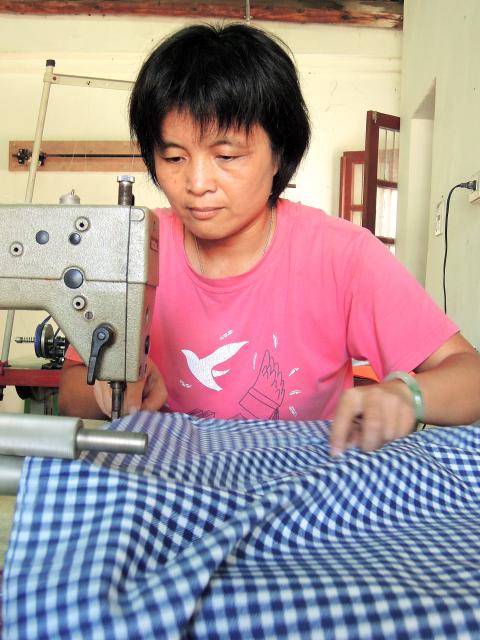
Photo: Camaron Kao, Taipei Times
However, in the 1980s, about 95 percent of the nation’s umbrella manufacturers relocated to China to take advantage of the lower wages there and the industry gradually fell into obsolescence, until Fuyu Umbrella’s owners returned to relaunch their business in Taiwan in 2006.
“Because of its umbrella-making history, there are many experienced workers in Changhua who retired as the industry declined and we aim to find them so we can hire them to make high-quality umbrellas using traditional methods,” Fuyu Umbrella president Joyce Chou (周淑秋) told the Taipei Times on Friday. “We think that machine-made umbrellas are fine, but handmade ones are even stronger and better.”
The Changhua-based company recruits 40 to 50 people on a subcontracting basis and can make 36,000 umbrellas a year the old-fashioned way, compared with the 1 million machine-made umbrellas that its factory in Shenzhen, China, can produce.
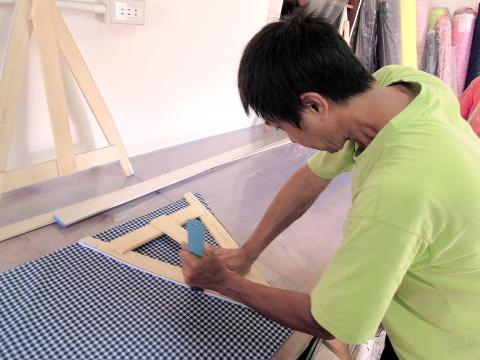
Photo: Camaron Kao, Taipei Times
Although the company’s sales only account for 3 percent to 5 percent of the nation’s total umbrella sales, its handmade umbrellas make up 30 percent of umbrellas ordered by domestic department stores and enterprises, such as car distributor Hotai Motor Co (和泰汽車) and cosmetics maker Shiseido Taiwan, to be given as gifts to customers, Chou said.
Fuyu Umbrella reported revenue of NT$62 million last year, with handmade items contributing 20 percent of that figure.
Chou said that she and her husband used to run a factory making umbrella frames in Taiwan, but moved their business to China in 1994. In 2000, they sold their Chinese factory and came back across the Taiwan Strait to take care of their elderly family members and young children.
The pair were active in community service until they opened Fuyu Umbrella in Changhua.
“Doing community service helped us meet potential employees and build friendships with them,” Chou said. “Sometimes, our employees come visit us at home when they are not working.”
Two-thirds of Fuyu Umbrella’s employees are single parents, were recently unemployed or have ailing elderly family members to take care of, she said.
“I decided to run this company because I see it as my responsibility to help the many local people who need jobs to make their living or simply want to use their skills,” she added.
Chen Yu-ling (陳玉玲), who started working for Fuyu Umbrella a year ago, said it is difficult to find a boss like Chou in Taiwan.
“Chou is relatively undemanding and sets reasonable requirements [for her workers],” Chen said by telephone on Saturday. “She is very considerate about the difficulties we face when learning to craft umbrellas.”
With a family of four to take care of, Chen, who is the only person in the family working full-time to make umbrellas, said she can earn as much as NT$15,000 a month by sewing 3,000 umbrellas.
Starting next month, Fuyu will invest NT$10 million to transform its three-section compound into a museum for the local umbrella industry, the construction of which is set to be completed before the Lunar New Year holiday.
The company also plans to build a factory nearby to increase its handmade umbrella production capacity to 216,000 units a year.
“It would be a pity if such a specialized skill were to vanish in Taiwan, and my daughter and I will try to revive the industry to preserve the craft and give opportunities to young people,” Chou said.
“Although we face severe competition from companies in Hong Kong and China, we can still succeed because umbrellas of a similar caliber sell for twice as much as ours in China,” Chou’s daughter and Fuyu Umbrella vice president Lin Wan-ling (林琬玲) said.

The domestic unit of the Chinese-owned, Dutch-headquartered chipmaker Nexperia BV will soon be able to produce semiconductors locally within China, according to two company sources. Nexperia is at the center of a global tug-of-war over critical semiconductor technology, with a Dutch court in February ordering a probe into alleged mismanagement at the company. The geopolitical tussle has disrupted supply chains, with some carmakers reportedly forced to cut production due to chip shortages. Local production would allow Nexperia’s domestic arm, Nexperia Semiconductors (China) Ltd (安世半導體中國), to bypass restrictions in place since October on the supply of silicon wafers — etched with tiny components to

Singapore-based ride-hailing and delivery giant Grab Holdings Ltd has applied for regulatory approval to acquire the Taiwan operations of Germany-based Delivery Hero SE's Foodpanda in a deal valued at about US$600 million. Grab submitted the filing to the Fair Trade Commission on Friday last week, with the transaction subject to regulatory review and approval, the company said in a statement yesterday. Its independent governance structure would help foster a healthy and competitive market in Taiwan if the deal is approved, Grab said. Grab, which is listed on the NASDAQ, said in the filing that US-based Uber Technologies Inc holds about 13 percent of
Taiwan Semiconductor Manufacturing Co (TSMC, 台積電) yesterday received government approval to deploy its advanced 3-nanometer (3nm) process at its second fab currently under construction in Japan, the Ministry of Economic Affairs said in a news release. The ministry green-lit the plan for the facility in Kumamoto, which is scheduled to start installing equipment and come online in 2028 with a monthly production capacity of 15,000 12-inch wafers, the ministry said. The Department of Investment Review in June 2024 authorized a US$5.26 billion investment for the facility, slated to manufacture 6- to 12nm chips, significantly less advanced than 3nm process. At a meeting with

Taiwan’s food delivery market could undergo a major shift if Singapore-based Grab Holdings Ltd completes its planned acquisition of Delivery Hero SE’s Foodpanda business in Taiwan, industry experts said. Grab on Monday last week announced it would acquire Foodpanda’s Taiwan operations for US$600 million. The deal is expected to be finalized in the second half of this year, with Grab aiming to complete user migration to its platform by the first half of next year. A duopoly between Uber Eats and Foodpanda dominates Taiwan’s delivery market, a structure that has remained intact since the Fair Trade Commission (FTC) blocked Uber Technologies Inc’s


 RSS
RSS