


TCI Co Ltd (大江生醫), which manufactures healthy food, functional beverages and skin care products, yesterday said it would shift its listing from the Emerging Securities Market to the GRETAI Securities Market on Sept. 12. This will make TCI the fourth biomedical company to list on the GRETAI this year.
The company is set to raise NT$401.13 million (US$13.40 million) by issuing 4.46 million common shares priced under NT$90.
TCI’s shares rose 3.35 percent to NT$133.39 on the Emerging Securities Market yesterday.
The company’s facial masks will now be sold by Sephora, the international cosmetics retail chain owned by LVMH Moet Hennessy Louis Vuitton SA (MC), general manager Vincent Lin (林詠翔) said.
“We have already shipped millions of facial masks to Sephora,” Lin said.
Facial mask sales accounted for 10 percent of the company’s revenue of NT$1.15 billion last year, while sales of functional drinks made up 60 percent, the company said.
TCI is planning to use the proceeds from its GRETAI debut to improve its financial status, develop new markets and finance capital expenditures, TCI chairman William Yang (楊武男) said on the sidelines of the company’s investors’ conference.
Deputy general manager William Liao (廖偉傑) said a new factory in Shanghai will become operational this quarter, producing facial masks and “essence” liquid, while another factory in Shanghai that will open in the second quarter next year will manufacture functional drinks.
The company will also open a logistics center in Pingtung County in the first quarter of next year, he added.
The company reported profit of NT$82.64 million, or NT$2.14 per share for the first half of the year, up 35.75 percent from NT$60.88 million, or NT$1.53 per share for the same period last year, the company’s filing to the Taiwan Stock Exchange showed.
In comparision, another functional drink producer, Grape King Inc (葡萄王), posted a profit of NT$506.4 million, or NT$2.87 per share over the same period, up 29.2 percent from NT$391.93 million, or NT$2.21 per share, last year.
TCI’s revenue for the first half of the year was NT$713.84 million, up 26.36 percent from NT$564.92 million a year ago, with China accounting for 59 percent of sales and Taiwan contributing 18 percent, the stock exchange filing showed. Hong Kong, Malaysia, Singapore and South Korea made up the remaining 23 percent.
Liao said sales will grow in the second half of this year on the back of rising sales in China and Southeast Asia.
However, gross margin during the first six months of this year dropped to 33.98 percent from 36.03 percent the previous year, the stock exchange filing showed.
“Our product prices in China are lower than in other places, and as revenue share in China increase, gross margin declines,” Liao said.
Hua Nan Securities Investment Management Co (華南投顧) forecast the company's earnings per share to reach NT$4.13 this year and revenue could hit NT$1.46 billion.

The domestic unit of the Chinese-owned, Dutch-headquartered chipmaker Nexperia BV will soon be able to produce semiconductors locally within China, according to two company sources. Nexperia is at the center of a global tug-of-war over critical semiconductor technology, with a Dutch court in February ordering a probe into alleged mismanagement at the company. The geopolitical tussle has disrupted supply chains, with some carmakers reportedly forced to cut production due to chip shortages. Local production would allow Nexperia’s domestic arm, Nexperia Semiconductors (China) Ltd (安世半導體中國), to bypass restrictions in place since October on the supply of silicon wafers — etched with tiny components to

Singapore-based ride-hailing and delivery giant Grab Holdings Ltd has applied for regulatory approval to acquire the Taiwan operations of Germany-based Delivery Hero SE's Foodpanda in a deal valued at about US$600 million. Grab submitted the filing to the Fair Trade Commission on Friday last week, with the transaction subject to regulatory review and approval, the company said in a statement yesterday. Its independent governance structure would help foster a healthy and competitive market in Taiwan if the deal is approved, Grab said. Grab, which is listed on the NASDAQ, said in the filing that US-based Uber Technologies Inc holds about 13 percent of

Taiwan Semiconductor Manufacturing Co (TSMC, 台積電) yesterday received government approval to deploy its advanced 3-nanometer (3nm) process at its second fab currently under construction in Japan, the Ministry of Economic Affairs said in a news release. The ministry green-lit the plan for the facility in Kumamoto, which is scheduled to start installing equipment and come online in 2028 with a monthly production capacity of 15,000 12-inch wafers, the ministry said. The Department of Investment Review in June 2024 authorized a US$5.26 billion investment for the facility, slated to manufacture 6- to 12nm chips, significantly less advanced than 3nm process. At a meeting with
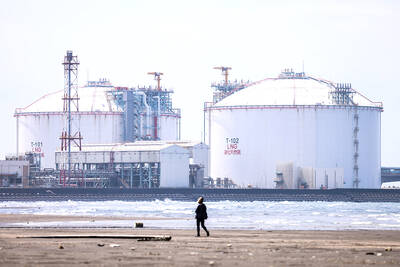
Taiwan is open to joining a global liquefied natural gas (LNG) program if one is created, but on the condition that countries provide delivery even in a scenario where there is a conflict with China, an energy department official said yesterday. While Taiwan’s priority is to have enough LNG at home, the nation is open to exploring potential strategic reserves in other countries such as Japan or South Korea, Energy Administration Deputy Director-General Chen Chung-hsien (陳崇憲) said. While the LNG market does not have a global reserve for emergencies like that of oil, the concept has been raised a few times —


 RSS
RSS