


A Bolivian brewer has come up with an innovative solution for quenching thirst and coping with altitude sickness: coca beer, based on the same leaf used to make cocaine.
Coca has only recently acquired its nefarious reputation: for millennia, people living along the Andes Mountains have chewed coca leaves. The juice from the leaves has a mild stimulant effect, easing stomach pain and helping people from the lowlands cope with altitude sickness, known locally as soroche.
Visitors to high mountain cities like La Paz — 3,600m above sea level — often rest and drink coca tea to deal with soroche. Now there is another option.
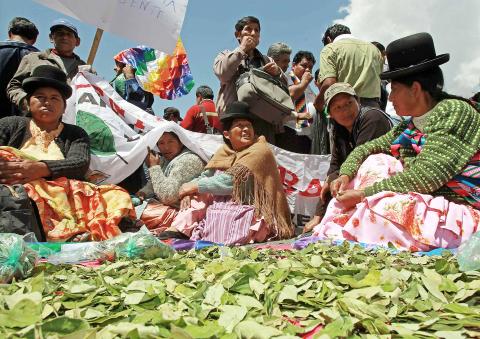
Photo: EPA
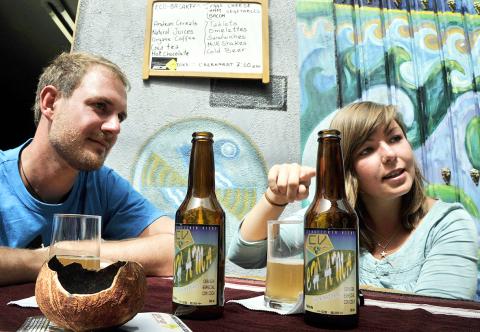
“As good Germans, we love beer,” said Hamburg native Malina, who sipped her beer along with her traveling companion Timo.
The friends are students in their late 20s traveling across South America.
“There are many types in Germany, but this coca beer is good because here in La Paz it helps us handle altitude sickness,” she said.
Warning: Excessive consumption of alcohol can damage your health.
Photo: AFP
She compared the taste to Hefeweizen, a full-bodied unfiltered wheat beer from Bavaria.
Her companion agreed.
“This is a very good beer, just like that from southern Germany, but not as heavy and the alcohol gets to you faster,” he said.
Warning: Excessive consumption of alcohol can damage your health.
Photo: AFP
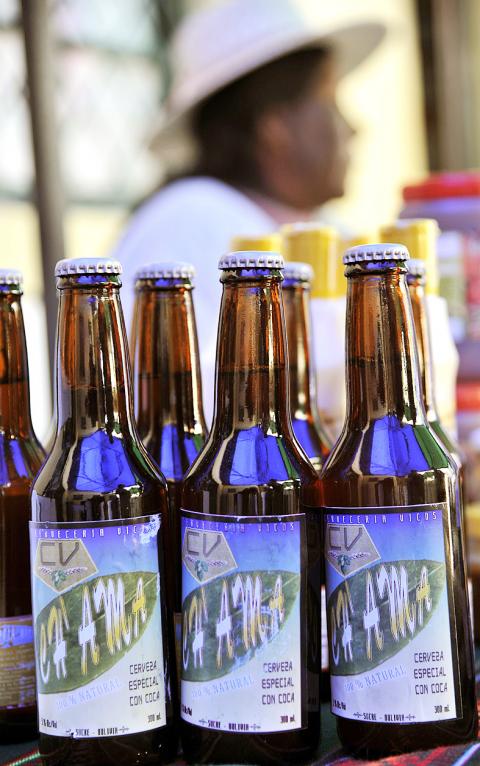
The beer in question is called Ch’ama, or strength, in the Aymara language of the Lake Titicaca area natives. It is made from malt, yeast, hops and soaked coca leaves, with no additives or preservatives.
The beer is in demand among tourists “who want to try something new,” said Alejandra Orihuela, owner of a bar named K’umara (“healthy” in Aymara).
She said that a group of German and US tourists liked it so much they came by several times a day for their coca beer, “as if it were breakfast and lunch.”
Coca beer has been produced since 2011 by Cerveceria Vicos, a brewery based in the southeastern city of Sucre.
“This is a highly fermented white beer with 5 percent alcohol content, unfiltered, unpasteurized and has the moderate aroma, color and flavor of coca leaf and hops,” Vicos owner and manager Victor Escobar told reporters.
He claims the beverage is an “energizing” tonic.
To produce Ch’ama coca beer, Escobar first soaks coca leaves in water, then adds malted barley and hops until the mix reaches its proper consistency. After a 20-day fermentation process, the concoction is bottled.
Cerveceria Vicos is a small brewery, producing 10 hectoliters of coca beer a day.
Retail prices vary, but Ch’ama beer sells for up to US$3.60 per bottle. It is sold in Bolivia and towns just across the borders with Peru and Chile.
So what about coca leaves and that illegal drug, cocaine?
Cocaine is also produced by soaking coca leaves, but instead of water, drug dealers use kerosene, gasoline and chemicals like hydrochloric acid and ammonia. A solution from the leaves is then filtered, refined and crystallized.
Bolivia opposes the use of cocaine, but deplores the demonization of the coca plant.
Bolivian President Evo Morales, a former head of the country’s coca growers union, is a strong supporter of finding legal ways of using the plant and of rehabilitating its reputation.
Bolivia withdrew from the Vienna-based UN Convention on Narcotic Drugs last year, angry that the coca leaf was labeled an illegal drug. It was readmitted in January after winning an opt-out allowing its population to keep legally chewing the leaves.
The coca bush grows exclusively in the eastern slopes of the Andes.
Bolivia is the world’s third-largest producer of coca leaves after Peru and Colombia.

The domestic unit of the Chinese-owned, Dutch-headquartered chipmaker Nexperia BV will soon be able to produce semiconductors locally within China, according to two company sources. Nexperia is at the center of a global tug-of-war over critical semiconductor technology, with a Dutch court in February ordering a probe into alleged mismanagement at the company. The geopolitical tussle has disrupted supply chains, with some carmakers reportedly forced to cut production due to chip shortages. Local production would allow Nexperia’s domestic arm, Nexperia Semiconductors (China) Ltd (安世半導體中國), to bypass restrictions in place since October on the supply of silicon wafers — etched with tiny components to

Singapore-based ride-hailing and delivery giant Grab Holdings Ltd has applied for regulatory approval to acquire the Taiwan operations of Germany-based Delivery Hero SE's Foodpanda in a deal valued at about US$600 million. Grab submitted the filing to the Fair Trade Commission on Friday last week, with the transaction subject to regulatory review and approval, the company said in a statement yesterday. Its independent governance structure would help foster a healthy and competitive market in Taiwan if the deal is approved, Grab said. Grab, which is listed on the NASDAQ, said in the filing that US-based Uber Technologies Inc holds about 13 percent of

Taiwan Semiconductor Manufacturing Co (TSMC, 台積電) yesterday received government approval to deploy its advanced 3-nanometer (3nm) process at its second fab currently under construction in Japan, the Ministry of Economic Affairs said in a news release. The ministry green-lit the plan for the facility in Kumamoto, which is scheduled to start installing equipment and come online in 2028 with a monthly production capacity of 15,000 12-inch wafers, the ministry said. The Department of Investment Review in June 2024 authorized a US$5.26 billion investment for the facility, slated to manufacture 6- to 12nm chips, significantly less advanced than 3nm process. At a meeting with

Taiwan’s food delivery market could undergo a major shift if Singapore-based Grab Holdings Ltd completes its planned acquisition of Delivery Hero SE’s Foodpanda business in Taiwan, industry experts said. Grab on Monday last week announced it would acquire Foodpanda’s Taiwan operations for US$600 million. The deal is expected to be finalized in the second half of this year, with Grab aiming to complete user migration to its platform by the first half of next year. A duopoly between Uber Eats and Foodpanda dominates Taiwan’s delivery market, a structure that has remained intact since the Fair Trade Commission (FTC) blocked Uber Technologies Inc’s


 RSS
RSS