


All Nippon Airways Co (ANA), the biggest customer for Boeing Co’s 787 Dreamliner, wants the planemaker to compensate it in cash, rather than discounts on future purchases, for losses racked up since the aircraft was grounded worldwide in mid-January, a person familiar with the airline’s intention said.
All 50 Dreamliners have been idled for two months after separate incidents with the plane’s battery at a US airport and on a domestic flight in Japan. ANA operates 17 of those aircraft and has likely been hardest hit by having the plane out of service. The airline has canceled more than 3,600 flights to the end of May.
“ANA would prefer to have the cash,” said the person, who asked not to be identified, adding that compensation talks with Boeing had not yet begun.
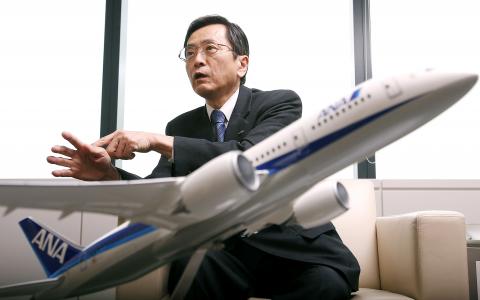
Photo: Reuters
“This is not something we have disclosed,” All Nippon Airways spokesman Ryosei Nomura said. “Nothing has been decided regarding future talks with Boeing.”
Boeing has yet to say if it will compensate carriers for lost revenue from the 787’s grounding. Nor has it indicated how it would do this or how much it might pay.
Persuading customers to accept discounts on future purchases would allow Boeing to spread any reimbursement costs over several years. Airlines, though, may see cash compensation as a quicker way to make up for their losses.
Boeing declined to comment on compensation issues. “There’s a singular focus on getting the airplanes returned to service. Our customers want that and we’re working hard to achieve that,” company spokesman Marc Birtel said.
Boeing is reported to have already faced billions of US dollars in fees for three years of delays in getting the 787 into service because of problems with a global production system.
While airplane purchase deals tend to be very complex and can involve long-term ties, compromise is common. For example,when Boeing’s 747-8 hit snags, instead of canceling, Hong Kong’s Cathay Pacific Airways Ltd (國泰航空) came away with a good deal on new 777s, air industry sources said.
After ANA, which has ordered another 66 Dreamliners, the biggest 787 operator is rival Japan Airlines Co (JAL) with seven of the jetliners, and another 38 on order. United Continental Holdings Inc’s United Airlines and Air India both have six.
ANA has not said how much the 787’s grounding has cost it to date, though it has said it was losing US$868,300 in revenue per plane in the last two weeks of January.
Japan Airlines president Yoshiharu Ueki said on Tuesday the 787’s grounding could knock ¥1.1 billion (US$11.6 million) off the airline’s operating profit for April to May, taking the total hit since the grounding to ¥1.8 billion.
Without yet having found what caused the battery incidents in January, Boeing last week unveiled a new battery system and predicted the 787 could be back in the air within weeks — a forecast that ANA chief Osamu Shinobe described as a best-case scenario as it remained unclear how long regulators will take to approve Boeing’s battery fix.

Singapore-based ride-hailing and delivery giant Grab Holdings Ltd has applied for regulatory approval to acquire the Taiwan operations of Germany-based Delivery Hero SE's Foodpanda in a deal valued at about US$600 million. Grab submitted the filing to the Fair Trade Commission on Friday last week, with the transaction subject to regulatory review and approval, the company said in a statement yesterday. Its independent governance structure would help foster a healthy and competitive market in Taiwan if the deal is approved, Grab said. Grab, which is listed on the NASDAQ, said in the filing that US-based Uber Technologies Inc holds about 13 percent of

The domestic unit of the Chinese-owned, Dutch-headquartered chipmaker Nexperia BV will soon be able to produce semiconductors locally within China, according to two company sources. Nexperia is at the center of a global tug-of-war over critical semiconductor technology, with a Dutch court in February ordering a probe into alleged mismanagement at the company. The geopolitical tussle has disrupted supply chains, with some carmakers reportedly forced to cut production due to chip shortages. Local production would allow Nexperia’s domestic arm, Nexperia Semiconductors (China) Ltd (安世半導體中國), to bypass restrictions in place since October on the supply of silicon wafers — etched with tiny components to

Taiwan Semiconductor Manufacturing Co (TSMC, 台積電) yesterday received government approval to deploy its advanced 3-nanometer (3nm) process at its second fab currently under construction in Japan, the Ministry of Economic Affairs said in a news release. The ministry green-lit the plan for the facility in Kumamoto, which is scheduled to start installing equipment and come online in 2028 with a monthly production capacity of 15,000 12-inch wafers, the ministry said. The Department of Investment Review in June 2024 authorized a US$5.26 billion investment for the facility, slated to manufacture 6- to 12nm chips, significantly less advanced than 3nm process. At a meeting with

Taiwan’s food delivery market could undergo a major shift if Singapore-based Grab Holdings Ltd completes its planned acquisition of Delivery Hero SE’s Foodpanda business in Taiwan, industry experts said. Grab on Monday last week announced it would acquire Foodpanda’s Taiwan operations for US$600 million. The deal is expected to be finalized in the second half of this year, with Grab aiming to complete user migration to its platform by the first half of next year. A duopoly between Uber Eats and Foodpanda dominates Taiwan’s delivery market, a structure that has remained intact since the Fair Trade Commission (FTC) blocked Uber Technologies Inc’s


 RSS
RSS