


A smartphone that can take the pulse of a user just by looking at the user’s face was unveiled in Japan yesterday.
Technology giant Fujitsu Ltd plans to put the invention to practical use within a year, enabling people at work or at home to track their health and collect data for analysis without wearing special devices.
The smartphone works by measuring variations in the brightness of a person’s face caused by the flow of blood.
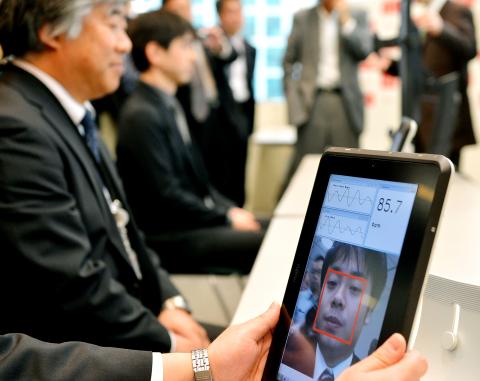
Photo: AFP
Researchers say countless tiny blood vessels run through the face, enabling monitoring of haemoglobin which absorbs green light. Haemoglobin is a protein found in red blood cells that contains iron and transports oxygen.
Simply pointing a camera at a person’s face for as little as five seconds would enable pulse-taking, while the technology automatically filters out the effect of head movements or changes caused by standing up quickly.
“Even at a busy workplace, or any time a person is sitting in front of a PC, whether for teleconferencing or writing e-mails, their pulse can be measured during brief moments of quiet,” the company said in a press release.
“At home, a camera built into a TV can measure the pulse of people relaxing in front of it, or a mirror, for when people are getting ready in the morning,” it said. “Pulse detectors built into gates at event sites or control points at airports could be a possible security application by detecting people in ill health and people acting suspiciously.”

Cairo’s new monorail slices across the city skyline, running above the familiar chaos of blaring horns and aging buses’ exhaust fumes that mark rush hour below. The US$4.5 billion monorail, opened this month, is among Egypt’s most prominent new transport projects, part of a debt-funded infrastructure drive criticized for sapping state finances while bringing limited benefits to most of the country’s 109 million people. “It feels like you’re in a different country,” said Ramy Sayed, a restaurant manager, aboard a driverless Innovia 300 train. “No noise, no traffic, we’re not used to this.” The eastern line runs 56km from the bustling middle-class

Taiwanese firms have increased investment in the Philippines in recent years as Manila’s ties with Washington deepen and global supply chains continue to shift away from China, an expert at the Chung-Hua Institution for Economic Research (CIER, 中華經濟研究院) said yesterday. The Philippines had not been among Taiwanese investors’ top choices in Southeast Asia, CIER Taiwan ASEAN Studies Center director Kristy Hsu (徐遵慈) said at a seminar in Taipei. However, Taiwan’s investment in the country has grown significantly since the COVID-19 pandemic, reaching US $257 million last year, a high in recent years, she said. Although Taiwan’s total investment in the Philippines still lags
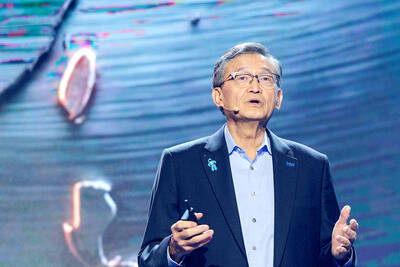
Intel Corp regards Taiwan Semiconductor Manufacturing Co (TSMC, 台積電) as a longstanding partner, as the US chipmaker would continue outsourcing production of advanced chips to TSMC, Intel chief executive officer Lip-Bu Tan (陳立武) said yesterday. “I don’t look at people as competitors. I look at the collaboration... Nvidia is also, you know, a good friend,” Tan told a news conference following his keynote speech at the Computex trade show in Taipei. “It’s a very trusted partnership for us... We are a big, top customer for them, and we’re going to continue doing that,” he said, referring to TSMC, the world’s largest foundry

Artificial intelligence (AI) agents would supplant smartphones as the center of people’s digital lives, fundamentally reshaping personal devices and driving a major computing upgrade cycle, Qualcomm Inc CEO Cristiano Amon said yesterday. In his keynote speech for this year’s Computex trade show in Taipei, Amon said that the rise of "agentic AI" — AI systems capable of reasoning, planning and carrying out tasks autonomously — would transform how people interact with technology across phones, PCs, vehicles and wearable devices. Describing the technology as the next major evolution in computing, Amon said that "2026 is the year of agents.” For decades, smartphones have sat


 RSS
RSS