


Local chip designers Elite Semiconductor Memory Technology Inc (晶豪科技) and Zentel Electronics Corp (力積電子) yesterday said they planned to buy wafer production facilities from loss-making Powerchip Technology Corp (力晶科技).
Elite Semiconductor and Zentel Electronics are among several local chipmakers and integrated circuit (IC) designers, who include Vanguard International Semiconductor Corp (VISC, 世界先進) and Etron Technology Inc (鈺創), that have recently expressed interest in acquiring Powerchip’s production facilities to boost capacity to meet growing customer demand.
Elite Semiconductor, located in Hsinchu Science Park (新竹科學園區), said in a filing to the Taiwan Stock Exchange after the local stock market closed that it had signed a memorandum of understanding (MOU) with Powerchip to purchase some production equipment from the latter’s 12-inch wafer fab, named P3.
UNDERSTANDING
Under the MOU, Elite Semiconductor said Powerchip also agreed to produce memory-related products for it on a contract-making basis, according to the filing.
“Elite Semiconductor plans to place the newly acquired production equipment within the P3 factory and make Powerchip a manufacturing partner to the company,” Elite spokesman Wu Hung-chi (吳鴻基) said in the filing. “The purpose of the deal is to ensure sufficient supply for the company’s wafer capacity.”
Elite Semiconductor supplies various memory ICs. Rather than the commodity DRAM used for PCs, servers and workstations, the company’s DRAM products focus on specialty DRAM memory used in PC peripherals, IA products, consumer products, optical devices and communication devices.
SECOND BID
Meanwhile, Zentel Electronics said in a separate filing to the stock exchange that its board of directors yesterday also approved a management proposal to purchase Powerchip’s 12-inch wafer fab to meet its future wafer capacity demand.
“The company has authorized the appointed company representative to sign the purchase agreement [with Powerchip],” Zentel vice president Robert Chang (張榮輝) said in the filing.
In late November last year, Vanguard Semiconductor said its board had agreed to give the chairman the authority to assess potential asset purchases, although it did not elaborate on what assets it was considering acquiring and from who.
Powerchip has gradually shifted its focus to the contract chipmaking business from PC DRAM chips.
The debt-ridden memorychip maker has hired Singapore-based Equvo Pte Co to help it auction the 12-inch fab in Hsinchu. It plans to use the proceeds to repay debts and strengthen its working capital.
Yesterday was the deadline set for the sale and Equvo is expected to decide on the winning bids and notify the successful bidders by the end of this month, Powerchip said last month.
Powerchip lost NT$13.17 billion (US$455 milion) in the first three quarters of last year after accumulating losses of NT$54.4 billion over the past several years.
Additional reporting by Lisa Wang

RUN IT BACK: A succesful first project working with hyperscalers to design chips encouraged MediaTek to start a second project, aiming to hit stride in 2028 MediaTek Inc (聯發科), the world’s biggest smartphone chip supplier, yesterday said it is engaging a second hyperscaler to help design artificial intelligence (AI) accelerators used in data centers following a similar project expected to generate revenue streams soon. The first AI accelerator project is to bring in US$1 billion revenue next year and several billion US dollars more in 2027, MediaTek chief executive officer Rick Tsai (蔡力行) told a virtual investor conference yesterday. The second AI accelerator project is expected to contribute to revenue beginning in 2028, Tsai said. MediaTek yesterday raised its revenue forecast for the global AI accelerator used
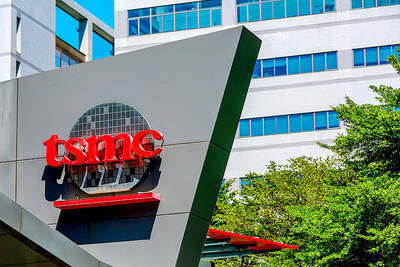
Taiwan Semiconductor Manufacturing Co (TSMC, 台積電) has secured three construction permits for its plan to build a state-of-the-art A14 wafer fab in Taichung, and is likely to start construction soon, the Central Taiwan Science Park Bureau said yesterday. Speaking with CNA, Wang Chun-chieh (王俊傑), deputy director general of the science park bureau, said the world’s largest contract chipmaker has received three construction permits — one to build a fab to roll out sophisticated chips, another to build a central utility plant to provide water and electricity for the facility and the other to build three office buildings. With the three permits, TSMC
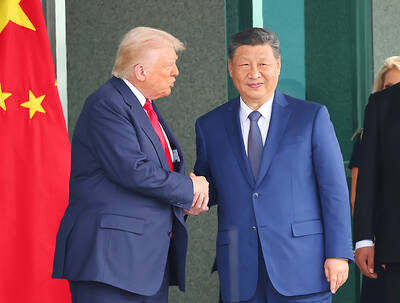
TEMPORARY TRUCE: China has made concessions to ease rare earth trade controls, among others, while Washington holds fire on a 100% tariff on all Chinese goods China is effectively suspending implementation of additional export controls on rare earth metals and terminating investigations targeting US companies in the semiconductor supply chain, the White House announced. The White House on Saturday issued a fact sheet outlining some details of the trade pact agreed to earlier in the week by US President Donald Trump and Chinese President Xi Jinping (習近平) that aimed to ease tensions between the world’s two largest economies. Under the deal, China is to issue general licenses valid for exports of rare earths, gallium, germanium, antimony and graphite “for the benefit of US end users and their suppliers

Dutch chipmaker Nexperia BV’s China unit yesterday said that it had established sufficient inventories of finished goods and works-in-progress, and that its supply chain remained secure and stable after its parent halted wafer supplies. The Dutch company suspended supplies of wafers to its Chinese assembly plant a week ago, calling it “a direct consequence of the local management’s recent failure to comply with the agreed contractual payment terms,” Reuters reported on Friday last week. Its China unit called Nexperia’s suspension “unilateral” and “extremely irresponsible,” adding that the Dutch parent’s claim about contractual payment was “misleading and highly deceptive,” according to a statement


 RSS
RSS