


Hotelier Dieter Mueller wants to achieve a first by creating an international German hotel chain that proves cheap can be so much more than cheerful in the increasingly competitive budget sector.
With its promise of high design at low prices, Mueller’s fast-growing Motel One chain has joined citizenM and B&B Hotels as part of a new breed of hotels leading the charge on established budget brands such as Travelodge, Whitbread’s Premier Inn and Accor’s Formule 1.
Mueller, Motel One’s chief executive and founder, aims to bring the brand’s turquoise and cream stylings to the UK, Austria and Belgium.
“There’s not a German hotel chain with an international presence,” he said. “We want to change that.”
The city center locations and funky decor of the new chains are proving popular with tourists and business travelers alike as they rein in budgets in debt-hit Europe. Motel One says that 60 percent to 65 percent of its guests are on business trips.
In Germany, large firms have cut spending on business travel by about 12 percent since 2007, even though the average amount of traveling has remained unchanged, the VDR travel association said.
“Budget hotels are making a bid for the cost-conscious, but style-seeking consumer, and are remodeling their rooms and atmosphere to compete with the look that the boutique hotels made famous,” Euromonitor travel and tourism analyst Nadejda Popova said.
Sales figures for budget hotels rose 10 percent last year, representing a 41 percent share of the US$162.5 billion European hotel industry, Popova said.
“The budget segment has changed dramatically,” said Ursula Kriegl, of the hotel investment services company Jones Lang LaSalle Hotels. “More chains have expanded and contributed to a more diverse, more professional offer.”
Citizen M, whose motto is “affordable luxury for the people,” offers rooms in London from about £99 (US$150), while Motel One rooms in Germany generally start at 50 to 60 euros (US$62 to US$74) a night.
Marc Socker, senior director of hotel fund management at Invesco Real Estate, said this was a good time to invest in the hotel sector.
“Supply is very low — there are very few hotels being built in Europe — but demand is high, with occupancy near historic highs, and global tourism is continuing to grow,” he said.
The IPD Pan-European Hotel report published this month said the budget hotel sector provided a 9.8 per cent return on investment last year, beating the 6 percent for European hotels overall.
The pressure from the new chains means that the established players are having to sharpen up their act and give their hotels a more contemporary feel.
“You have to ask these days ‘what is budget?’ If you can pay an extra £10 and get a more design-style hotel, then you will,” Socker said. “I’m wary for players like Premier Inn and Travelodge because, with the sort of product they have, there are few barriers to entry.”
Accor’s Ibis, Europe’s largest economy hotel chain and the fourth biggest worldwide, saw second-quarter sales growth slow, dragged down by its budget hotels business.
Ibis is renovating its budget hotels, rebranding the Etap/Formule 1 and All Seasons properties as Ibis Budget and Ibis Styles, with a focus on unique design features and new beds, mattresses and pillows. Holiday Inn, which terms itself mid-range and is part of the world’s biggest hotelier InterContinental, recently finished a US$1 billion refurbishment.
It has 492 hotels in Europe, with a further 62 Holiday Inn and Holiday Inn Express hotels in the pipeline in Europe. In the first quarter, comparable revenue per available room for its Holiday Inn Express hotels, the more basic brand, grew 9 percent, outstripping the group average of 7.6 percent.
Motel One will begin its assault on the UK at the end of this year with a hotel in Edinburgh. Further hotels are planned for London, Manchester and Newcastle, along with Brussels, Vienna and more in Germany.
The Munich-based group achieved a 70 percent jump in revenue last year to 134.8 million euros, with pretax profit up 25 percent at 23.4 million euros. It operates 39 hotels with more than 8,500 rooms and aims to have 60 hotels with 13,500 rooms by 2014.
The established UK budget chains, such as Travelodge and Premier Inn, have ambitious expansion plans of their own.
Travelodge, which has more than 500 hotels, opened four in London alone this month and plans nine more by the end of next year. It says there is a lack of budget rooms in London and is seeking another 50 sites across the capital, as it looks to increase its overall estate to 1,100 hotels with 100,000 rooms by 2025.
Premier Inn, the UK’s largest chain with 620 hotels, aims to have 65,000 rooms by 2016.
Socker expects the branded budget sector to achieve more growth in continental Europe than in the UK.
“The UK is one of the most brand-penetrated markets in Europe, whereas Germany, Spain, Italy and the Netherlands have few branded hotels,” he said.

The domestic unit of the Chinese-owned, Dutch-headquartered chipmaker Nexperia BV will soon be able to produce semiconductors locally within China, according to two company sources. Nexperia is at the center of a global tug-of-war over critical semiconductor technology, with a Dutch court in February ordering a probe into alleged mismanagement at the company. The geopolitical tussle has disrupted supply chains, with some carmakers reportedly forced to cut production due to chip shortages. Local production would allow Nexperia’s domestic arm, Nexperia Semiconductors (China) Ltd (安世半導體中國), to bypass restrictions in place since October on the supply of silicon wafers — etched with tiny components to

Singapore-based ride-hailing and delivery giant Grab Holdings Ltd has applied for regulatory approval to acquire the Taiwan operations of Germany-based Delivery Hero SE's Foodpanda in a deal valued at about US$600 million. Grab submitted the filing to the Fair Trade Commission on Friday last week, with the transaction subject to regulatory review and approval, the company said in a statement yesterday. Its independent governance structure would help foster a healthy and competitive market in Taiwan if the deal is approved, Grab said. Grab, which is listed on the NASDAQ, said in the filing that US-based Uber Technologies Inc holds about 13 percent of

Taiwan Semiconductor Manufacturing Co (TSMC, 台積電) yesterday received government approval to deploy its advanced 3-nanometer (3nm) process at its second fab currently under construction in Japan, the Ministry of Economic Affairs said in a news release. The ministry green-lit the plan for the facility in Kumamoto, which is scheduled to start installing equipment and come online in 2028 with a monthly production capacity of 15,000 12-inch wafers, the ministry said. The Department of Investment Review in June 2024 authorized a US$5.26 billion investment for the facility, slated to manufacture 6- to 12nm chips, significantly less advanced than 3nm process. At a meeting with
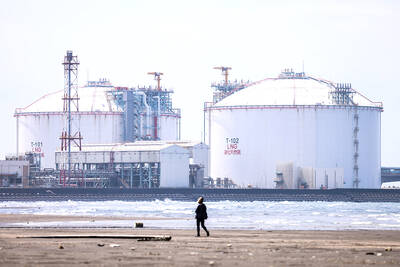
Taiwan is open to joining a global liquefied natural gas (LNG) program if one is created, but on the condition that countries provide delivery even in a scenario where there is a conflict with China, an energy department official said yesterday. While Taiwan’s priority is to have enough LNG at home, the nation is open to exploring potential strategic reserves in other countries such as Japan or South Korea, Energy Administration Deputy Director-General Chen Chung-hsien (陳崇憲) said. While the LNG market does not have a global reserve for emergencies like that of oil, the concept has been raised a few times —


 RSS
RSS