


A labor rights group said yesterday that it had found “deplorable” conditions at Apple suppliers in China, following a probe of several firms that make the US technology giant’s hugely popular products.
New York-based China Labor Watch said a four-month investigation of 10 suppliers to Apple in southern and eastern China uncovered violations of workers’ rights, including excessive overtime and hazardous work conditions.
“This investigation of 10 different Apple factories in China finds that harmful, damaging work environments characterized by illegally long hours for low levels of pay are widespread in Apple’s supply [chain],” the group said.
The report was based on surveys and interviews of 620 workers, as well as first-hand observations by a team of six, including some who entered the factories undercover.
The lengthy report followed findings announced in March by the Fair Labor Association (FLA), which toured three Chinese suppliers with Apple’s consent and also reported on forced overtime and other problems.
China Labor Watch director Li Qiang (李強) urged Apple to make good on pledges to improve, and in a letter to the California-based company’s chief executive Tim Cook called for immediate changes to be made.
“Are these promises sincere or merely a public relations ploy?” the report asked.
Li said the FLA investigation had better access than his organization, but that report blamed the suppliers instead of placing responsibility on Apple.
“Apple should take the responsibility to change the poor working conditions of those workers,” Li said.
Following the FLA report, Apple’s largest supplier, Taiwan’s Foxconn (富士康), pledged to end workplace abuses at its factories in China, including overtime above the amount permitted by Chinese law.
Foxconn has come under scrutiny since 2010, following a spate of suicides and incidents of labor unrest at its Chinese plants.
China Labor Watch reported that other Apple suppliers had treated their staff worse than Foxconn, which has received the most attention.
“The labor rights violations at Foxconn also exist in virtually all other Apple supplier factories and in many cases are actually significantly more dire than Foxconn,” the report said.
The group found employees worked an average of between 100 and 130 hours of overtime a month at the 10 factories, well above China’s legal limit of 36 hours.
Low wages compelled workers to accept overtime and some factories did not properly compensate them for the hours, it said.
Working conditions in factories that produce cases for Apple products were especially poor, including exposure to loud noise and toxic chemicals, the report said.
The 10 firms investigated included Foxconn, Jabil Circuit and BYD Electronic (比亞迪) in Shenzhen, as well as Riteng Computer Accessory (日騰) and Kenseisha in Shanghai and five others in Jiangsu Province.

Taichung reported the steepest fall in completed home prices among the six special municipalities in the first quarter of this year, data compiled by Taiwan Realty Co (台灣房屋) showed yesterday. From January through last month, the average transaction price for completed homes in Taichung fell 8 percent from a year earlier to NT$299,000 (US$9,483) per ping (3.3m²), said Taiwan Realty, which compiled the data based on the government’s price registration platform. The decline could be attributed to many home buyers choosing relatively affordable used homes to live in themselves, instead of newly built homes in the city’s prime property market, Taiwan Realty
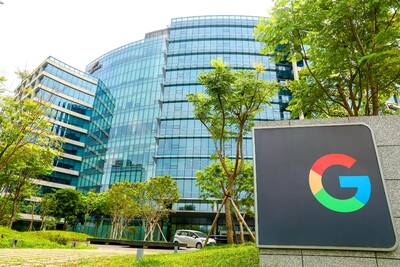
The government yesterday approved applications by Alphabet Inc’s Google to invest NT$27.08 billion (US$859.98 million) in Taiwan, the Ministry of Economic Affairs said in a statement. The Department of Investment Review approved two investments proposed by Google, with much of the funds to be used for data processing and electronic information supply services, as well as inventory procurement businesses in the semiconductor field, the ministry said. It marks the second consecutive year that Google has applied to increase its investment in Taiwan. Google plans to infuse NT$25.34 billion into Charter Investments Ltd (特許投資顧問) through its Singapore-based subsidiary Fructan Holdings Singapore Pte Ltd, and

JET JUICE: The war on Iran’s secondary effects have seen fuel prices skyrocket, knocking flight schedules down to earth in return as airlines struggle with costs Airline passengers should brace for more irritation in the next few months as carriers worldwide cancel flights and ground planes to cope with stratospheric increases in jet-fuel prices. Dutch flag carrier KLM is the latest company to cut its schedule, saying on Thursday that it would scrap 80 return flights at Amsterdam’s Schiphol Airport in the coming month. That puts it in the same league as United Airlines Holdings Inc, Deutsche Lufthansa AG and Cathay Pacific Airways Ltd, which have all pruned itineraries to mitigate costs. Global capacity for next month has been reduced by about 3 percentage points, with all

FORESEEABLE CONSEQUENCES: New technology always comes with new innovations by the iniquitous in exploiting users for financial gain or more nefarious ends Artificial intelligence (AI) “agents” say they can save users time and energy by automating tasks, but the growing power of systems such as OpenClaw is putting cybersecurity experts on edge. Powered by a wave of hype, OpenClaw today says it has more than three million users worldwide. The system allows users to create so-called agents, tools based on a large language model (LLM) such as OpenAI’s ChatGPT or Anthropic PBC’s Claude, that can carry out online tasks. “We’ve moved from an AI you could talk with via a chatbot to an agentic AI, which can take action... the threat and the risks are


 RSS
RSS