


Billionaire investor George Soros called on Europe to start a fund to buy Italian and Spanish bonds, warning that a failure by leaders meeting this week to produce drastic measures could spell the demise of the currency.
Policymakers should create a European Fiscal Authority to purchase sovereign debt in return for Italy and Spain implementing achievable budget cuts, Soros said in an interview in London on Sunday. Funding for the purchases would come from the sale of European Treasuries, which would have low yields because they would be backed by each euro member, he said.
France and Italy are urging Germany to take decisive action to end the two-and-a-half-year-old debt crisis after Spain’s 10-year bond yields jumped to more than 7 percent last week, a level that economists consider unsustainable. Leaders are at an impasse as they prepare to meet in Brussels on Thursday. That risks disaster because Europe is running out of time to show investors it will do what is necessary to save the euro, Soros said.
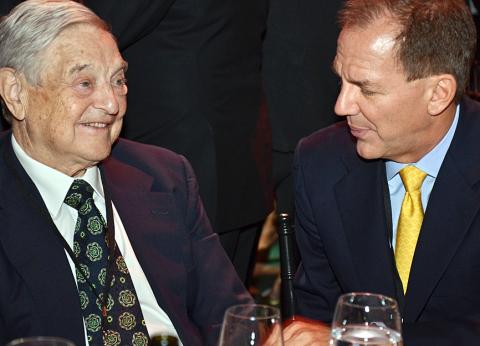
Photo: Bloomberg
“There is a disagreement on the fiscal side,” Soros, 81, said in an interview with Bloomberg Television’s Francine Lacqua at his home in London. “Unless that is resolved in the next three days, then I am afraid the summit could turn out to be a fiasco. That could actually be fatal.”
German Chancellor Angela Merkel said in a speech on June 15 that she opposed “premature” proposals for issuing eurozone bonds, arguing that such debt could not be sold until there was a full fiscal union for the region. Germany has also demanded that Greece, the recipient of a 240 billion euro (US$300 billion) bailout, and other indebted countries implement budget cuts in return for rescue funds needed to make their bond payments. Merkel is worsening Europe’s crisis because countries need growth, not austerity, to pay down their debt, Soros said.
“Merkel has emerged as a strong leader,” Soros said. “Unfortunately, she has been leading Europe in the wrong direction.”
Greek Prime Minister Antonis Samaras, who was sworn in on Wednesday, has pledged to seek relief from austerity measures imposed on the country while keeping the bailout funds flowing.
“It is very hard to see how Greece can actually meet the conditions that have been set,” he said. “The Germans are absolutely determined not to modify those conditions. One has to now calculate on Greece being forced out of the euro.”
Under Soros’s plan, outlined in a paper he has sent to EU leaders, bonds sold by the European Fiscal Authority would receive a zero-risk weighting from regulators, allowing the European Central Bank to treat them as the highest-quality collateral. That would spur demand for banks to buy the securities and ensure that their yields would be less than 1 percent, a more sustainable level than the rates Spain and Italy are currently paying, he said.
Spanish and Italian borrowing costs ended last week lower, aided by speculation that European leaders would take action at the Brussels meeting. Spain’s 10-year-bond yields retreated to 6.38 percent on Friday. Comparable Italian yields slid to 5.8 percent after climbing to as much as 6.17 percent on June 18.
Neither Spain nor Italy has the ability to “print money” because they are both members of the euro, making it likelier that financial markets can push one of them out of the bloc, Soros said. Spain is likely to need a full bailout unless leaders announce drastic measures at the meeting, he said.
Creating a European equivalent to Treasuries would buy the union time to form a true political union that will ultimately lead to the sale of bonds backed by the entire bloc, Soros said. European Treasuries could be sold to the market within three to six months once an agreement is in place among leaders, he said.
“Germany will only do it if Italy and Spain really insist on it, because they are the ones who are hurting,” he said.
Soros predicted in the interview that stock and bond markets would react negatively if Europe fails to announce a plan this week to ease pressure on Spain and Italy.

The domestic unit of the Chinese-owned, Dutch-headquartered chipmaker Nexperia BV will soon be able to produce semiconductors locally within China, according to two company sources. Nexperia is at the center of a global tug-of-war over critical semiconductor technology, with a Dutch court in February ordering a probe into alleged mismanagement at the company. The geopolitical tussle has disrupted supply chains, with some carmakers reportedly forced to cut production due to chip shortages. Local production would allow Nexperia’s domestic arm, Nexperia Semiconductors (China) Ltd (安世半導體中國), to bypass restrictions in place since October on the supply of silicon wafers — etched with tiny components to

Singapore-based ride-hailing and delivery giant Grab Holdings Ltd has applied for regulatory approval to acquire the Taiwan operations of Germany-based Delivery Hero SE's Foodpanda in a deal valued at about US$600 million. Grab submitted the filing to the Fair Trade Commission on Friday last week, with the transaction subject to regulatory review and approval, the company said in a statement yesterday. Its independent governance structure would help foster a healthy and competitive market in Taiwan if the deal is approved, Grab said. Grab, which is listed on the NASDAQ, said in the filing that US-based Uber Technologies Inc holds about 13 percent of
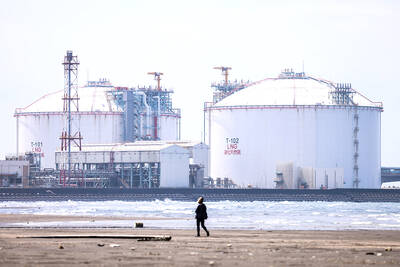
Taiwan is open to joining a global liquefied natural gas (LNG) program if one is created, but on the condition that countries provide delivery even in a scenario where there is a conflict with China, an energy department official said yesterday. While Taiwan’s priority is to have enough LNG at home, the nation is open to exploring potential strategic reserves in other countries such as Japan or South Korea, Energy Administration Deputy Director-General Chen Chung-hsien (陳崇憲) said. While the LNG market does not have a global reserve for emergencies like that of oil, the concept has been raised a few times —

Taiwan Semiconductor Manufacturing Co (TSMC, 台積電) yesterday received government approval to deploy its advanced 3-nanometer (3nm) process at its second fab currently under construction in Japan, the Ministry of Economic Affairs said in a news release. The ministry green-lit the plan for the facility in Kumamoto, which is scheduled to start installing equipment and come online in 2028 with a monthly production capacity of 15,000 12-inch wafers, the ministry said. The Department of Investment Review in June 2024 authorized a US$5.26 billion investment for the facility, slated to manufacture 6- to 12nm chips, significantly less advanced than 3nm process. At a meeting with


 RSS
RSS