


Japan’s Elpida Memory Inc filed for bankruptcy protection yesterday, days after one of the world’s biggest microchip makers admitted it was struggling to solve its debt problems.
In the biggest corporate failure in Japanese manufacturing history, the company went to the courts to seek shelter against liabilities totaling ¥448 billion (US$5.53 billion).
Separately, its major subsidiary Akita Elpida Memory Inc also filed for bankruptcy protection with ¥7.9 billion of liabilities, the company said.
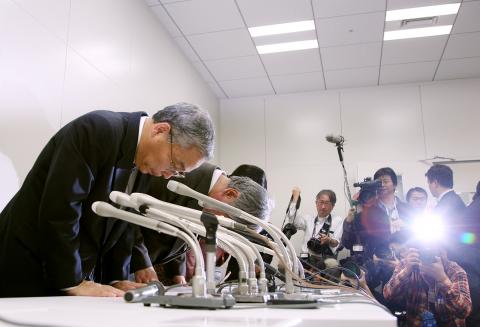
Photo: Bloomberg
“We sincerely regret any inconvenience caused ... for creditors as well as the people who have been supporting us,” Elpida said in an English-language statement. “We have concluded that, if we continue the business by ourselves, we will face cash shortage soon.”
Elpida president Yukio Sakamoto, once hailed as a corporate turnaround specialist in the chip sector, was expected to step down, Kyodo News said.
Elpida is the world’s third-largest maker of DRAM chips used in mobile phones and other personal electronics, but the punishingly high yen, global market volatility and fierce competition with South Korean and Taiwanese rivals have made life difficult.
“Its balance sheet has not been stable amid intensifying competition in the international DRAM market as well as due to its high costs,” said Tokyo Shoko Research, which specializes in bankruptcy data.
The move came after Elpida failed to find ways to survive via possible tie-ups and requests for fresh bank loans, said another research firm, Teikoku Databank.
Elpida shares rose 0.6 percent to ¥334 in Tokyo yesterday before the announcement. The shares were suspended for trading after the market closed. The stock has declined 6.7 percent this year after slumping 62 percent last year.
Bankruptcy for Elpida would help Taiwanese rivals such as Nanya Technology Corp (南亞科技), according to Andy Wei, who helps manage US$80 billion at Eastspring Investments (瀚亞投資), the Asia asset management unit for Prudential Plc.
“In the short term, this may be positive news for Taiwan DRAM companies as there would be a supply shortage,” Wei said. “This will be good for the industry in the long term if the restructuring or takeover of Elpida means better control of capacity.”
Elpida’s bankruptcy would be the nation’s biggest since Japan Airlines Corp sought protection in January 2010 with ¥2.32 trillion in liabilities, according to data from Tokyo Shoko Research.
Elpida was established in 1999 from a merger of the chipmaking divisions of NEC and Hitachi. It became Japan’s only DRAM maker in 2003, when Mitsubishi Electric sold its chip division to the company.
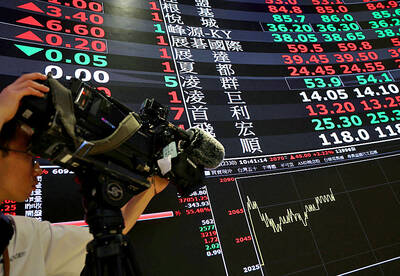
After several years flying high as Asia’s best Nvidia Corp proxy, Taiwan Semiconductor Manufacturing Co (TSMC, 台積電) is increasingly vying with other artificial intelligence (AI) stocks for investor attention. Stock traders are chasing a wider array of beneficiaries as mainstream usage of AI creates demand for hardware beyond the most-advanced chips TSMC makes for Nvidia. Subthemes from the deepening memory crunch to advances in robotics are also luring bids. At the same time, investment caps on single stocks are pushing funds to diversify, while retail investors long familiar with TSMC through its US depositary receipts are being offered a broader set of

Netherlands-based semiconductor equipment supplier ASML Holding NV yesterday said that it is planning to hire an additional 1,000 people in Taiwan this year in response to growing demand from clients. ASML had previously planned to recruit 600 people this year, but that the plan has been adjusted upward, ASML vice president and ASML Taiwan general manager Grace Wang (汪佳慧) told reporters. ASML has a workforce of more than 4,500 in Taiwan, accounting for about 10 percent of its global total, Wang said. This year’s recruitment campaign would focus on adding people in the customer support, manufacturing and supply chain domains to assist ASML
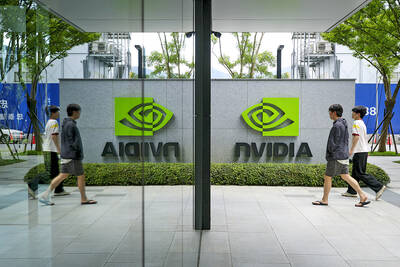
UNDER MICROSCOPE: Taiwan detained three people who allegedly conspired to buy servers in Taiwan and export them using fraudulent documentation, prosecutors said Nvidia Corp chief executive officer Jensen Huang (黃仁勳) on Saturday urged Super Micro Computer Inc to tighten up on compliance after Taiwan detained three people this week for allegedly making fraudulent declarations about artificial intelligence (AI) servers made by its US partner. The development marked the nation’s first crackdown on semiconductor smuggling, which grew after the US slapped restrictions on exports of high-end chips such as Nvidia AI accelerators to China. Nvidia is “rigorous” in explaining regulations to all of its partners, Huang told reporters after arriving in Taipei. “Ultimately Super Micro has to run their own company,” he said in response to

Nvidia Corp yesterday announced that CEO Jensen Huang (黃仁勳) would attend an employee meeting in Taipei tomorrow to celebrate the launch of the company’s Taiwan headquarters project. Huang would attend a gathering at the site of Nvidia’s planned headquarters in Beitou Shilin Technology Park (北投士林科技園區), the company said in a statement. After arriving in Taiwan on Saturday last week, Huang told reporters that he plans to meet with Quanta Computer Inc (廣達) chairman Barry Lam (林百里) and Taiwan Semiconductor Manufacturing Co (TSMC, 台積電) chairman C.C. Wei (魏哲家), and would attend the groundbreaking ceremony for Nvidia’s Taiwan headquarters tomorrow. Nvidia has not yet applied


 RSS
RSS