


Technology giant Sony yesterday held the world launch of its next-generation PlayStation Vita handheld console in Japan, as the company aims to take a bite out of the growing smartphone games market.
Gaming fans in Japan, Sony’s home country, flocked to the shops to get their hands on the device, which costs between ¥25,000 and ¥30,000 (US$320 to US$380).
It features a 5-inch (12cm) LED touch screen, two cameras and a GPS receiver, and comes in WiFi and 3G models.
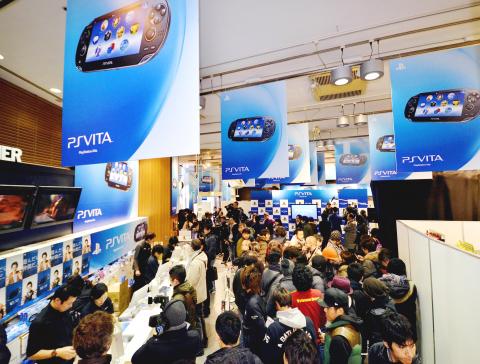
Photo: AFP
By mid-morning hundreds were lining up at stores in Tokyo’s Akihabara electronics district to buy the PS Vita, which hit Japanese shops in time for the end-of-year festivities.
It will be released in the US and Europe in February.
“It’s actually quite fun. The waiting, the excitement. Lots of people are getting together and sharing this moment, it’s a bit like a party,” said Ken Iioka, who turned up at 5:30am.
Sony mounted a major promotional effort: Stands displaying the device were set up in the streets, and shop interiors were decorated in the PS Vita’s wide range of bright colors.
“A number of the devices are already sold out, most customers had reserved them in advance,” one salesman in Akihabara said.
“The first customers are mostly men between 20 and 30 years of age,” he said, adding that the 20 games available to play on the PS Vita as of yesterday were also geared towards the same demographic.
Nintendo’s Game Boy, released in 1989, led the handheld game market until the mid-2000s, when Sony’s PSP cut into its share. But the emergence of iPhone and Android games is threatening the existence of game-specific handheld devices.
Nintendo launched its 3DS portable game console about 10 months ago and it is gaining popularity.
“I already have the previous PSP model and a Nintendo 3DS, but I wanted at all costs to have the PS Vita too,” said one male in his thirties, who was lining up to buy a shopping basket full of accessories for his new gadget.
“It’s a bit overbearing but still very attractive,” another customer said about the device, playing with it for the first time.
However, some came away empty-handed.
“I wanted to buy it, despite the price, but I was too late to reserve one and apparently there’s no chance today,” a disappointed customer said, playing on a different device instead.
“I’ve got lots of games consoles because I love video games and not all games can be played on all models,” he said.

SECOND-RATE: Models distilled from US products do not perform the same as the original and undo measures that ensure the systems are neutral, the US’ cable said The US Department of State has ordered a global push to bring attention to what it said are widespread efforts by Chinese companies, including artificial intelligence (AI) start-up DeepSeek (深度求索), to steal intellectual property from US AI labs, according to a diplomatic cable. The cable, dated Friday and sent to diplomatic and consular posts around the world, instructs diplomatic staff to speak to their foreign counterparts about “concerns over adversaries’ extraction and distillation of US AI models.” Distillation is the process of training smaller AI models using output from larger, more expensive ones to lower the costs of training a powerful new

Micron Technology Inc is a driving force pushing the US Congress to pass legislation that would put new export restrictions on equipment its Chinese competitors use to make their chips, according to people familiar with the matter. A US House of Representatives panel yesterday was to vote on the “MATCH Act,” a bill designed to close gaps in restrictions on chipmaking equipment. It would also pressure foreign companies that sell equipment to Chinese chipmaking facilities to align with export curbs on US companies like Lam Research Corp and Applied Materials Inc. The bill targets facilities operated by China’s ChangXin Memory Technologies Inc

Singapore-based ride-hailing and delivery giant Grab Holdings’ planned acquisition of Foodpanda’s Taiwan operations has yet to enter the formal review stage, as regulators await supplementary documents, the Fair Trade Commission (FTC) said yesterday. Acting FTC Chairman Chen Chih-min (陳志民) told the legislature’s Economics Committee that although Grab submitted its application on March 27, the case has not been officially accepted because required materials remain incomplete. Once the filing is finalized, the FTC would launch a formal probe into the deal, focusing on issues such as cross-shareholding and potential restrictions on market competition, Chen told lawmakers. Grab last month announced that it would acquire
The artificial intelligence (AI) boom has triggered a seismic reshuffling of global equity markets, with Taiwan and South Korea muscling past European nations one by one. With its stock market now valued at nearly US$4.3 trillion, Taiwan surpassed the UK, Europe’s biggest market, earlier this month, data compiled by Bloomberg showed. South Korea is about US$140 billion away from doing the same. The tech-heavy Asian markets have shot past Germany and France in the past seven months. The shift is largely down to massive gains in shares of three companies that provide essential hardware for AI: Taiwan Semiconductor Manufacturing Co (TSMC, 台積電),


 RSS
RSS