


Bicycle taxis with padded passenger seats fashioned onto their metal baggage racks line the road waiting for customers to hop on for a low cost ride — Malawian-style.
Two-wheeled transport rivals cars outside of big cities in this small southern African nation, where simple bikes with few bells and whistles are used to ferry anything from giant stacks of firewood to iced lollies and even the sick, in special attachable wagons.
“Boat making was a hard job, that’s why I decided to switch. I make about 1,000 Malawian kwacha [US$6.60] a day,” said Panjira Khombe, 28, who has taxied passengers for two years.
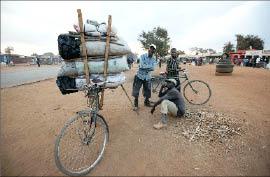
Photo: AFP
“I’m used to it. I’m able to carry big-bodied people,” he said, unfazed at potential heavy loads. “We don’t mind — so long as there is a customer.”
Unlike the noisy swarm of motorcycles that have replaced bicycles in other parts of Africa, rural Malawi has a quaintly unhurried retro feel set to the occasional gentle squeak of bicycle parts at work.
Alex Hockin, a volunteer with Engineers Without Borders — a non-profit group which works to improve lives in rural Africa — paid just over US$1 to a kabaza driver to glide along an empty stretch of highway with her shopping from the eastern town of Salima near Lake Malawi.
“I really like them,” said the 21-year-old environmental sciences student, comparing their ease and availability to the public transport system in her native Canada.
“You just hop on a bike taxi if you want to get around,” she said, adding, however, that she’s learned to stay clear of the models with non-padded passenger seats.
“It was surprising. There are like 10 or 20 bikes for every car that you see going through Salima. It makes sense though I guess because of the fuel crisis,” Hockin said.
Malawi, a poor, mainly agricultural country of about 16 million people, registers about 3,000 vehicles per month.
However, motorists are crippled by unprecedented petrol and diesel shortages that have also affected the frequency and cost of public transport in a land struggling to make up for years of underdevelopment.
This is where the taxi bikes step in. Not only can they skirt the fuel costs, they are able to reach more places and people in an impoverished, rural, land-locked country where 39 percent of the population live on less than a US$1 a day.
“The bicycle is very popular in Malawi, because people can’t afford a motorbike and because Malawi has a high density of population,” said Dutchman Peter Meijer, who set up a bike business, Sakaramenta, in 2009.
His company, based in the economic capital, Blantyre, makes several bike carts, notably to transport or sell goods. However, his most popular product is what he calls the “CareCar” bicycle ambulance, which carries patients in a special cart attached to the bike, with 800 already sold.
“The demand for the ‘CareCar’ is big,” Meijer said, adding that 80 percent go to non-governmental organizations, while companies with social responsibility policies snap up the rest. “It is used to transport patients and pregnant women from the village to the hospital. The average distance in the rural areas in Malawi from the village to the health center is 13km. Normally people have to walk this distance.”
Meanwhile, countrywide dealer Farmers World sells 8,000 to 10,000 bikes a year imported from India for between 12,000 and 15,000 kwacha. A basic single gear, standard 55cm wheel model is the most popular.
“It is a tool to transport people as well as goods, [requires] no road taxes and does not need a parking space,” procurement manager Amin Edhi said.
In a busy street market in Nsundwe, west of the administrative capital Lilongwe in central Malawi, bike mechanics busied with repairs near two-wheelers loaded with firewood.
“People use bikes because they are poor,” said Felix Ziwande, next to a group of bikes outside his video shop, Helbert Video Show, which charges 10 kwacha to watch a Chinese movie screened on a small television with subtitles in English, the official language.
Moving through the market was 16-year-old Banda Chimupuwe, a frozen lolly seller, with a red cooler box strapped to his bike.
“It’s easy when I want to sell my business,” he said about his green bike that he bought new for 12,000 kwacha. “It’s cheap — it does not need petrol.”
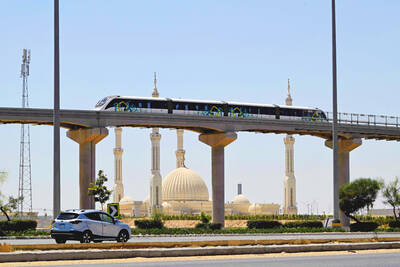
Cairo’s new monorail slices across the city skyline, running above the familiar chaos of blaring horns and aging buses’ exhaust fumes that mark rush hour below. The US$4.5 billion monorail, opened this month, is among Egypt’s most prominent new transport projects, part of a debt-funded infrastructure drive criticized for sapping state finances while bringing limited benefits to most of the country’s 109 million people. “It feels like you’re in a different country,” said Ramy Sayed, a restaurant manager, aboard a driverless Innovia 300 train. “No noise, no traffic, we’re not used to this.” The eastern line runs 56km from the bustling middle-class

Taiwanese firms have increased investment in the Philippines in recent years as Manila’s ties with Washington deepen and global supply chains continue to shift away from China, an expert at the Chung-Hua Institution for Economic Research (CIER, 中華經濟研究院) said yesterday. The Philippines had not been among Taiwanese investors’ top choices in Southeast Asia, CIER Taiwan ASEAN Studies Center director Kristy Hsu (徐遵慈) said at a seminar in Taipei. However, Taiwan’s investment in the country has grown significantly since the COVID-19 pandemic, reaching US $257 million last year, a high in recent years, she said. Although Taiwan’s total investment in the Philippines still lags

Intel Corp regards Taiwan Semiconductor Manufacturing Co (TSMC, 台積電) as a longstanding partner, as the US chipmaker would continue outsourcing production of advanced chips to TSMC, Intel chief executive officer Lip-Bu Tan (陳立武) said yesterday. “I don’t look at people as competitors. I look at the collaboration... Nvidia is also, you know, a good friend,” Tan told a news conference following his keynote speech at the Computex trade show in Taipei. “It’s a very trusted partnership for us... We are a big, top customer for them, and we’re going to continue doing that,” he said, referring to TSMC, the world’s largest foundry

Artificial intelligence (AI) agents would supplant smartphones as the center of people’s digital lives, fundamentally reshaping personal devices and driving a major computing upgrade cycle, Qualcomm Inc CEO Cristiano Amon said yesterday. In his keynote speech for this year’s Computex trade show in Taipei, Amon said that the rise of "agentic AI" — AI systems capable of reasoning, planning and carrying out tasks autonomously — would transform how people interact with technology across phones, PCs, vehicles and wearable devices. Describing the technology as the next major evolution in computing, Amon said that "2026 is the year of agents.” For decades, smartphones have sat


 RSS
RSS