


Sony Corp says it is set to start selling a head-mounted display that provides a 3D theater of music videos, movies and games, targeting people who prefer solitary entertainment rather than sitting in front of a TV with family or friends.
The company said yesterday that the ¥60,000 (US$800) “HMZ personal 3D viewer” is set to go on sale on Nov. 11 in Japan and it is planned for the US and Europe, perhaps in time for Christmas, although dates have not yet been set.
Resembling a futuristic visor, HMZ, which stands for “head-mounted display,” is worn like chunky goggle and earphones in one.
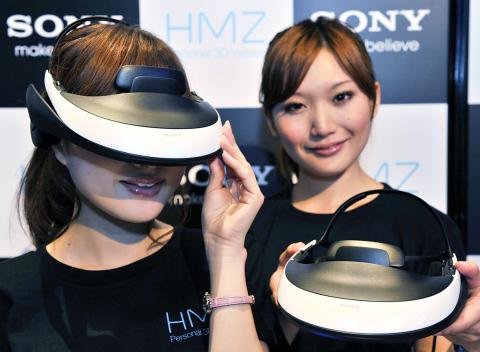
Photo: AFP
The footage before the viewer — a music video of a Japanese singer in the demonstration for reporters in Tokyo — is crystal-clear and feels like peering into a doll’s house in which a real-life tiny singer is moving.
It seems unlikely that most people — or even technology enthusiasts — will want to buy a product that involves sitting alone and wearing a little helmet.
The HMZ might not be Sony’s long-awaited answer to Apple Inc’s iPod or iPad, but just another quirky device packed with cutting-edge technology that is headed for a very limited niche following.
A 3D wearable gaming machine, Virtual Boy from Nintendo Co, which went on sale in the 1990s bombed, partly because of the bulky headgear that was required, as well as the image being all red.
Sony’s latest product is far more sophisticated.
Sony officials said the gadget delivers the immersive experience of home-theater, or the equivalent of sitting in one of the best seats of a movie theater.
The machine, which hooks up to a Blu-ray disc player or a games machine, is targeting people who want to enjoy movies or games alone.
The HMZ is not recommended for people 15 years old or younger because some medical experts believe overly stimulating imagery is not good for teenagers because their brains are still developing, Sony vice president Shigeru Kato said.
On the plus side, consumers are growing more accustomed to 3D these days, with the arrival of 3D TVs and games machines.
Kato noted the most popular movies last year, including Avatar and Toy Story 3, were screened in 3D.
The HMZ uses Sony’s own OLED screen, a relatively new kind of display that relays superb image quality and color, compared with the more prevalent LCD and plasma displays used in laptops and flat-panel TVs.
Kato said the major challenge had been making a very small display without compromising image quality.

The domestic unit of the Chinese-owned, Dutch-headquartered chipmaker Nexperia BV will soon be able to produce semiconductors locally within China, according to two company sources. Nexperia is at the center of a global tug-of-war over critical semiconductor technology, with a Dutch court in February ordering a probe into alleged mismanagement at the company. The geopolitical tussle has disrupted supply chains, with some carmakers reportedly forced to cut production due to chip shortages. Local production would allow Nexperia’s domestic arm, Nexperia Semiconductors (China) Ltd (安世半導體中國), to bypass restrictions in place since October on the supply of silicon wafers — etched with tiny components to

Singapore-based ride-hailing and delivery giant Grab Holdings Ltd has applied for regulatory approval to acquire the Taiwan operations of Germany-based Delivery Hero SE's Foodpanda in a deal valued at about US$600 million. Grab submitted the filing to the Fair Trade Commission on Friday last week, with the transaction subject to regulatory review and approval, the company said in a statement yesterday. Its independent governance structure would help foster a healthy and competitive market in Taiwan if the deal is approved, Grab said. Grab, which is listed on the NASDAQ, said in the filing that US-based Uber Technologies Inc holds about 13 percent of

Taiwan Semiconductor Manufacturing Co (TSMC, 台積電) yesterday received government approval to deploy its advanced 3-nanometer (3nm) process at its second fab currently under construction in Japan, the Ministry of Economic Affairs said in a news release. The ministry green-lit the plan for the facility in Kumamoto, which is scheduled to start installing equipment and come online in 2028 with a monthly production capacity of 15,000 12-inch wafers, the ministry said. The Department of Investment Review in June 2024 authorized a US$5.26 billion investment for the facility, slated to manufacture 6- to 12nm chips, significantly less advanced than 3nm process. At a meeting with

Taiwan’s food delivery market could undergo a major shift if Singapore-based Grab Holdings Ltd completes its planned acquisition of Delivery Hero SE’s Foodpanda business in Taiwan, industry experts said. Grab on Monday last week announced it would acquire Foodpanda’s Taiwan operations for US$600 million. The deal is expected to be finalized in the second half of this year, with Grab aiming to complete user migration to its platform by the first half of next year. A duopoly between Uber Eats and Foodpanda dominates Taiwan’s delivery market, a structure that has remained intact since the Fair Trade Commission (FTC) blocked Uber Technologies Inc’s


 RSS
RSS