


Sporting a mohican haircut and a protest T-shirt, Japan’s maverick Internet tycoon Takafumi Horie yesterday headed to a Tokyo jail to serve a two-and-a-half-year sentence for accounting fraud.
The flamboyant dotcom entrepreneur — who shook up Japan Inc’s often staid ways with his -media-savvy persona and hostile takeover bids — has long insisted he is a victim of the establishment.
Horie, 38, was sentenced by the Tokyo district court in 2007 for falsely reporting a pre-tax profit of ¥5 billion (US$61 million at today’s rates) to hide losses at the Internet service provider.
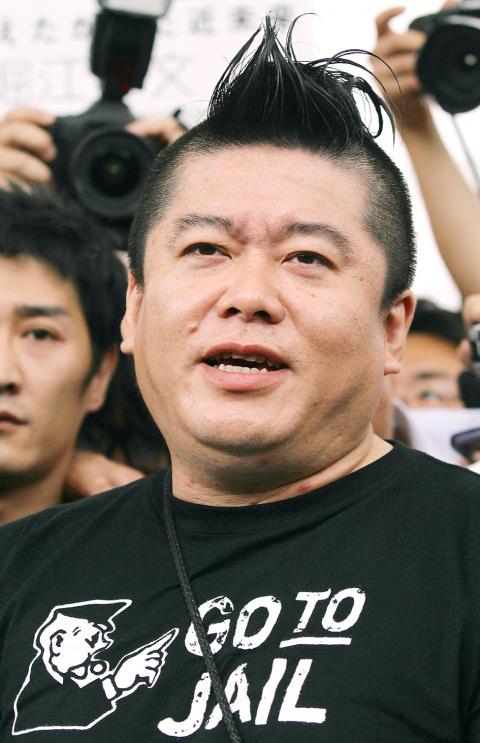
Photo: AFP
A high court appeal the following year was rejected, and the supreme court turned down the Livedoor founder again in April this year.
Before heading to prison, Horie gave a news conference wearing a T-shirt with the words “Go to Jail” from the Monopoly board game, along with a list of failed big companies whose executives were not imprisoned.
Surrounded by a swarm of supporters wearing the same T-shirt, and reporters, before setting out for the Tokyo High Prosecutors’ Office to start his sentence, he said: “I want to reset my life. I’m really sorry that I caused big trouble to Livedoor shareholders ... As a penalty I’ll serve my two-years-and-six-months sentence and come back.”
His incarceration is expected to be slightly shorter because he has already served 40 days in custody after his arrest.
Livedoor Holdings was delisted in April 2006 in the wake of the accounting fraud scandal, but has since recovered from the episode.
Its current incarnation, LDH, is still embroiled in lawsuits filed by Livedoor shareholders seeking compensation for losses after its stock price plunged in the wake of the scandal.
In a recent interview with the Asahi TV network, Horie said he was trying not to think about what his life would be like in prison, saying only that “it doesn’t seem fun.”
“What I can promise people is that I will lose weight” in jail, the entrepreneur said.
The University of Tokyo literature dropout, who prefers T-shirts to business suits, became a household name with his start-up style that broke the rules of corporate Japan and made him a hero to many young people.
He made headlines in 2004 when he attempted to take over Osaka’s indebted Kintetsu Buffaloes baseball team.
The following year, he launched a rare hostile takeover bid for Nippon Broadcasting System from TV broadcaster Fuji TV, which failed but led Fuji to take a minority stake in Livedoor.

The domestic unit of the Chinese-owned, Dutch-headquartered chipmaker Nexperia BV will soon be able to produce semiconductors locally within China, according to two company sources. Nexperia is at the center of a global tug-of-war over critical semiconductor technology, with a Dutch court in February ordering a probe into alleged mismanagement at the company. The geopolitical tussle has disrupted supply chains, with some carmakers reportedly forced to cut production due to chip shortages. Local production would allow Nexperia’s domestic arm, Nexperia Semiconductors (China) Ltd (安世半導體中國), to bypass restrictions in place since October on the supply of silicon wafers — etched with tiny components to

Singapore-based ride-hailing and delivery giant Grab Holdings Ltd has applied for regulatory approval to acquire the Taiwan operations of Germany-based Delivery Hero SE's Foodpanda in a deal valued at about US$600 million. Grab submitted the filing to the Fair Trade Commission on Friday last week, with the transaction subject to regulatory review and approval, the company said in a statement yesterday. Its independent governance structure would help foster a healthy and competitive market in Taiwan if the deal is approved, Grab said. Grab, which is listed on the NASDAQ, said in the filing that US-based Uber Technologies Inc holds about 13 percent of

Taiwan Semiconductor Manufacturing Co (TSMC, 台積電) yesterday received government approval to deploy its advanced 3-nanometer (3nm) process at its second fab currently under construction in Japan, the Ministry of Economic Affairs said in a news release. The ministry green-lit the plan for the facility in Kumamoto, which is scheduled to start installing equipment and come online in 2028 with a monthly production capacity of 15,000 12-inch wafers, the ministry said. The Department of Investment Review in June 2024 authorized a US$5.26 billion investment for the facility, slated to manufacture 6- to 12nm chips, significantly less advanced than 3nm process. At a meeting with

Taiwan’s food delivery market could undergo a major shift if Singapore-based Grab Holdings Ltd completes its planned acquisition of Delivery Hero SE’s Foodpanda business in Taiwan, industry experts said. Grab on Monday last week announced it would acquire Foodpanda’s Taiwan operations for US$600 million. The deal is expected to be finalized in the second half of this year, with Grab aiming to complete user migration to its platform by the first half of next year. A duopoly between Uber Eats and Foodpanda dominates Taiwan’s delivery market, a structure that has remained intact since the Fair Trade Commission (FTC) blocked Uber Technologies Inc’s


 RSS
RSS