


Apple Inc’s iPad and other tablet computers are replacing traditional note pads in some Asian schools, which some say is making the lives of thousands of students a whole lot easier.
Soon pupils could be reading on their tablets about a quaint old communication device called “paper,” especially in Asia’s advanced economies where many schools are racing toward a paperless classroom.
The slim glass slabs slip easily into a bag and can store thousands of textbooks, making a fat school bag full of heavy books, pens and notepads a thing of the past.
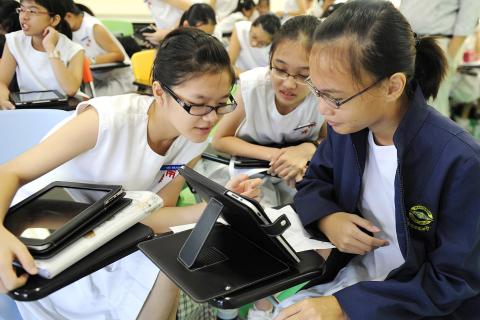
Photo: AFP
“I like the iPad because it is portable and we do not have to carry so many bags and files around,” said 13-year-old Nicole Ong, who now makes notes on her iPad during class at Nanyang Girls’ High School in Singapore.
A sample group of more than 120 students and 16 teachers at the school have been given iPads, at a cost of over US$100,000. By 2013, every student in the school will have one.
The number of software applications — or apps — that can be used for educational purposes on tablet computers is set to explode.

Photo: Reuters
It’s a brand new business that even media mogul Rupert Murdoch has identified as an area of huge potential growth. Murdoch said his News Corp group is to push into the education technology market in a speech to the e-G8 conference of Internet entrepreneurs and European policymakers in Paris last month.
He described education as the “last holdout from the digital revolution” and outlined a vision for personalized learning with lessons delivered by the world’s best teachers to thousands of students via the Internet.
“Today’s classroom looks almost exactly the same as it did in the Victorian age,” Murdoch added.
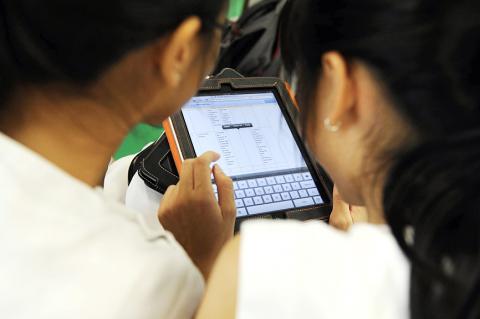
Photo: AFP
However, many Asian schools are already way ahead of the game.
Rene Yeo, head of the information technology department at Tampines Secondary School, also in Singapore, teaches science with his iPad. His students learn factorization by simply moving the numbers around on the screen.
They also read about animal cells and the human brain structure by clicking on the various parts. And tablet computers make the double helix structure of a human DNA practically come to life before a student’s eyes.
There are apps to learn English and maths, pupils can do cause and effect analysis on iBrainstorm, prepare for oral exams and speeches with AudioNote and even strum the guitar for a music lesson on GarageBand.
The rise of classroom technology will mirror its rise throughout society, says Sam Han, a US-based expert on the role of technology in education.
Han, instructional technology fellow at the Macaulay Honors College, City University of New York, said he expects some Asian countries to leapfrog the West.
“While the Internet was birthed in the US, Singapore and South Korea boast far greater broadband Internet access penetration and infrastructure than the US,” he said.
Japan’s communications -ministry has given tablets to more than 3,000 pupils under the age of 12 at 10 elementary schools and even fitted classrooms with interactive electronic blackboards under the so-called “future school” pilot project.
In South Korea, where schools have Wi-Fi zones, the education ministry has been testing “digital textbooks” in some schools since 2007. Next year, the ministry says it will decide whether to supply tablets to schools nationwide.
Singapore has a hugely competitive education system known for its high level of science and mathematics instruction. The education ministry provides a grant for schools to buy this kind of equipment, as well as software and services. Many schools already have Wi-Fi, making it easy for students to connect to the Internet. Although some teachers acknowledged there are students who get distracted by playing games or surfing Facebook and other social media sites like Twitter.
Education psychologist Qiu Lin cautioned against schools getting carried away and promoting the blind use of technological devices and neglecting the real goals of education.
“The trend of integrating technology into education will definitely increase,” said the assistant professor at Nanyang Technological University, which is separate from the high school.
“But after one month when the novelty of iPads wears down, a good curriculum and teaching materials that can increase deep thinking and problem solving in students needs to be in place,” Qiu said.

Taichung reported the steepest fall in completed home prices among the six special municipalities in the first quarter of this year, data compiled by Taiwan Realty Co (台灣房屋) showed yesterday. From January through last month, the average transaction price for completed homes in Taichung fell 8 percent from a year earlier to NT$299,000 (US$9,483) per ping (3.3m²), said Taiwan Realty, which compiled the data based on the government’s price registration platform. The decline could be attributed to many home buyers choosing relatively affordable used homes to live in themselves, instead of newly built homes in the city’s prime property market, Taiwan Realty
The government yesterday approved applications by Alphabet Inc’s Google to invest NT$27.08 billion (US$859.98 million) in Taiwan, the Ministry of Economic Affairs said in a statement. The Department of Investment Review approved two investments proposed by Google, with much of the funds to be used for data processing and electronic information supply services, as well as inventory procurement businesses in the semiconductor field, the ministry said. It marks the second consecutive year that Google has applied to increase its investment in Taiwan. Google plans to infuse NT$25.34 billion into Charter Investments Ltd (特許投資顧問) through its Singapore-based subsidiary Fructan Holdings Singapore Pte Ltd, and
Micron Technology Inc is a driving force pushing the US Congress to pass legislation that would put new export restrictions on equipment its Chinese competitors use to make their chips, according to people familiar with the matter. A US House of Representatives panel yesterday was to vote on the “MATCH Act,” a bill designed to close gaps in restrictions on chipmaking equipment. It would also pressure foreign companies that sell equipment to Chinese chipmaking facilities to align with export curbs on US companies like Lam Research Corp and Applied Materials Inc. The bill targets facilities operated by China’s ChangXin Memory Technologies Inc

Singapore-based ride-hailing and delivery giant Grab Holdings’ planned acquisition of Foodpanda’s Taiwan operations has yet to enter the formal review stage, as regulators await supplementary documents, the Fair Trade Commission (FTC) said yesterday. Acting FTC Chairman Chen Chih-min (陳志民) told the legislature’s Economics Committee that although Grab submitted its application on March 27, the case has not been officially accepted because required materials remain incomplete. Once the filing is finalized, the FTC would launch a formal probe into the deal, focusing on issues such as cross-shareholding and potential restrictions on market competition, Chen told lawmakers. Grab last month announced that it would acquire


 RSS
RSS