


Taiwanese contract makers Quanta Computer Inc (廣達電腦) and Wistron Corp (緯創) are the two players best positioned to benefit from the cloud computing server market that is expected to boom in the next three years, according to a report issued on Tuesday by Morgan Stanley.
As companies shift from on-premise to managed or public cloud environments, x86 server share leaders Dell and Hewlett-Packard are at risk of losing market share to Asian original design manufacturers (ODMs) like Quanta and Wistron, which ship servers directly to some of the largest cloud services vendors, the report said.
“We see a significant shift in the competitive landscape between on-premise server sales, which typically benefit the top three x86 server OEMs — Hewlett-Packard, Dell, IBM — and the managed or cloud server sales, which increasingly benefit ODMs in Asia, including Quanta and Wistron,” the brokerage said.
Some cloud service providers have decreased the percentage of servers ordered from top server vendors from as much as 75 to 100 percent historically to 50 percent to date, and the brokerage believes the impact of the changing cloud computing business will cause Hewlett-Packard and Dell to grow more slowly than the overall server market over the next several years.
As a result, the brokerage has downgraded Hewlett-Packard to “equal-weight” and retained “underweight” status for Dell, while it gives promising prospects to Quanta and Wistron.
There are two specific shifts caused by the cloud that benefit Quanta and Wistron — direct hardware order placements from Internet service providers (ISPs) and telecommunications companies, and total hardware and software solutions for cloud services.
Quanta, the world’s biggest contract laptop maker, is predicted to double its server sales year-on-year, accounting for 5 percent of total sales and 10 percent of profits at the end of this year, the brokerage said.
Earlier this month, Quanta predicted servers for cloud computing and tablet PCs would take a 30 percent share of its total revenue this year compared with the 20 to 25 percent of last year.
Server sales of Wistron, Quanta’s smaller rival, will account for 4 percent of this year’s total sales and 8 percent of profits, with server sales starting to show stronger momentum in the second half of this year, growing at least 20 percent year-on-year next year, the brokerage projected.
Among major IT companies in the US, Europe and the Asia-Pacific, the percentage using the public cloud is expected to rise from 28 percent to 51 percent in three years, while the portion of their workload running in the cloud will likely more than double from 10 percent to 22 percent.
The number of servers shipping into public-cloud environments will grow at 60 percent annually through 2013, as this migration of workloads from on-premise environments to the public cloud will continue to be a key driver in technology spending, the brokerage said.
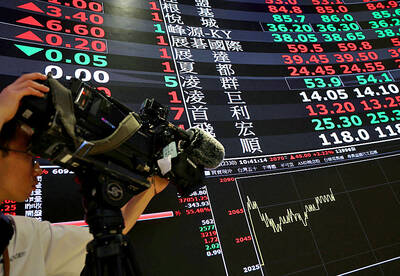
After several years flying high as Asia’s best Nvidia Corp proxy, Taiwan Semiconductor Manufacturing Co (TSMC, 台積電) is increasingly vying with other artificial intelligence (AI) stocks for investor attention. Stock traders are chasing a wider array of beneficiaries as mainstream usage of AI creates demand for hardware beyond the most-advanced chips TSMC makes for Nvidia. Subthemes from the deepening memory crunch to advances in robotics are also luring bids. At the same time, investment caps on single stocks are pushing funds to diversify, while retail investors long familiar with TSMC through its US depositary receipts are being offered a broader set of

UNDER MICROSCOPE: Taiwan detained three people who allegedly conspired to buy servers in Taiwan and export them using fraudulent documentation, prosecutors said Nvidia Corp chief executive officer Jensen Huang (黃仁勳) on Saturday urged Super Micro Computer Inc to tighten up on compliance after Taiwan detained three people this week for allegedly making fraudulent declarations about artificial intelligence (AI) servers made by its US partner. The development marked the nation’s first crackdown on semiconductor smuggling, which grew after the US slapped restrictions on exports of high-end chips such as Nvidia AI accelerators to China. Nvidia is “rigorous” in explaining regulations to all of its partners, Huang told reporters after arriving in Taipei. “Ultimately Super Micro has to run their own company,” he said in response to

TECH RELIANCE: Growth is increasingly reflecting an unequal K-shaped distribution, where technology sectors outperform and other industries struggle, an expert said Standard Chartered Bank has significantly raised its forecast for Taiwan’s economic growth to 9.5 percent this year, up from 7.6 percent previously, citing surging artificial intelligence (AI) demand driving exports, semiconductor production and investment. The upgrade reflects a sustained AI supercycle that continues to fuel demand for advanced chips and technology infrastructure, which form the backbone of Taiwan’s exports, the bank said in a report this week. “We raise our 2026 growth forecast to reflect a much stronger-than-expected first-quarter GDP figure,” Standard Chartered senior economist for greater China and Asia Tommy Wu (胡東安) said in the report. Driven largely by a 35.3 percent
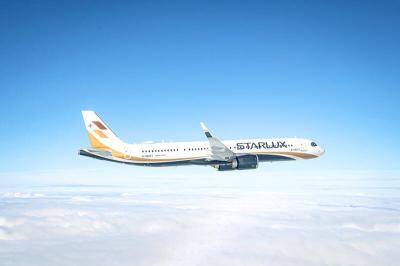
Two of Taiwan’s international carriers, Starlux Airlines Co (星宇航空) and EVA Airways Corp (長榮航空), have retained the five-star airline rating awarded by international airline review organization Skytrax. Starlux was awarded the distinction for a second consecutive year, while EVA Air received it for the 11th straight year, Skytrax said in statements released yesterday and on Thursday last week, respectively. The five-star rating is considered one of the airline industry's highest honors and is awarded following professional audits of airline product and frontline service standards, Skytrax said. The ratings are based on in-depth assessments using unified global quality standards rather than customer review scores


 RSS
RSS