


US shoppers came back in force for the holidays, right to the end. After two dreary years, this Christmas will go down as the holiday US citizens rediscovered how much they like to shop.
People spent more than expected on family and friends and splurged on themselves, too, an ingredient missing for two years.
Clothing such as fur vests and beaded sweaters replaced practical items like pots and pans. Even the family dog is getting a little something extra.
“You saw joy back in the holiday season,” said Sherif Mityas, a partner in the retail practice at A.T. Kearney.
A strong Christmas Eve augmented a great season for retailers.
The National Retail Federation predicts spending this holiday season will reach US$451.5 billion, up 3.3 percent over last year.
That would be the biggest increase since 2006, and the largest total since a record US$452.8 billion in 2007. The holiday season runs from Nov. 1 through Dec. 31, so a strong week after Christmas could still make this the biggest of all time. Spending numbers through Dec. 24 won’t be available until next week and final numbers, through Dec. 31, arrive next month.
The economy has not improved significantly from last year.
Unemployment is 9.8 percent, credit remains tight and the housing market is moribund, but recent economic reports suggest employers are laying off fewer workers and businesses are spending more.
Consumer confidence is rising.
“I was unemployed last year, so I’m feeling better,” said Hope Jackson, who was at Maryland’s Mall in Columbia on Friday morning.
Jackson bought laptops and PlayStation 2 games for her three daughters earlier in the season but was at the mall on Christmas Eve to grab US$50 shirts marked down to US$12 at Aeropostale.
Some spending growth online has been driven by free shipping offers and convenience. From Oct. 31 through Thursday, about US$36 billion has been spent online, a 15 percent increase over last year, according to MasterCard Advisors’ SpendingPulse.
Taubman Centers and Mall of America have reported strong clothing sales, which was a hard sell last year. Jewelry sales sparkled throughout the season.
Stores expect solid profits because they didn’t have to slash prices as Christmas neared, analysts say.
Some habits adopted during the recession lingered. Shoppers used cash more and credit cards less.
The final six days of the holiday shopping season are today through Friday. Despite being only 10 percent of the 61 holiday shopping days they can account for more than 15 percent of spending.
For the economy, the key question is whether strong spending this holiday season will continue into the new year.
Still, stores were encouraged by what they saw in the final stretch of the holiday season.

The domestic unit of the Chinese-owned, Dutch-headquartered chipmaker Nexperia BV will soon be able to produce semiconductors locally within China, according to two company sources. Nexperia is at the center of a global tug-of-war over critical semiconductor technology, with a Dutch court in February ordering a probe into alleged mismanagement at the company. The geopolitical tussle has disrupted supply chains, with some carmakers reportedly forced to cut production due to chip shortages. Local production would allow Nexperia’s domestic arm, Nexperia Semiconductors (China) Ltd (安世半導體中國), to bypass restrictions in place since October on the supply of silicon wafers — etched with tiny components to

Singapore-based ride-hailing and delivery giant Grab Holdings Ltd has applied for regulatory approval to acquire the Taiwan operations of Germany-based Delivery Hero SE's Foodpanda in a deal valued at about US$600 million. Grab submitted the filing to the Fair Trade Commission on Friday last week, with the transaction subject to regulatory review and approval, the company said in a statement yesterday. Its independent governance structure would help foster a healthy and competitive market in Taiwan if the deal is approved, Grab said. Grab, which is listed on the NASDAQ, said in the filing that US-based Uber Technologies Inc holds about 13 percent of
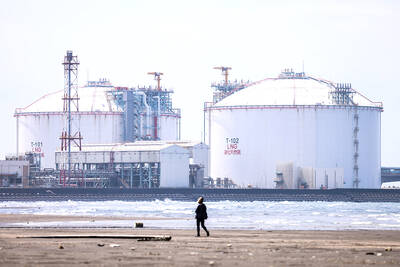
Taiwan is open to joining a global liquefied natural gas (LNG) program if one is created, but on the condition that countries provide delivery even in a scenario where there is a conflict with China, an energy department official said yesterday. While Taiwan’s priority is to have enough LNG at home, the nation is open to exploring potential strategic reserves in other countries such as Japan or South Korea, Energy Administration Deputy Director-General Chen Chung-hsien (陳崇憲) said. While the LNG market does not have a global reserve for emergencies like that of oil, the concept has been raised a few times —

Taiwan Semiconductor Manufacturing Co (TSMC, 台積電) yesterday received government approval to deploy its advanced 3-nanometer (3nm) process at its second fab currently under construction in Japan, the Ministry of Economic Affairs said in a news release. The ministry green-lit the plan for the facility in Kumamoto, which is scheduled to start installing equipment and come online in 2028 with a monthly production capacity of 15,000 12-inch wafers, the ministry said. The Department of Investment Review in June 2024 authorized a US$5.26 billion investment for the facility, slated to manufacture 6- to 12nm chips, significantly less advanced than 3nm process. At a meeting with


 RSS
RSS