


Bank of America Corp’s Web site was problem-free through mid-afternoon on Saturday after the bank joined several other financial institutions in refusing to handle payments for WikiLeaks, the latest blow to the secret--releasing organization’s efforts to continue operating under pressure from governments and the corporate world.
The Charlotte, North -Carolina-based bank’s move adds to similar actions by Mastercard Inc and PayPal Inc. Though previous moves have prompted reprisals by hackers, Bank of America’s site is as well-protected as they come, security experts say.
“This decision is based upon our reasonable belief that -WikiLeaks may be engaged in activities that are, among other things, inconsistent with our internal policies for processing payments,” the bank said in a statement on Saturday.

PHOTO: REUTERS
The move was first reported by the Charlotte Observer.
Earlier this month, Internet “hacktivists” operating under the label “Operation Payback” claimed responsibility in a Twitter message for causing technical problems at the MasterCard Web site after it ended its relationship with WikiLeaks. PayPal saw its Web site subject to an attack that slowed it down, but did not significantly affect payments.
Bank of America’s Web site offers access to customer accounts through its home page, but it could be a tough nut for hackers to crack, security experts say.
No financial institution can “fully keep the bad guys out,” said Rich Mogull, an analyst and CEO with the security research firm Securosis. However, he added that customers shouldn’t worry about WikiLeaks supporters plundering their accounts, because the bank has plenty of practice in warding off hackers. Also, previous attacks in support of WikiLeaks haven’t targeted customer accounts.
“Bank of America, I can guarantee you, is one of the top targets in the world,” Mogull said.
He also said the company probably confronts denial-of-service attacks regularly, too, and likely has strong defenses.
“I’m not going to guarantee it’s enough,” he said. “It always depends on how big the attack is.”
In such attacks, computers are harnessed — sometimes surreptitiously — to jam target sites with mountains of requests for data, knocking them out of commission.
Reached by telephone, Bank of America spokesman Scott Silvestri declined further comment on Saturday.
WikiLeaks says it’s preparing a release of information on banks, which could include documents it says it has on Bank of America.
WikiLeaks responded to Bank of America’s announcement with a Twitter message urging supporters to stop doing business with the bank.
“We ask that all people who love freedom close out their accounts at Bank of America,” WikiLeaks said in its posting Saturday.
It also called on businesses to switch funds from the bank.
WikiLeaks has received increasing global attention for its leaks of sensitive government data as the year has gone on. In recent weeks, it has released parts of a cache of more than 250,000 secret US State Department diplomatic cables from around the world.
The site has come under pressure from several directions besides the financial. US Attorney General Eric Holder has said repeatedly a criminal investigation of WikiLeaks’ release of the cables is under way.

The domestic unit of the Chinese-owned, Dutch-headquartered chipmaker Nexperia BV will soon be able to produce semiconductors locally within China, according to two company sources. Nexperia is at the center of a global tug-of-war over critical semiconductor technology, with a Dutch court in February ordering a probe into alleged mismanagement at the company. The geopolitical tussle has disrupted supply chains, with some carmakers reportedly forced to cut production due to chip shortages. Local production would allow Nexperia’s domestic arm, Nexperia Semiconductors (China) Ltd (安世半導體中國), to bypass restrictions in place since October on the supply of silicon wafers — etched with tiny components to

Singapore-based ride-hailing and delivery giant Grab Holdings Ltd has applied for regulatory approval to acquire the Taiwan operations of Germany-based Delivery Hero SE's Foodpanda in a deal valued at about US$600 million. Grab submitted the filing to the Fair Trade Commission on Friday last week, with the transaction subject to regulatory review and approval, the company said in a statement yesterday. Its independent governance structure would help foster a healthy and competitive market in Taiwan if the deal is approved, Grab said. Grab, which is listed on the NASDAQ, said in the filing that US-based Uber Technologies Inc holds about 13 percent of

Taiwan Semiconductor Manufacturing Co (TSMC, 台積電) yesterday received government approval to deploy its advanced 3-nanometer (3nm) process at its second fab currently under construction in Japan, the Ministry of Economic Affairs said in a news release. The ministry green-lit the plan for the facility in Kumamoto, which is scheduled to start installing equipment and come online in 2028 with a monthly production capacity of 15,000 12-inch wafers, the ministry said. The Department of Investment Review in June 2024 authorized a US$5.26 billion investment for the facility, slated to manufacture 6- to 12nm chips, significantly less advanced than 3nm process. At a meeting with
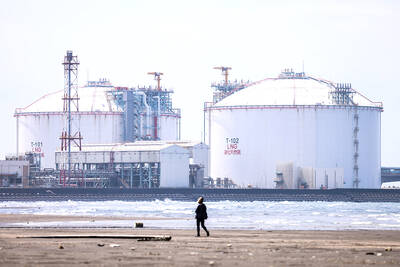
Taiwan is open to joining a global liquefied natural gas (LNG) program if one is created, but on the condition that countries provide delivery even in a scenario where there is a conflict with China, an energy department official said yesterday. While Taiwan’s priority is to have enough LNG at home, the nation is open to exploring potential strategic reserves in other countries such as Japan or South Korea, Energy Administration Deputy Director-General Chen Chung-hsien (陳崇憲) said. While the LNG market does not have a global reserve for emergencies like that of oil, the concept has been raised a few times —


 RSS
RSS