


The former head of Italian food conglomerate Parmalat was sentenced to 18 years in prison and ordered to pay huge sanctions on Thursday after a massive fraud trial on a case dubbed “Europe’s Enron.”
Calisto Tanzi, 72, was not in court for the sentencing and has only served nine months between prison and house arrest since the spectacular collapse in 2003 of a company that he founded in 1961 and operated in 30 countries.
The court in Parmalat’s home town of Parma in northern Italy said Tanzi and other former executives sentenced with him will have to pay 2 billion euros (US$2.6 billion) back to the company, which has emerged from bankruptcy.
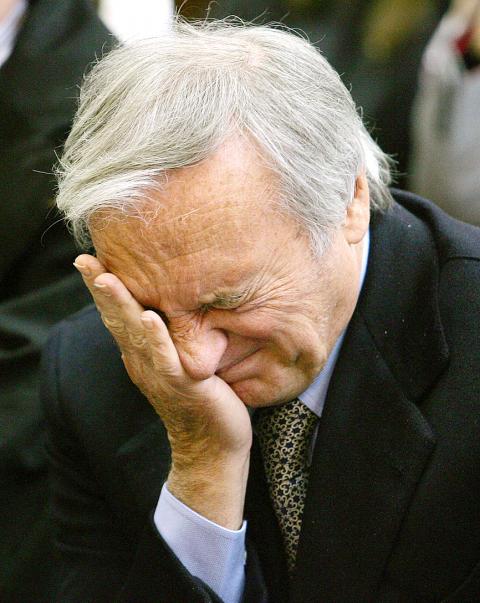
PHOTO: AFP
They will also have to compensate the 30,000 defrauded investors who were plaintiffs in the trial with around 30 million euros — a figure dismissed as “very disappointing” by one of the investors who attended the hearing.
Tanzi was sentenced along with 14 other former managers of Parmalat.
The prosecution had sought a 20-year sentence for Tanzi, but prosecutor Gerardo Laguardia said he was “fully satisfied” with the verdict.
Tanzi’s defense lawyer Giampiero Biancolella said his client was “not expecting such a severe sentence” and would appeal the verdict.
Tanzi has already been sentenced in a separate trial in Milan to 10 years in prison for stock market manipulation and an upcoming appeals hearing will decide whether or not he will serve time for that sentence.
Earlier rulings found that he was too old to go to prison, but the prosecution warned he could use hidden funds to flee Italy.
Reports at the time showed pictures of the luxurious villa complex near Parma in which he was living and described an extensive art collection including paintings by Claude Monet and Paul Cezanne that he had hidden away.
The Parmalat scandal seven years ago destroyed the savings of some 135,000 people, left a gaping 14 billion euro hole in the company’s finances and ruined the image of one of Italy’s leading business empires.
Among the 17 defendants who were on trial, Parmalat’s former financial director Fausto Tonna was also sentenced to 14 years in prison and Tanzi’s brother Giovanni got 10-and-a-half years. Two men were acquitted.
At the time of its collapse, Parmalat employed around 36,000 people and was a major player on the international stage.
Its many subsidiaries included the Parma soccer club and a tourism unit.
It now has around 14,000 employees in 15 countries including Australia, Canada, South Africa and in South America.
Parmalat was restructured and re-listed on the Milan stock exchange in 2005.

The domestic unit of the Chinese-owned, Dutch-headquartered chipmaker Nexperia BV will soon be able to produce semiconductors locally within China, according to two company sources. Nexperia is at the center of a global tug-of-war over critical semiconductor technology, with a Dutch court in February ordering a probe into alleged mismanagement at the company. The geopolitical tussle has disrupted supply chains, with some carmakers reportedly forced to cut production due to chip shortages. Local production would allow Nexperia’s domestic arm, Nexperia Semiconductors (China) Ltd (安世半導體中國), to bypass restrictions in place since October on the supply of silicon wafers — etched with tiny components to

Singapore-based ride-hailing and delivery giant Grab Holdings Ltd has applied for regulatory approval to acquire the Taiwan operations of Germany-based Delivery Hero SE's Foodpanda in a deal valued at about US$600 million. Grab submitted the filing to the Fair Trade Commission on Friday last week, with the transaction subject to regulatory review and approval, the company said in a statement yesterday. Its independent governance structure would help foster a healthy and competitive market in Taiwan if the deal is approved, Grab said. Grab, which is listed on the NASDAQ, said in the filing that US-based Uber Technologies Inc holds about 13 percent of

Taiwan Semiconductor Manufacturing Co (TSMC, 台積電) yesterday received government approval to deploy its advanced 3-nanometer (3nm) process at its second fab currently under construction in Japan, the Ministry of Economic Affairs said in a news release. The ministry green-lit the plan for the facility in Kumamoto, which is scheduled to start installing equipment and come online in 2028 with a monthly production capacity of 15,000 12-inch wafers, the ministry said. The Department of Investment Review in June 2024 authorized a US$5.26 billion investment for the facility, slated to manufacture 6- to 12nm chips, significantly less advanced than 3nm process. At a meeting with

Taiwan is open to joining a global liquefied natural gas (LNG) program if one is created, but on the condition that countries provide delivery even in a scenario where there is a conflict with China, an energy department official said yesterday. While Taiwan’s priority is to have enough LNG at home, the nation is open to exploring potential strategic reserves in other countries such as Japan or South Korea, Energy Administration Deputy Director-General Chen Chung-hsien (陳崇憲) said. While the LNG market does not have a global reserve for emergencies like that of oil, the concept has been raised a few times —


 RSS
RSS