


Raising its stake in green energy investment, Taiwan Semiconductor Manufacturing Co (TSMC, 台積電) on Sept. 16 announced that it would invest an initial US$258 million building its first solar cell factory, from which it aims to produce its first batch of solar cell modules.
Since unveiling a manifesto in the summer of last year stating that it would enter the green energy market, TSMC has begun to construct two factories, including an LED plant, and wrapped up two merger-and-acquisition deals with US solar company Stion and local solar cell maker Motech Industries Inc (茂迪) for a combined US$248 million ahead of widespread recovery in the solar industry this year.
“Those investments [including expansion of chip capacity] represent our commitment to future growth ... as well as our commitment to protect the environment,” TSMC chairman Morris Chang (張忠謀) said during a -groundbreaking ceremony for the solar plant in the middle of last month. “We hope [the company’s revenues] will grow at least 10 percent on average in the future.”
Revenues in the global semiconductor industry are expected to expand by a compounded annual rate of 9.6 percent from last year to 2014, research firm Gartner Inc forecast.
The global solar industry, on the other hand, is expected to expand by a composite annual rate of 23 percent from this year to 2015, TSMC forecast, citing a report from an unspecified research firm.
Industry analysts like Jonah Cheng (程正樺) of UBS Securities PTE LTD, Taipei branch, say that the solar investments are “not creative enough” because the solar industry is nothing new and solar players are vulnerable to price competition and changes in government subsidies.
However, Julian Wang (王仲良), a semiconductor analyst with Grand Cathay Securities Co (大華投顧), said TSMC “has a good chance to duplicate its foundry [contract chip-making business] success in the solar industry because of its strong technological background and deep pockets.”
TSMC is not the only semiconductor company to jump on the green energy bandwagon via a relatively small investment in a solar factory, compared with a chip factory that costs at least NT$100 billion (US$3.2 billion) to construct.
United Microelectronics Corp (UMC, 聯電), the world’s second-largest contract chipmaker, also plans to build a full solar manufacturing chain from solar wafer manufacturing to solar farm operations by leveraging the strength of its subsidiaries.
“It’s premature to say when we can start making money from this [solar] business. All we have to know is we are doing the right thing,” said Chen Wen-yang (陳文洋), head of UMC’s new business department.
Announcements this year by Taiwanese companies in almost every sector have said they want a piece of the fledging solar business either to boost returns or to rejuvenate stagnant businesses because of the low technology and investment thresholds.
Earlier this year, local optical disc maker Gigastorage Corp (國碩科技) decided to make a foray into solar wafer manufacturing, following in the footsteps of its bigger rivals. Gigastorage plans to spend NT$750 million to build a solar wafer production line.
“Developing a solar wafer business will help the company diversify operations and reach sustainable development,” company spokesman Carl Lee (李朝欽) said.
Taiwan’s struggling optical disc makers CMC Magnetics Corp (中環) and Ritek Corp (錸德) were forced in the past to expand into the solar industry and other sectors using borrowed money because of royalties payments and high materials costs.
In addition to optical disc firms, Taiwanese LCD panel maker AU Optronics Corp (友達光電), which is much more vulnerable to industrial ups and downs than its South Korean competitors, is also aiming to establish a greater presence in the solar industry supply chain from solar cell making to panel installation services this year.
The government also supports Taiwanese firms’ fast expansion into the solar industry because it expects solar businesses to emerge as the manufacturing sector’s third-biggest driver, with revenues exceeding NT$1 trillion in the future, after the semiconductor and LCD industries.
Taiwanese solar companies are expected to expand their revenues to NT$450 billion by 2015 by seizing a 15 percent share of the global solar market, from NT$101 billion in 2008, benefiting from an agreement reached by the world’s major economies to reduce carbon emissions over the next decade, according to statistics from the Council For Economic Planning and Development.
Amid growing optimism regarding green energy businesses, a new solar cell firm is about to be -established. Last week, local -notebook computer maker Inventec (英業達) said it planned to invest NT$3 billion to form a solar cell venture with its mobile device arm Inventec Appliance Corp (英華達), electronic dictionary maker Inventec Besta Co (無敵科技) and Win Semiconductor Corp (穩懋半導體).
However, some analysts are concerned that the frenzy in new solar investments, not to say the plans to almost double as capacity of existing solar cell makers, could lead to overcapacity in the future, the same fate that befell the nation’s memory sector.
TSMC’s new business head, Rick Tsai (蔡力行), believes he has an answer.
“We are hoping to become a technology provider with good efficiency ... we think the market is big enough and will grow fast enough. If we can do our job well, we believe we will have good profitability,” he said.

The domestic unit of the Chinese-owned, Dutch-headquartered chipmaker Nexperia BV will soon be able to produce semiconductors locally within China, according to two company sources. Nexperia is at the center of a global tug-of-war over critical semiconductor technology, with a Dutch court in February ordering a probe into alleged mismanagement at the company. The geopolitical tussle has disrupted supply chains, with some carmakers reportedly forced to cut production due to chip shortages. Local production would allow Nexperia’s domestic arm, Nexperia Semiconductors (China) Ltd (安世半導體中國), to bypass restrictions in place since October on the supply of silicon wafers — etched with tiny components to

Singapore-based ride-hailing and delivery giant Grab Holdings Ltd has applied for regulatory approval to acquire the Taiwan operations of Germany-based Delivery Hero SE's Foodpanda in a deal valued at about US$600 million. Grab submitted the filing to the Fair Trade Commission on Friday last week, with the transaction subject to regulatory review and approval, the company said in a statement yesterday. Its independent governance structure would help foster a healthy and competitive market in Taiwan if the deal is approved, Grab said. Grab, which is listed on the NASDAQ, said in the filing that US-based Uber Technologies Inc holds about 13 percent of

Taiwan Semiconductor Manufacturing Co (TSMC, 台積電) yesterday received government approval to deploy its advanced 3-nanometer (3nm) process at its second fab currently under construction in Japan, the Ministry of Economic Affairs said in a news release. The ministry green-lit the plan for the facility in Kumamoto, which is scheduled to start installing equipment and come online in 2028 with a monthly production capacity of 15,000 12-inch wafers, the ministry said. The Department of Investment Review in June 2024 authorized a US$5.26 billion investment for the facility, slated to manufacture 6- to 12nm chips, significantly less advanced than 3nm process. At a meeting with
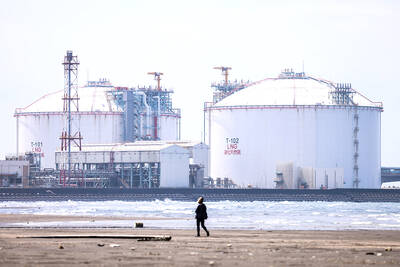
Taiwan is open to joining a global liquefied natural gas (LNG) program if one is created, but on the condition that countries provide delivery even in a scenario where there is a conflict with China, an energy department official said yesterday. While Taiwan’s priority is to have enough LNG at home, the nation is open to exploring potential strategic reserves in other countries such as Japan or South Korea, Energy Administration Deputy Director-General Chen Chung-hsien (陳崇憲) said. While the LNG market does not have a global reserve for emergencies like that of oil, the concept has been raised a few times —


 RSS
RSS