


Housewives huddle over jewelry counters in Yangon’s bustling Chinatown, but fashion is not foremost on their minds. This is banking in Myanmar’s dysfunctional economy.
On nearby Shwe Bontha Street, the heart of the gold market since colonial times, Nyan Tun is more than just a trader: He is an unofficial banker in the military-ruled country.
“Normally, the major buyers are farmers. They will buy gold with a little bit of extra money to sell before the next harvest,” he said. “Second are the housewives, who love to buy jewelery as savings.”
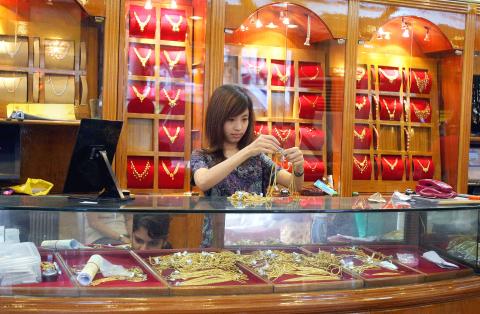
Photo: AFP
The global economic crisis may have reignited suspicion of banks worldwide, but in isolated Myanmar such distrust has long run deep and savers have no desire to put their money into the backward banking system.
Not that people have much to spare: Decades of economic mismanagement by the country’s rulers, plus international boycotts and sanctions, have generated a population struggling to get by and facing soaring consumer prices.
Between 2005 and last year, the annual inflation rate in Myanmar averaged 20 percent, according to the Asian Development Bank.
“If you want to catch up with inflation, you buy gold. If you save money in the bank you lose money,” Nyan Tun said.
“People have much more trust in gold as a store of value,” added the trader, whose name has been changed in this article at his request.
In military-ruled Myanmar, saying anything seen as critical of the junta can have serious consequences.
Nyan Tun said the value of a gold “tical” — about half a troy ounce — had increased more than 30-fold in the local currency, the kyat, since his early days as a gold trader in the late 1980s.
Sean Turnell, a specialist in Myanmar’s economy at Macquarie University in Sydney, said rampant increases in consumer prices were largely a result of the government’s habit of simply printing more money to fund its spending.
An abundance of natural treasures — including gold, gas, teak, oil, jade and gems — could make the country a rich nation as it once was before coming under military rule in 1962.
But Myanmar remains one of the world’s least developed countries, with nearly a third of the population living below the poverty line, according to World Bank figures, as the junta and its associates exploit these raw materials for their own benefit.
“The fiscal situation should be good,” said Turnell, on the basis that earnings from gas supplies should fund government spending. “But they [the military rulers] don’t bring money they get from gas properly into public accounts. These funds are not recorded.”
Few believe Myanmar’s controversial first election in 20 years, due on Nov. 7, will bring about much-needed economic reform, as the polls are widely expected to simply cloak military rule with civilian clothing.
However, there have been some shifts in the economic landscape ahead of the election, with the junta instigating a spate of privatizations of state firms and properties.
Along with these sell-offs of assets including ports, factories and cinemas, four conglomerates on international sanctions lists and run by junta-friendly tycoons have been given licenses to start up new banks.
Turnell said the cronyism apparent in these recent developments suggested the country was “drifting in a really strange direction away from a totalitarian system into one that works like a semi-criminal economy.”
For the average Myanmar citizen, there is still no economic stability, or decent alternative to their trustworthy treasure.
With the precious metal playing such a key role, the regime keeps a close eye on its trade. Nyan Tun said plain-clothed special branch police lurk on Shwe Bontha Street and pressure traders to stop selling when prices go up.
“Maybe the government thinks inflation is due to the price of gold, but actually it’s the other way round,” he said.
“The gold price is the index of inflation to citizens,” agreed a business editor in Yangon who did not want to be named. “People don’t know how else to judge inflation. The government gives no explanation.”
Myanmar’s banking system has never really recovered from a major crisis in 2003, which saw three banks completely collapse and was exacerbated by the policies of the Central Bank, such as recalling loans from borrowers.
People have also been hit hard in the past when the authorities scrapped certain currency units as legal tender.
A mass uprising against the military in 1988, which was brutally crushed, escalated from protests over a major episode of demonetization by the regime.
“That wiped out the savings of a huge amount of people,” Turnell said. “I have never come across a single Burmese person who saves money in the banks.”
For now gold remains the safest haven in Myanmar — the reason why a fishmonger will wear her savings around her neck.
“Gold: This is the only thing people trust,” the business editor said.
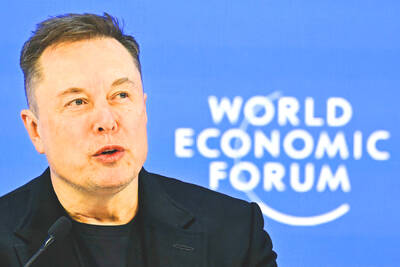
Elon Musk’s lieutenants have reached out to chip industry suppliers, including Applied Materials Inc, Tokyo Electron Ltd and Lam Research Corp, for his envisioned Terafab, early steps in an audacious and likely arduous attempt to break into the production of cutting-edge chips. Staff working for the joint venture between Tesla Inc and Space Exploration Technologies Corp (SpaceX) have sought price quotes and delivery times for an array of chipmaking gear, people familiar with the matter said. In past weeks, they’ve contacted makers of photomasks, substrates, etchers, depositors, cleaning devices, testers and other tools, according to the people, who asked not to

The EU and US are nearing an agreement to coordinate on producing and securing critical minerals, part of a push to break reliance on Chinese supplies. The potential deal would create incentives, such as minimum prices, that could advantage non-Chinese suppliers, according to a draft of an “action plan” seen by Bloomberg. The EU and US would also cooperate on standards, investments and joint projects, as well as coordinate on any supply disruptions by countries like China. The two sides are additionally seeking other “like-minded partners” to join a multicountry accord to help create these new critical mineral supply chains, which feed into

Japan approved ¥631.5 billion (US$3.97 billion) in additional subsidies to hasten Rapidus Corp’s entry into the high-stakes artificial intelligence (AI) chipmaking arena, ramping up support for a project widely regarded as a long shot. The capital is intended to bankroll Rapidus’ work for information technology firm Fujitsu Ltd, one of the initial customers that Tokyo hopes would get the signature endeavor off the ground. The new money raises the fees and investments that the government is injecting into the start-up to ¥2.6 trillion by the end of the current fiscal year to March next year, the Japanese Ministry of Economy, Trade and
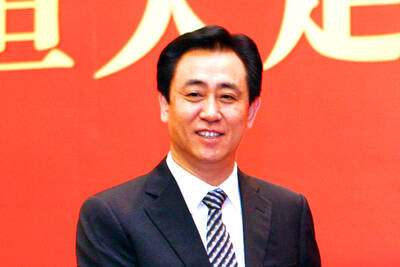
The founder of Chinese property giant Evergrande Group (恆大集團) has pleaded guilty to charges of fraud and bribery, a court said yesterday, the latest blow for what was once the country’s leading developer. Evergrande’s rise was propelled by decades of rapid urbanization and rising living standards, but in 2020, its access to credit dramatically narrowed when the government introduced curbs on excessive borrowing and speculation. The company defaulted in 2021 after struggling to repay creditors. Founder Xu Jiayin (許家印), 67, known as Hui Ka Yan in Cantonese, was reportedly held by police in 2023, with Evergrande saying he had been subjected to


 RSS
RSS