


Local solar cell makers Motech Industries Inc (茂迪) and Gintech Energy Corp (昱晶) were given a positive review by Credit Suisse yesterday, citing a "better-than-feared" industry outlook for the second half of this year.
Credit Suisse's latest report on Taiwan's solar energy sector followed the Swiss brokerage's forecast for demand in Germany last month which was revised upwards to 5.5 gigawatts of peak power (GWp) after an earlier estimate of 4.7 GWp.
It also came after US President Barack Obama on Saturday announced the award of nearly US$2 billion to two solar power 〝companies to build new plants in Arizona, Colorado and Indiana.
Credit Suisse's Taipei-based analyst Darryl Cheng (鄭德榮) said yesterday in the report that he believed Germany's scheduled feed-in tariff (FIT) cuts next year could help boost solar photovoltaic (PV) installation in that country, during the second half of the year, and hence increase output from Taiwanese solar cell makers.
FIT is a mechanism by which governments around the world offer a guaranteed purchase price for electricity generated by renewable energy sources over a fixed long-term contract. In Taiwan, the Ministry of Economic Affairs has demanded the state-run Taiwan Power Co (Taipower, 台電) adopt a FIT program to help develop the nation's renewable energy industry.
"First-quarter solar PV installation in Germany was 715 megawatts of peak power [MWp], only 13 percent of our 5.5 GWp estimate due to weak first-quarter seasonality ... However, we expect significant pick-up in the second quarter and the second half," Cheng said in the report.
The average selling prices (ASP) of solar PV have dropped since the fourth quarter of last year, which also implies a lower cost for governments to subsidize use of solar energy, Cheng said.
"We expect more government initiatives to be rolled out in the coming quarters," he wrote in the report.
While Credit Suisse forecast moderate ASP decline, Gintech chairman Pan Wenent (潘文炎) said yesterday he expected product prices to be slightly higher in the third quarter than in the second.
Gintech's profit in the second quarter was little changed from the first, Bloomberg quoted Pan as saying at a ground-breaking ceremony for a new facility in Miaoli County's Jhunan Township (竹南). The market across the region for its products "isn't bad," he said.
Credit Suisse rated "outperform" on Motech and Gintech stocks with target prices of NT$131 and NT$106, respectively, but offered a "neutral" recommendation on Sino-American Silicon Products Inc (SAS,中美晶) with a target price of NT$77.
Motech yesterday ended the day 2.79 percent higher at NT$110.5, Gintech closed 1.47 percent lower at NT$93.7, while SAS edged down 0.67 percent to NT$73.7.

The domestic unit of the Chinese-owned, Dutch-headquartered chipmaker Nexperia BV will soon be able to produce semiconductors locally within China, according to two company sources. Nexperia is at the center of a global tug-of-war over critical semiconductor technology, with a Dutch court in February ordering a probe into alleged mismanagement at the company. The geopolitical tussle has disrupted supply chains, with some carmakers reportedly forced to cut production due to chip shortages. Local production would allow Nexperia’s domestic arm, Nexperia Semiconductors (China) Ltd (安世半導體中國), to bypass restrictions in place since October on the supply of silicon wafers — etched with tiny components to

Singapore-based ride-hailing and delivery giant Grab Holdings Ltd has applied for regulatory approval to acquire the Taiwan operations of Germany-based Delivery Hero SE's Foodpanda in a deal valued at about US$600 million. Grab submitted the filing to the Fair Trade Commission on Friday last week, with the transaction subject to regulatory review and approval, the company said in a statement yesterday. Its independent governance structure would help foster a healthy and competitive market in Taiwan if the deal is approved, Grab said. Grab, which is listed on the NASDAQ, said in the filing that US-based Uber Technologies Inc holds about 13 percent of

Taiwan Semiconductor Manufacturing Co (TSMC, 台積電) yesterday received government approval to deploy its advanced 3-nanometer (3nm) process at its second fab currently under construction in Japan, the Ministry of Economic Affairs said in a news release. The ministry green-lit the plan for the facility in Kumamoto, which is scheduled to start installing equipment and come online in 2028 with a monthly production capacity of 15,000 12-inch wafers, the ministry said. The Department of Investment Review in June 2024 authorized a US$5.26 billion investment for the facility, slated to manufacture 6- to 12nm chips, significantly less advanced than 3nm process. At a meeting with
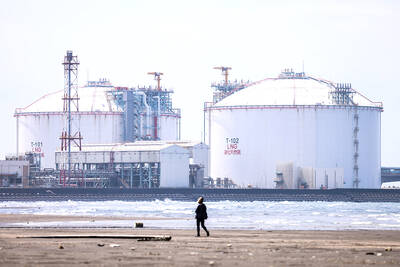
Taiwan is open to joining a global liquefied natural gas (LNG) program if one is created, but on the condition that countries provide delivery even in a scenario where there is a conflict with China, an energy department official said yesterday. While Taiwan’s priority is to have enough LNG at home, the nation is open to exploring potential strategic reserves in other countries such as Japan or South Korea, Energy Administration Deputy Director-General Chen Chung-hsien (陳崇憲) said. While the LNG market does not have a global reserve for emergencies like that of oil, the concept has been raised a few times —


 RSS
RSS