


Prime View International Co Ltd (元太科技), the world’s biggest supplier of electronic paper displays used in electronic readers like Amazon’s Kindle series, plans to spend US$500 million expanding capacity in China over the next five years to cope with rapidly growing demand.
This could be part of the Hsinchu-based flat-panel maker’s broader plan to boost capacity 14-fold within five years.
Prime View plans to assemble electronic paper displays and electronic ink processing in Yangzhou, Jiangsu Province, company chairman Scott Liu (劉思誠) said in a statement on Saturday.
Global shipments of electronic readers are expected to more than triple to 15.21 million units this year from 4.99 million units last year, Market researcher DisplaySearch said.
Prime View said Yangzhou would become the company’s major manufacturing base for electronic paper displays.
At present, the company assembles electronic paper displays and TFT-LCD panels for portable devices through Transcend Optronics (Yangzhou) Co Ltd (川奇光電), a Chinese subsidiary in Yangzhou.
Earlier this year, Prime View told investors that it intended to spend between US$50 million and US$60 million on new equipment to double capacity this year, compared with NT$500 million (US$15.93 million) last year.
Prime View said nine out of 10 electronic readers on the market are using its electronic paper displays made with E Ink Corp’s technology. The company also provides electronic paper displays to Sony Corp and Barnes & Noble Inc, the biggest book seller in the US.
Earlier this year, E Ink merged with Prime View for US$215 million and 120 million shares, a crucial move by the flat-panel maker following its acquisition of electronic ink displays from Philips in 2005.
Last month, Prime View obtained syndicated loans of NT$8 billion and another US$20 million in bank loans.
Prime View lost NT$1.39 billion in the January-to-September period last year, with revenues of NT$11.11 billion.
In a separate press release, Prime View said on Saturday it had signed an agreement with Chinese digital content provider Fanshu.com (方正蕃薯網), a subsidiary of PKU Founder Group (北京方正), allowing Prime View’s customers to access digital content from Fanshu.com.
Fanshu.com is the world’s biggest Chinese digital content provider, with more than 1.8 million Chinese titles.
Yesterday, Prime View said it had signed a contract with Chinese publishing company Phoenix Publishing & Media Network (鳳凰集團) to provide digital content via electronic readers to students.

NO BREAKTHROUGH? More substantial ‘deliverables,’ such as tariff reductions, would likely be saved for a meeting between Trump and Xi later this year, a trade expert said China launched two probes targeting the US semiconductor sector on Saturday ahead of talks between the two nations in Spain this week on trade, national security and the ownership of social media platform TikTok. China’s Ministry of Commerce announced an anti-dumping investigation into certain analog integrated circuits (ICs) imported from the US. The investigation is to target some commodity interface ICs and gate driver ICs, which are commonly made by US companies such as Texas Instruments Inc and ON Semiconductor Corp. The ministry also announced an anti-discrimination probe into US measures against China’s chip sector. US measures such as export curbs and tariffs
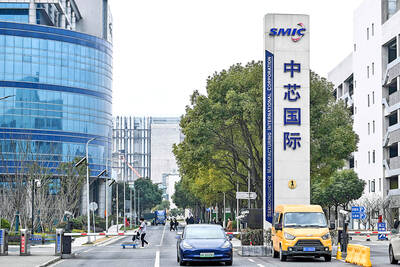
The US on Friday penalized two Chinese firms that acquired US chipmaking equipment for China’s top chipmaker, Semiconductor Manufacturing International Corp (SMIC, 中芯國際), including them among 32 entities that were added to the US Department of Commerce’s restricted trade list, a US government posting showed. Twenty-three of the 32 are in China. GMC Semiconductor Technology (Wuxi) Co (吉姆西半導體科技) and Jicun Semiconductor Technology (Shanghai) Co (吉存半導體科技) were placed on the list, formally known as the Entity List, for acquiring equipment for SMIC Northern Integrated Circuit Manufacturing (Beijing) Corp (中芯北方積體電路) and Semiconductor Manufacturing International (Beijing) Corp (中芯北京), the US Federal Register posting said. The

India’s ban of online money-based games could drive addicts to unregulated apps and offshore platforms that pose new financial and social risks, fantasy-sports gaming experts say. Indian Prime Minister Narendra Modi’s government banned real-money online games late last month, citing financial losses and addiction, leading to a shutdown of many apps offering paid fantasy cricket, rummy and poker games. “Many will move to offshore platforms, because of the addictive nature — they will find alternate means to get that dopamine hit,” said Viren Hemrajani, a Mumbai-based fantasy cricket analyst. “It [also] leads to fraud and scams, because everything is now

MORTGAGE WORRIES: About 34% of respondents to a survey said they would approach multiple lenders to pay for a home, while 29.2% said they would ask family for help New housing projects in Taiwan’s six special municipalities, as well as Hsinchu city and county, are projected to total NT$710.65 billion (US$23.61 billion) in the upcoming fall sales season, a record 30 percent decrease from a year earlier, as tighter mortgage rules prompt developers to pull back, property listing platform 591.com (591新建案) said yesterday. The number of projects has also fallen to 312, a more than 20 percent decrease year-on-year, underscoring weakening sentiment and momentum amid lingering policy and financing headwinds. New Taipei City and Taoyuan bucked the downturn in project value, while Taipei, Hsinchu city and county, Taichung, Tainan and Kaohsiung


 RSS
RSS