


Starting on April 1, EasyCard (悠遊卡) holders will be able to use the cards to pay for purchases at more than 10,000 retail stores, the company said yesterday.
“The smartcard payment system in Taiwan has lagged behind Hong Kong and Singapore for many years,” EasyCard Corp (悠遊卡股份有限公司) chairman Sean Lien (連勝文) told a press conference yesterday. “But now we are catching up.”
Launched in 1997, Hong Kong’s Octopus is one of the world’s leading smartcard payment systems. It has more than 2,500 partnering service providers, including operators of public transport, parking, retail, vending and kiosks, schools and leisure facilities, and can be used as access control for residential and commercial buildings.
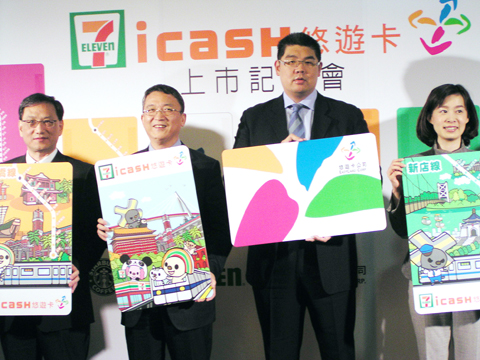
PHOTO: CNA
More than 20 million Octopus cards and products are in circulation, and the system handles more than 11 million transactions a day, with the total amount exceeding HK$100 million (US$13 million), its Web site says.
Taiwan’s Financial Supervisory Commission gave the green light in January to EasyCard Corp’s application to use the card as an electronic cash card.
Users will be able to store as much as NT$10,000 (US$300) on their EasyCard to pay for transactions below NT$1,000. The daily spending limit will be capped at NT$3,000.
There are currently 17.7 million cards in circulation, with more than 4 million used every day. Major retailers have joined the campaign to promote smartcard payment. Convenience store chains such as 7-Eleven, cosmetics and drugstore chains Watsons and Cosmed (康是美), food and beverage brands Pizza Hut, Mister Donut and Starbucks, as well as Miramar Cinemas (美麗華影城) will be among the first wave of vendors accepting payment via EasyCard.
President Chain Store Corp (統一超商), the operator of 7-Eleven, yesterday said it would offer a two-in-one smartcard that combines its icash card and EasyCard’s functions.
The company allows consumers to use the chip-embedded icash card to store cash to pay for transactions at its 4,800 stores and collect bonus points.
It is the most widely circulated membership card among all convenience store chains, with 8.4 million in circulation.
The new icash/EasyCard should boost icash circulation to 13 million by the end of the year, it said.

Cairo’s new monorail slices across the city skyline, running above the familiar chaos of blaring horns and aging buses’ exhaust fumes that mark rush hour below. The US$4.5 billion monorail, opened this month, is among Egypt’s most prominent new transport projects, part of a debt-funded infrastructure drive criticized for sapping state finances while bringing limited benefits to most of the country’s 109 million people. “It feels like you’re in a different country,” said Ramy Sayed, a restaurant manager, aboard a driverless Innovia 300 train. “No noise, no traffic, we’re not used to this.” The eastern line runs 56km from the bustling middle-class

Taiwanese firms have increased investment in the Philippines in recent years as Manila’s ties with Washington deepen and global supply chains continue to shift away from China, an expert at the Chung-Hua Institution for Economic Research (CIER, 中華經濟研究院) said yesterday. The Philippines had not been among Taiwanese investors’ top choices in Southeast Asia, CIER Taiwan ASEAN Studies Center director Kristy Hsu (徐遵慈) said at a seminar in Taipei. However, Taiwan’s investment in the country has grown significantly since the COVID-19 pandemic, reaching US $257 million last year, a high in recent years, she said. Although Taiwan’s total investment in the Philippines still lags

Intel Corp regards Taiwan Semiconductor Manufacturing Co (TSMC, 台積電) as a longstanding partner, as the US chipmaker would continue outsourcing production of advanced chips to TSMC, Intel chief executive officer Lip-Bu Tan (陳立武) said yesterday. “I don’t look at people as competitors. I look at the collaboration... Nvidia is also, you know, a good friend,” Tan told a news conference following his keynote speech at the Computex trade show in Taipei. “It’s a very trusted partnership for us... We are a big, top customer for them, and we’re going to continue doing that,” he said, referring to TSMC, the world’s largest foundry

Artificial intelligence (AI) agents would supplant smartphones as the center of people’s digital lives, fundamentally reshaping personal devices and driving a major computing upgrade cycle, Qualcomm Inc CEO Cristiano Amon said yesterday. In his keynote speech for this year’s Computex trade show in Taipei, Amon said that the rise of "agentic AI" — AI systems capable of reasoning, planning and carrying out tasks autonomously — would transform how people interact with technology across phones, PCs, vehicles and wearable devices. Describing the technology as the next major evolution in computing, Amon said that "2026 is the year of agents.” For decades, smartphones have sat


 RSS
RSS