


TAIEX increases 0.52 percent
Taiwanese shares closed higher yesterday, with the weighted TAIEX index, the market’s key barometer, increasing 43.48 points, or 0.52 percent, to close at 8,280.90.
The bourse opened at 8,222.42 and traded between 8,369.55 and 8,143,45 during the session.
A total of 5.76 billion shares changed hands on market turnover of NT$159.99 billion (US$5.02 billion). Gainers outnumbered losers 1,641 to 1,493, with 233 stocks remaining unchanged. Foreign institutional investors were net buyers of NT$7.46 billion in shares.
TWSE to include Epistar
Taiwan Stock Exchange Corp (TWSE, 台灣證交所) has decided to add light-emitting-diode (LED) maker Epistar Corp (晶元光電) to its large-cap Taiwan 50 index after its latest review, according to a press release on Thursday.
At the same time, TWSE will remove Evergreen Marine Corp (長榮海運) from the large-cap Taiwan 50 index, which it compiles with FTSE Group, the release said, citing the shipping company’s declining market capitalization.
Evergreen Marine will instead join the mid-cap Taiwan 100 index, TWSE said. Seven other new stocks that will also be added into the mid-cap index are memory-chip maker Nanya Technology Corp (南亞科技), solar-cell maker Gintech Energy Corp (昱晶能源), optical product designer Young Optics Inc (揚明光學), flat-panel TV maker Amtran Technology Co (瑞軒科技), passive component maker Yageo Corp (國巨), touchscreen panel maker Sintek Photronic Corp (和鑫光電) and Taiwan Life Insurance Co (台灣人壽), TWSE said.
The changes will take effect on Jan. 18.
Acer recalls laptops
Acer Inc (宏碁) recalled about 22,000 laptop computers that could overheat and cause burns.
No injuries have been reported, but the US Consumer Product Safety Commission said on Thursday that a short circuit in an internal microphone wire under the palm rest has damaged three machines.
The recall covers the several models in the Aspire series of notebooks, including the Acer AS3410, AS3410T, AS3810T, AS3810TG, AS3810TZ and AS3810TZG. The computers were sold between June and October of last year.
AUO to help form BriView
AU Optronics Corp (AUO, 友達光電), the world’s third-largest maker of liquid-crystal displays (LCDs), announced yesterday it would invest US$20 million in forming a company in China, BriView (Hefei) Corp (景智電子合肥公司), which will make and sell LCD products and related components.
The company made the announcement in a stock exchange filing without providing further details.
Hua Nan posts profit
Hua Nan Financial Holdings Co (華南金控) posted a full-year post-tax profit of NT$4.47 billion, it said in an exchange filing yesterday.
Fubon Financial Holding Co (富邦金控), meanwhile, said its preliminary net profit for last year was NT$19.73 billion, or NT$2.44 a share. The result was 81.3 percent higher than its net profit of NT$10.88 billion a year earlier.
Jih Sun Financial Holding Co (日盛金控) however posted NT$5.62 billion in after-tax loss for last year, or NT$1.31 loss per share.
While the company’s core unit Jih Sun Securities Co (日盛證券) made NT$1.55 billion in after-tax profit last year, its banking unit Jih Sun International Bank (日盛國際商銀) reported a NT$6.88 billion loss for the year.
NT dollar declines slightly
The New Taiwan dollar lost ground against the US dollar on the Taipei Foreign Exchange yesterday, falling NT$0.030 to close at NT$31.880.
Turnover was US$574 million.

The domestic unit of the Chinese-owned, Dutch-headquartered chipmaker Nexperia BV will soon be able to produce semiconductors locally within China, according to two company sources. Nexperia is at the center of a global tug-of-war over critical semiconductor technology, with a Dutch court in February ordering a probe into alleged mismanagement at the company. The geopolitical tussle has disrupted supply chains, with some carmakers reportedly forced to cut production due to chip shortages. Local production would allow Nexperia’s domestic arm, Nexperia Semiconductors (China) Ltd (安世半導體中國), to bypass restrictions in place since October on the supply of silicon wafers — etched with tiny components to

Singapore-based ride-hailing and delivery giant Grab Holdings Ltd has applied for regulatory approval to acquire the Taiwan operations of Germany-based Delivery Hero SE's Foodpanda in a deal valued at about US$600 million. Grab submitted the filing to the Fair Trade Commission on Friday last week, with the transaction subject to regulatory review and approval, the company said in a statement yesterday. Its independent governance structure would help foster a healthy and competitive market in Taiwan if the deal is approved, Grab said. Grab, which is listed on the NASDAQ, said in the filing that US-based Uber Technologies Inc holds about 13 percent of

Taiwan Semiconductor Manufacturing Co (TSMC, 台積電) yesterday received government approval to deploy its advanced 3-nanometer (3nm) process at its second fab currently under construction in Japan, the Ministry of Economic Affairs said in a news release. The ministry green-lit the plan for the facility in Kumamoto, which is scheduled to start installing equipment and come online in 2028 with a monthly production capacity of 15,000 12-inch wafers, the ministry said. The Department of Investment Review in June 2024 authorized a US$5.26 billion investment for the facility, slated to manufacture 6- to 12nm chips, significantly less advanced than 3nm process. At a meeting with
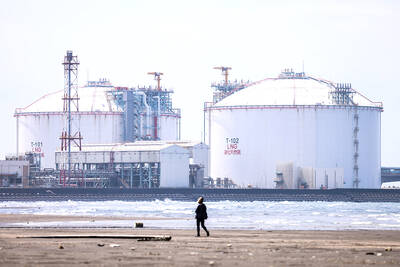
Taiwan is open to joining a global liquefied natural gas (LNG) program if one is created, but on the condition that countries provide delivery even in a scenario where there is a conflict with China, an energy department official said yesterday. While Taiwan’s priority is to have enough LNG at home, the nation is open to exploring potential strategic reserves in other countries such as Japan or South Korea, Energy Administration Deputy Director-General Chen Chung-hsien (陳崇憲) said. While the LNG market does not have a global reserve for emergencies like that of oil, the concept has been raised a few times —


 RSS
RSS