


Shin Kong Life Tower (新光摩天大樓), located across Zhongxiao W Rd from Taipei Railway Station, continued to top the capital’s skyscrapers this year with the highest government-assessed land price.
The building’s land price was NT$3.36 million (US$103,867) per ping (3.3m²), up 0.41 percent from last year, the Taipei City Government said yesterday.
The high-rise building retained its “King of Land” title for the 12th consecutive year, the Taipei City Land Department said in an annual press conference.
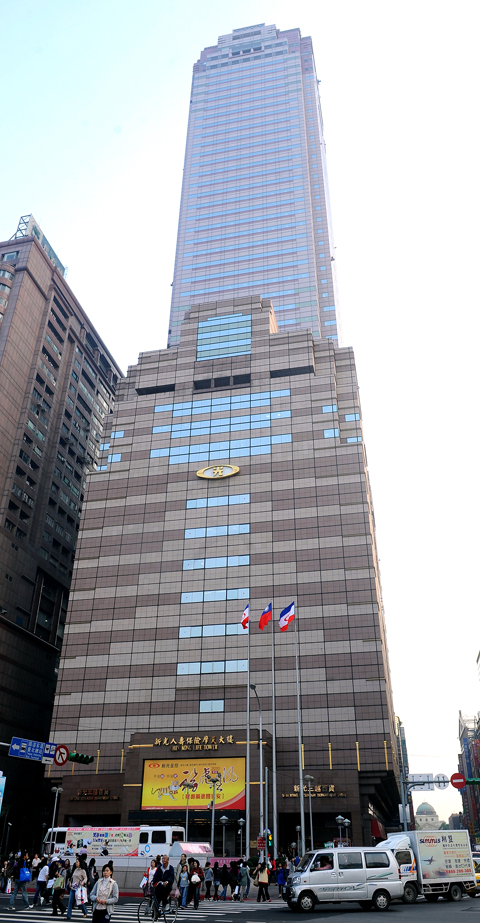
PHOTO: WANG MIN-WEI, TAIPEI TIMES
The department attributed the rise in the 51-story skyscraper’s land price to the opening of Taipei Bus Station in mid-August, construction of the airport express, its floor-to-area ratio of 1,600 percent and a proposal for twin tower buildings nearby, attracting bigger crowds and more business.
The land price of Shin Kong Life Tower was followed by Taipei 101 at NT$3.07 million per ping, the land department said.
The Xinyi District (信義) skyscraper’s land price was up 1.98 percent year-on-year. Taipei 101 has a lower floor-to-area ratio than the Shin Kong building at 710 percent, the department said.
Huang Rong-feng (黃榮峰), commissioner of the department, said Taipei 101 would continue to increase in value as a result of rapid development in the district and the completion of the Xinyi MRT line in 2012.
Chiu Tai-hsuan (邱太), a real estate analyst at Taiwan Realty Co (台灣房屋), forecast that Taipei 101 would quickly catch up and overtake the Shin Kong building in 2015 given the district’s rapid development.
He said in a statement yesterday that the land price of Taipei 101 had risen 3.25 percent in the past eight years, outperforming Skin Kong Tower’s 0.49 percent increase.
The department is expected to release its list of land prices on Jan. 1, which will be used for the city’s property owners to file for their land value taxes next year.
On average, the city’s land prices for next year will rise by 2.12 percent from this year — the smallest increase since 2005 and slightly smaller than the annual increase of 2.61 percent seen this year.
Huang said the financial crisis and the poor performance of the real estate market both contributed to the slow growth of real estate prices.
Well-planned public infrastructure, convenient transportation and a great business location attributed to the city’s land price gain amid the nation’s earlier property slump, the department said.
Among the city’s 12 administrative districts, Neihu District (內湖) saw the biggest jump in land prices at 2.89 percent year-on-year as more businesses move there and transportation improves.
Neihu was followed by Da-an (大安) and Zhongzheng (中正) districts, the department’s figures showed. The commercial area in Tianmu (天母), however, was hit by the economic slowdown, showing a slight drop in land prices.
Huang said the city’s land prices were calculated by collecting information from real estate agencies and land acquisition companies as a reference for the next year’s market prices.
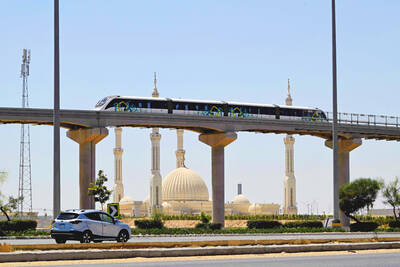
Cairo’s new monorail slices across the city skyline, running above the familiar chaos of blaring horns and aging buses’ exhaust fumes that mark rush hour below. The US$4.5 billion monorail, opened this month, is among Egypt’s most prominent new transport projects, part of a debt-funded infrastructure drive criticized for sapping state finances while bringing limited benefits to most of the country’s 109 million people. “It feels like you’re in a different country,” said Ramy Sayed, a restaurant manager, aboard a driverless Innovia 300 train. “No noise, no traffic, we’re not used to this.” The eastern line runs 56km from the bustling middle-class

Taiwanese firms have increased investment in the Philippines in recent years as Manila’s ties with Washington deepen and global supply chains continue to shift away from China, an expert at the Chung-Hua Institution for Economic Research (CIER, 中華經濟研究院) said yesterday. The Philippines had not been among Taiwanese investors’ top choices in Southeast Asia, CIER Taiwan ASEAN Studies Center director Kristy Hsu (徐遵慈) said at a seminar in Taipei. However, Taiwan’s investment in the country has grown significantly since the COVID-19 pandemic, reaching US $257 million last year, a high in recent years, she said. Although Taiwan’s total investment in the Philippines still lags
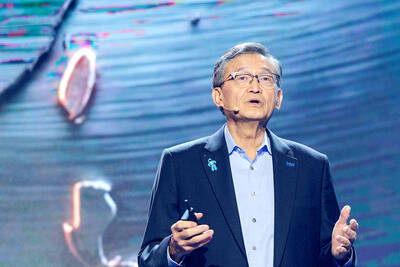
Intel Corp regards Taiwan Semiconductor Manufacturing Co (TSMC, 台積電) as a longstanding partner, as the US chipmaker would continue outsourcing production of advanced chips to TSMC, Intel chief executive officer Lip-Bu Tan (陳立武) said yesterday. “I don’t look at people as competitors. I look at the collaboration... Nvidia is also, you know, a good friend,” Tan told a news conference following his keynote speech at the Computex trade show in Taipei. “It’s a very trusted partnership for us... We are a big, top customer for them, and we’re going to continue doing that,” he said, referring to TSMC, the world’s largest foundry

Artificial intelligence (AI) agents would supplant smartphones as the center of people’s digital lives, fundamentally reshaping personal devices and driving a major computing upgrade cycle, Qualcomm Inc CEO Cristiano Amon said yesterday. In his keynote speech for this year’s Computex trade show in Taipei, Amon said that the rise of "agentic AI" — AI systems capable of reasoning, planning and carrying out tasks autonomously — would transform how people interact with technology across phones, PCs, vehicles and wearable devices. Describing the technology as the next major evolution in computing, Amon said that "2026 is the year of agents.” For decades, smartphones have sat


 RSS
RSS