


Taipei Times (TT): What incentive do you think the India market offers to attract potential Taiwanese investments?
Helen Hui (許穗華): If you look at the world’s IT products, most are dominated by Taiwanese players. And then if you look at India’s niche, it’s also IT, such as software, which is a very strong industry in India. From that perspective, Taiwanese businesses have been very smart and pragmatic in terms of how they go after businesses. They go wherever their clients go. For example, Nokia are a big customer of Hon Hai Precision Industry Co (鴻海精密). So, where Nokia opens an operation, Hon Hai will follow. Nokia has a huge operation here in Chennai of which all Nokia suppliers are a part.
Taiwanese companies get close to their customers for a very practical reason: logistics. It’s much easier, from a logistics point of view. When they make the goods, they just transport them two blocks rather than arranging for shipments that add to the cost.
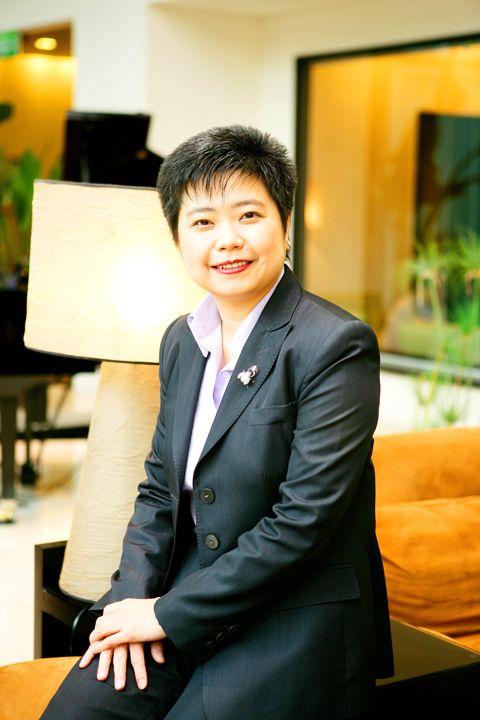
PHOTO: COURTESY OF STANDARD CHARTERED
From that angle, it makes a lot of sense for Taiwanese companies to consider investments in India as their clients have. And India has lots of IT talent and a steady flow of human capital — important elements for a manufacturing hub.
TT: From your observation, as one of the sponsors of the trade show TAITRONICS India in the past two years, are many Taiwanese businesses ready to tap into the India market?
Hui: Some are more ambitious than others, although a lot of the businesses are still in the assessment stage. And some are more ready than others — for example, Hon Hai or airline companies — if their clients are here. Some smaller companies are still looking at the big corporates as a part of their supply chain.
Toward the mid and the end of the supply chain, Taiwanese companies are dominating. But do they need to be here in a big way? It depends on their business value. Taiwanese businesspeople are very smart and go wherever they make money. It’s not in their blood to go places where they don’t make money [laughs]. And if they come up with a successful business model in India, the consumption power is also big.
Don’t underestimate the spending power here. China will of course always be a preferred location for Taiwanese. But nevertheless, do they want to put everything into one location when they can also tap into another big market like India, which is also known for its IT sector.
Some of the major financial institutions have moved their processing hubs into India because of the country’s IT intelligence and human capital. In our bank’s case, our [Chennai-based] Scope International employs more than 10,000 local people here to process 24 hours a day, seven days a week for the 72 country markets we operate globally.
TT: Now that some Taiwanese business has geared up to tap into the market here, is your bank interested in following your clients to cater to their needs for financial services?
Hui: Standard Chartered Bank bought Grindlays Bank from ANZ Bank back in 2000, which made us the largest foreign bank in India with 90 branches. So, we are very well positioned in India regardless of where our Taiwanese or local clients are.
From a presence and product point of view, we’re already big in the Indian market, one of our group’s top five markets.
If Taiwanese businesses start to make big investments in India, we’re well positioned to help them. What makes the whole picture complete is to add the language and cultural capabilities. If I can move a couple of Taiwanese bankers to come and be based in India to service the Taiwanese, I think we can then easily capture Taiwanese businesses in India.
TT: Will you set up a Taiwan desk similar the one you set up in Vietnam last month?
Hui: We talked about it [setting up a Taiwan desk in India] for the last 12 months. This is the second time I have come to Chennai to look at opportunities. We’re ready to put people here. And I’d like to get things going by the end of this year or the beginning of next year.
We’ll be adding two or whatever number of [Mandarin-speaking] bankers to leverage on the platform or products of our India businesses since the bank, as a global player, already has a huge infrastructure here.
TT: What financial services do you foresee Taiwanese businesses requiring if they decide to come to India?
Hui: In terms of products, we can do everything. Whatever we’re offering Indian clients, we can offer to Taiwanese clients. It depends on what the company needs from us, whether it’s working capital, refinancing, trade finances, mergers and acquisitions or corporate financing.
TT: How well is the Taiwan Desk in Vietnam doing?
Hui: Unlike our rivals, we’re not just hiring Vietnamese Mandarin-speakers. We’re sending people from Taiwan, who understand the clients’ culture. The feedback from our Taiwanese clients has been good although it’s too early to say whether we have turned a profit from the investment.
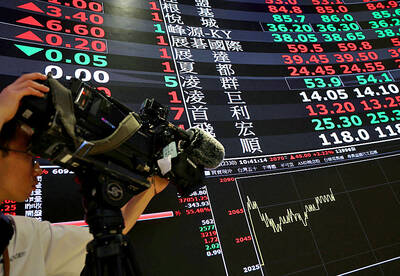
After several years flying high as Asia’s best Nvidia Corp proxy, Taiwan Semiconductor Manufacturing Co (TSMC, 台積電) is increasingly vying with other artificial intelligence (AI) stocks for investor attention. Stock traders are chasing a wider array of beneficiaries as mainstream usage of AI creates demand for hardware beyond the most-advanced chips TSMC makes for Nvidia. Subthemes from the deepening memory crunch to advances in robotics are also luring bids. At the same time, investment caps on single stocks are pushing funds to diversify, while retail investors long familiar with TSMC through its US depositary receipts are being offered a broader set of
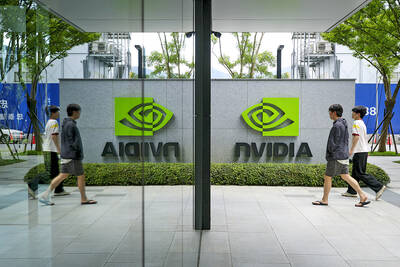
UNDER MICROSCOPE: Taiwan detained three people who allegedly conspired to buy servers in Taiwan and export them using fraudulent documentation, prosecutors said Nvidia Corp chief executive officer Jensen Huang (黃仁勳) on Saturday urged Super Micro Computer Inc to tighten up on compliance after Taiwan detained three people this week for allegedly making fraudulent declarations about artificial intelligence (AI) servers made by its US partner. The development marked the nation’s first crackdown on semiconductor smuggling, which grew after the US slapped restrictions on exports of high-end chips such as Nvidia AI accelerators to China. Nvidia is “rigorous” in explaining regulations to all of its partners, Huang told reporters after arriving in Taipei. “Ultimately Super Micro has to run their own company,” he said in response to
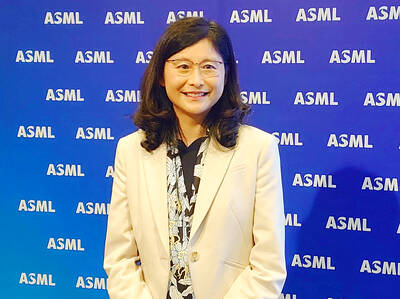
Netherlands-based semiconductor equipment supplier ASML Holding NV yesterday said that it is planning to hire an additional 1,000 people in Taiwan this year in response to growing demand from clients. ASML had previously planned to recruit 600 people this year, but that the plan has been adjusted upward, ASML vice president and ASML Taiwan general manager Grace Wang (汪佳慧) told reporters. ASML has a workforce of more than 4,500 in Taiwan, accounting for about 10 percent of its global total, Wang said. This year’s recruitment campaign would focus on adding people in the customer support, manufacturing and supply chain domains to assist ASML
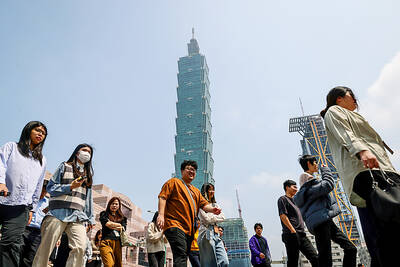
TECH RELIANCE: Growth is increasingly reflecting an unequal K-shaped distribution, where technology sectors outperform and other industries struggle, an expert said Standard Chartered Bank has significantly raised its forecast for Taiwan’s economic growth to 9.5 percent this year, up from 7.6 percent previously, citing surging artificial intelligence (AI) demand driving exports, semiconductor production and investment. The upgrade reflects a sustained AI supercycle that continues to fuel demand for advanced chips and technology infrastructure, which form the backbone of Taiwan’s exports, the bank said in a report this week. “We raise our 2026 growth forecast to reflect a much stronger-than-expected first-quarter GDP figure,” Standard Chartered senior economist for greater China and Asia Tommy Wu (胡東安) said in the report. Driven largely by a 35.3 percent


 RSS
RSS