


TAIEX drops below 5,000
Taiwanese share prices closed down 1.48 percent yesterday as investors pocketed recent gains after a Wall Street fall overnight, dealers said.
The weighted index fell 74.31 points to 4,961.62 on turnover of NT$101.40 billion (US$3 billion).
Losers outnumbered gainers by 1,316 to 564, with 137 stocks unchanged.
The market opened up 0.48 percent, but profit-taking emerged to erode early gains with the bellwether electronic sector in focus, dealers said.
The selling pulled the market down below the key 5,000-point mark, which still served as stiff technical resistance in the short term, they said.
Fuel prices rise today
Domestic gasoline and diesel prices will both be increased by NT$0.3 per liter, effective today, state-owned oil refiner CPC Corp, Taiwan (CPC, 台灣中油) and its private rival, Formosa Petrochemical Corp (台塑石化), said yesterday.
After the adjustment, CPC’s price for a liter of 98-octane unleaded gasoline will be NT$25.5 a liter, the company said.
The firm’s 95-octane unleaded gasoline will cost NT$24.0, 92-octane unleaded gasoline will cost NT$23.3 and diesel will be priced at NT$20.5 per liter.
Slowdown enters 12th cycle
The nation is entering its 12th business cycle forming part of a slowdown that started in April last year, the Council for Economic Planning and Development said yesterday.
The council said the most recent economic expansion began in March 2005 and lasted 37 months.
The upward trend peaked in March last year, when leading and concurrent indexes started to head down, the council said in a statement.
MOEA deputy appointed
Huang Chung-chiou (黃重球) was yesterday inaugurated as the new Deputy Minister of Economic Affairs, replacing Shih Yen-shiang (施顏祥), who was recently promoted to chair the state-run CPC Corp, Taiwan (台灣中油), a ministry statement said.
Huang has served his entire career at the Ministry of Economic Affairs (MOEA) in various departments and at various posts. Most recently, he was the vice chairman of the ministry’s State-Owned Enterprise Commission. Right before that Huang was director-general of the MOEA’s Department of Industrial Technology.
Cosmos to close 12 branches
The Financial Supervisory Commission yesterday gave its approval for Cosmos Bank Taiwan (萬泰銀行) to close down 12 of its branches, mostly in the Greater Taipei area, a commission official said yesterday.
The bank’s total number of branches will be reduced to 51.
“To enhance operational efficiency, the bank has been restructuring its organization since February,” the commission said in a press statement.
Bank executives were not available for comment.
Insurer to enter PRC province
Cathay Life Insurance Co’s (國泰人壽) joint venture with China Eastern Airlines Corp (東方航空) has acquired permission from China’s Insurance Regulatory Commission to begin operations in China’s Liaoning Province, the company said in a stock exchange filing yesterday.
Cathay Life, Taiwan’s largest life insurer, formed a joint venture with China Eastern Airlines in January 2005.
NT dollar gains ground
The New Taiwan dollar gained ground against the US currency on the Taipei Foreign Exchange yesterday, rising NT$0.124 to close at NT$33.8. Turnover was US$1.25 billion.
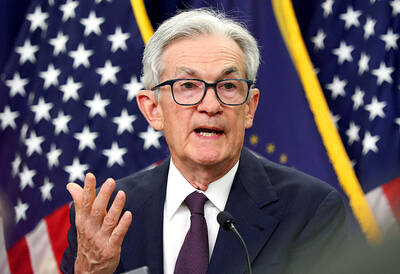
DIVIDED VIEWS: Although the Fed agreed on holding rates steady, some officials see no rate cuts for this year, while 10 policymakers foresee two or more cuts There are a lot of unknowns about the outlook for the economy and interest rates, but US Federal Reserve Chair Jerome Powell signaled at least one thing seems certain: Higher prices are coming. Fed policymakers voted unanimously to hold interest rates steady at a range of 4.25 percent to 4.50 percent for a fourth straight meeting on Wednesday, as they await clarity on whether tariffs would leave a one-time or more lasting mark on inflation. Powell said it is still unclear how much of the bill would fall on the shoulders of consumers, but he expects to learn more about tariffs

Meta Platforms Inc offered US$100 million bonuses to OpenAI employees in an unsuccessful bid to poach the ChatGPT maker’s talent and strengthen its own generative artificial intelligence (AI) teams, OpenAI CEO Sam Altman has said. Facebook’s parent company — a competitor of OpenAI — also offered “giant” annual salaries exceeding US$100 million to OpenAI staffers, Altman said in an interview on the Uncapped with Jack Altman podcast released on Tuesday. “It is crazy,” Sam Altman told his brother Jack in the interview. “I’m really happy that at least so far none of our best people have decided to take them

PLANS: MSI is also planning to upgrade its service center in the Netherlands Micro-Star International Co (MSI, 微星) yesterday said it plans to set up a server assembly line at its Poland service center this year at the earliest. The computer and peripherals manufacturer expects that the new server assembly line would shorten transportation times in shipments to European countries, a company spokesperson told the Taipei Times by telephone. MSI manufactures motherboards, graphics cards, notebook computers, servers, optical storage devices and communication devices. The company operates plants in Taiwan and China, and runs a global network of service centers. The company is also considering upgrading its service center in the Netherlands into a
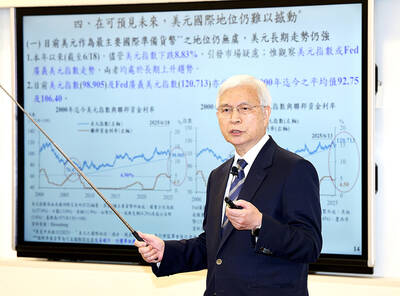
NOT JUSTIFIED: The bank’s governor said there would only be a rate cut if inflation falls below 1.5% and economic conditions deteriorate, which have not been detected The central bank yesterday kept its key interest rates unchanged for a fifth consecutive quarter, aligning with market expectations, while slightly lowering its inflation outlook amid signs of cooling price pressures. The move came after the US Federal Reserve held rates steady overnight, despite pressure from US President Donald Trump to cut borrowing costs. Central bank board members unanimously voted to maintain the discount rate at 2 percent, the secured loan rate at 2.375 percent and the overnight lending rate at 4.25 percent. “We consider the policy decision appropriate, although it suggests tightening leaning after factoring in slackening inflation and stable GDP growth,”


 RSS
RSS