


Shares down 1.66 percent
Taiwanese shares closed down 1.66 percent at an almost two-year low yesterday as the bellwether electronics sector extended losses amid concerns over global demand, dealers said.
The weighted index fell 113.27 points at 6,699.82, off a low of 6,675.09 and a high of 6,811.57, on turnover of NT$92.15 billion (US$2.92 billion).
Yesterday’s closing level was the lowest since mid-September 2006. Losers outnumbered gainers by 1,491 to 506 with 398 stocks unchanged.
President Securities (統一證券) analyst Steven Huang said that as the market falls below the key technical support of 6,700 points, it is possible that the index will test 6,500 points if Wall Street sees additional volatility.
Fujitsu, Nanya end feud
Fujitsu Microelectronics Ltd of Japan and Nanya Technology Corp (南亞科技) of Taiwan yesterday agreed to settle their patent disputes. In a joint statement, the two companies said they have signed a patent licensing agreement with financial arrangements to resolve the disputes.
In August 2005, Fujitsu Microelectronics sued Nanya Technology, accusing the Taiwanese company of infringing its patents involving DRAM chip production. Nanya Technology brought up countersuits against Fujitsu Microelectronics in the US and Japan in September 2006.
Banks lower THSRC interest
Some 20 creditor banks yesterday reached a consensus to lower the interest rate of their NT$279 billion (US$8.79 billion) in syndicated loans to Taiwan High Speed Rail Corp (THSRC, 台灣高鐵) by 0.494 percentage points, the loan’s leading bank, Mega International Commercial Bank (兆豐國際商銀), said in a press statement.
The final rate for the railway company’s loans will be lowered to average 3.9757 percent from the previous average 4.4697 percent, which creditor banks say is reasonable and helps THSRC to improve its finances. Within the syndicated loans, some NT$39.1 billion, however, will still have a higher interest rate of 4.5979 percent, the statement added.
Mega International hopes to officially ink the interest rate cut in a month after the remaining 19 banks finalize yesterday’s consensus.
Taiwan Lottery misses target
Taiwan Lottery Co (台灣彩券公司) will not be able to meet its sales target of NT$75 billion (US$2.36 billion) this year because of sluggish economic conditions, the company said on Monday.
Oliver Shang (尚瑞強), chairman of Taiwan Lottery, said the company has revised its sales target for the year down to NT$72 billion.
Total sales totaled NT$45.3 billion as of the end of last month, he said.
Noting that the fourth quarter is traditionally a high season for lottery ticket sales, Shang said the company should be able to meet its new goal with average monthly sales of NT$6.5 billion to the end of the year.
Despite lower than projected sales, the company expected its operating losses would fall to NT$200 million for this year from last year’s figure of NT$380 million.
Australia cuts rates
Australia’s central bank cut interest rates yesterday for the first time in more than six-and-a-half years, pushing them down 25 basis points to 7 percent amid signs of cooling economic growth
Reserve Bank of Australia Governor Glenn Stevens said the bank had taken the decision at its monthly meeting because financial conditions had become “quite tight” because of rate hikes earlier this year and the global credit squeeze.

The domestic unit of the Chinese-owned, Dutch-headquartered chipmaker Nexperia BV will soon be able to produce semiconductors locally within China, according to two company sources. Nexperia is at the center of a global tug-of-war over critical semiconductor technology, with a Dutch court in February ordering a probe into alleged mismanagement at the company. The geopolitical tussle has disrupted supply chains, with some carmakers reportedly forced to cut production due to chip shortages. Local production would allow Nexperia’s domestic arm, Nexperia Semiconductors (China) Ltd (安世半導體中國), to bypass restrictions in place since October on the supply of silicon wafers — etched with tiny components to

Singapore-based ride-hailing and delivery giant Grab Holdings Ltd has applied for regulatory approval to acquire the Taiwan operations of Germany-based Delivery Hero SE's Foodpanda in a deal valued at about US$600 million. Grab submitted the filing to the Fair Trade Commission on Friday last week, with the transaction subject to regulatory review and approval, the company said in a statement yesterday. Its independent governance structure would help foster a healthy and competitive market in Taiwan if the deal is approved, Grab said. Grab, which is listed on the NASDAQ, said in the filing that US-based Uber Technologies Inc holds about 13 percent of

Taiwan Semiconductor Manufacturing Co (TSMC, 台積電) yesterday received government approval to deploy its advanced 3-nanometer (3nm) process at its second fab currently under construction in Japan, the Ministry of Economic Affairs said in a news release. The ministry green-lit the plan for the facility in Kumamoto, which is scheduled to start installing equipment and come online in 2028 with a monthly production capacity of 15,000 12-inch wafers, the ministry said. The Department of Investment Review in June 2024 authorized a US$5.26 billion investment for the facility, slated to manufacture 6- to 12nm chips, significantly less advanced than 3nm process. At a meeting with
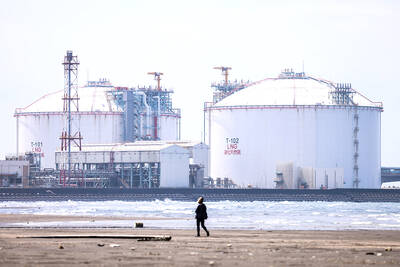
Taiwan is open to joining a global liquefied natural gas (LNG) program if one is created, but on the condition that countries provide delivery even in a scenario where there is a conflict with China, an energy department official said yesterday. While Taiwan’s priority is to have enough LNG at home, the nation is open to exploring potential strategic reserves in other countries such as Japan or South Korea, Energy Administration Deputy Director-General Chen Chung-hsien (陳崇憲) said. While the LNG market does not have a global reserve for emergencies like that of oil, the concept has been raised a few times —


 RSS
RSS