


Chi Mei plans new factory
Chi Mei Optoelectronics Corp (奇美電子), the nation’s second-biggest maker of liquid-crystal displays (LCDs), plans to build a factory in the southern county of Kaohsiung, the local government said.
The LCD maker may spend NT$213 billion (US$7 billion) to build the so-called 10th-generation LCD manufacturing line, the county government said on its Web site yesterday. Construction will begin in the second half of next year, the statement said.
“We are looking for land next to our 8.5-generation plant,” Denis Chen (陳世賢), a spokesman for Tainan-based Chi Mei, said by phone. He declined to elaborate.
Chi Mei would join Sharp Corp and Sony Corp in producing television screens measuring 60 inches (152cm) or larger diagonally. Sony agreed in February to buy 34 percent of a venture that will operate a 10G LCD factory Sharp is building in Sakai City, Japan.
Chi Mei now operates seven LCD plants in Taiwan and is building a so-called 8.5G plant in Kaohsiung that will make LCD TV screens measuring 50 inches and larger diagonally.
Hon Hai downplays reports
Hon Hai Precision Industry Co (鴻海精密) yesterday downplayed media reports about potential loss of business in an ongoing dispute with China’s BYD Electronic (International) Co (比亞迪).
Foxconn International Holdings Ltd (富士康控股), a Hon Hai subsidiary based in Hong Kong, and BYD are currently embroiled in a dispute now being heard in China courts, with the former accusing the latter of stealing trade secrets.
Recent media reports had said that BYD was poaching some Foxconn employees, and that some Foxconn customers were thinking of moving their business to BYD.
“We do not believe the validity of these stories,” Hon Hai said in a statement.
BMW’s China sales boom
Bayerische Motoren Werke AG (BMW), the world’s largest maker of luxury cars, increased sales 28 percent in China in the first half as rising affluence in the world’s fastest-growing major economy spurred demand.
The automaker sold a total of 30,325 BMW and Mini cars in China from January through last month, it said in an e-mailed statement late on Thursday. Sales in Hong Kong, Taiwan and Macau rose 25 percent to 35,468 vehicles during the period, it said.
Munich-based BMW expects record deliveries worldwide this year after selling 1.5 million vehicles last year.
Chip spending may slow: report
Global spending on chip equipment may decline 22 percent this year, more than previously predicted, because of an economic slowdown and a glut of computer memory, Gartner Inc said.
Equipment spending might drop to US$49.2 billion this year, the Stamford, Connecticut-based researcher said on Thursday in an e-mailed statement.
The economic slump, triggered by slowing home sales and a tightening of credit markets, could further reduce chip-equipment demand as consumers forgo purchases of PCs and electronics. Spending on machines that make dynamic random access memory will decrease about 41 percent, Gartner said.
The economy’s condition and memory oversupply together add “significant risk to an already grim forecast for capital equipment,” analyst Klaus Rinnen said in the statement.
NT dollar gains on greenback
The NT dollar rose against the US dollar on the Taipei Foreign Exchange Friday, advancing NT$0.026 to close at NT$30.392.
A total of US$779 million changed hands during the day’s trading.

Taichung reported the steepest fall in completed home prices among the six special municipalities in the first quarter of this year, data compiled by Taiwan Realty Co (台灣房屋) showed yesterday. From January through last month, the average transaction price for completed homes in Taichung fell 8 percent from a year earlier to NT$299,000 (US$9,483) per ping (3.3m²), said Taiwan Realty, which compiled the data based on the government’s price registration platform. The decline could be attributed to many home buyers choosing relatively affordable used homes to live in themselves, instead of newly built homes in the city’s prime property market, Taiwan Realty
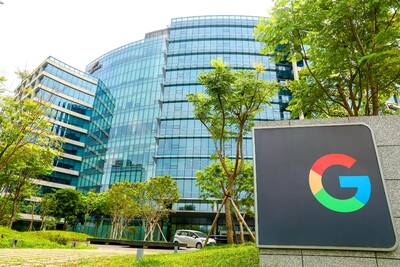
The government yesterday approved applications by Alphabet Inc’s Google to invest NT$27.08 billion (US$859.98 million) in Taiwan, the Ministry of Economic Affairs said in a statement. The Department of Investment Review approved two investments proposed by Google, with much of the funds to be used for data processing and electronic information supply services, as well as inventory procurement businesses in the semiconductor field, the ministry said. It marks the second consecutive year that Google has applied to increase its investment in Taiwan. Google plans to infuse NT$25.34 billion into Charter Investments Ltd (特許投資顧問) through its Singapore-based subsidiary Fructan Holdings Singapore Pte Ltd, and

JET JUICE: The war on Iran’s secondary effects have seen fuel prices skyrocket, knocking flight schedules down to earth in return as airlines struggle with costs Airline passengers should brace for more irritation in the next few months as carriers worldwide cancel flights and ground planes to cope with stratospheric increases in jet-fuel prices. Dutch flag carrier KLM is the latest company to cut its schedule, saying on Thursday that it would scrap 80 return flights at Amsterdam’s Schiphol Airport in the coming month. That puts it in the same league as United Airlines Holdings Inc, Deutsche Lufthansa AG and Cathay Pacific Airways Ltd, which have all pruned itineraries to mitigate costs. Global capacity for next month has been reduced by about 3 percentage points, with all

FORESEEABLE CONSEQUENCES: New technology always comes with new innovations by the iniquitous in exploiting users for financial gain or more nefarious ends Artificial intelligence (AI) “agents” say they can save users time and energy by automating tasks, but the growing power of systems such as OpenClaw is putting cybersecurity experts on edge. Powered by a wave of hype, OpenClaw today says it has more than three million users worldwide. The system allows users to create so-called agents, tools based on a large language model (LLM) such as OpenAI’s ChatGPT or Anthropic PBC’s Claude, that can carry out online tasks. “We’ve moved from an AI you could talk with via a chatbot to an agentic AI, which can take action... the threat and the risks are


 RSS
RSS