


China’s phone companies will merge into three large groups in a sweeping, long-awaited government restructuring of its giant telecommunications market that could lead to billions of dollars in new orders for foreign equipment suppliers.
A plan announced over the weekend calls for energizing competition by bringing together mobile and fixed-line operators.
It says once mergers are complete, licenses for next-generation services will be issued — a step that would require heavy spending on new equipment.
The announcement said mergers were expected to take place as quickly as possible but gave no time frame.
The plan is aimed at creating more robust competitors to China Mobile Ltd (中國移動通信), which dominates China’s market and is the world’s biggest carrier by number of subscribers, with more than 400 million accounts.
It would result in three groups based around the parent companies of China Mobile and fixed-line carriers China Telecom (中國電信) and China Netcom (中國網通).
Fixed-line carriers are struggling to attract new business at a time when first-time customers are passing up traditional service in favor of mobile phones.
China Mobile’s smaller rival, China Unicom (中國聯通), is also struggling to attract users to its network.
The merger plan highlights the communist government’s continued dominant role in the market even after an earlier restructuring that broke up China’s phone monopoly into smaller competitors.
The plan released by China’s telecoms regulator, the Ministry of Information Industry, directly applies to the state-owned parent companies of Chinese carriers. But it is expected to affect subsidiaries that have public shareholders abroad and equipment vendors such as AB LM Ericsson, Alcatel-Lucent SA, China’s Huawei Technologies Co (華為技術) and Nokia Siemens Networks, a partnership between Nokia Corp and Siemens AG.
The plan would have no direct effect on foreign carriers, which are barred from competing in China’s telecoms market.
The mergers would set in motion the awarding of licenses for third-generation (3G) service that supports wireless video, Web surfing and other services, the government statement said.
Nokia and other suppliers are anticipating billions of dollars in orders for 3G equipment.
China has the world’s biggest population of mobile phone users, with some 520 million accounts, and the government says that should reach 600 million soon.
The plan’s rollout began on Friday with the announcement that China Mobile’s parent, China Mobile Communications Corp (中國移動通信集團), will acquire China Railway Communication (鐵通), also known as Tietong.
The plan also calls for China Telecommunications Corp (中國電信集團), parent of China Telecom, China’s main fixed-line carrier, to buy a mobile network from China United Telecommunications Inc (中國聯通), Unicom’s parent company.
The rest of Unicom would be folded into Netcom’s parent, fixed-line China Network Communications Group Corp (中國網絡通信集團公司).
The remaining carrier, China Satellite Communications Corp (中國衛通) would be taken over by China Telecommunications.
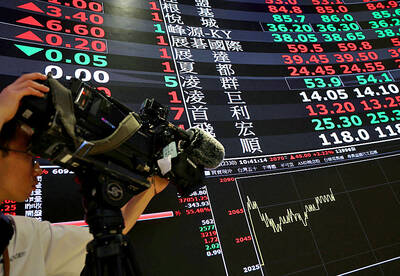
After several years flying high as Asia’s best Nvidia Corp proxy, Taiwan Semiconductor Manufacturing Co (TSMC, 台積電) is increasingly vying with other artificial intelligence (AI) stocks for investor attention. Stock traders are chasing a wider array of beneficiaries as mainstream usage of AI creates demand for hardware beyond the most-advanced chips TSMC makes for Nvidia. Subthemes from the deepening memory crunch to advances in robotics are also luring bids. At the same time, investment caps on single stocks are pushing funds to diversify, while retail investors long familiar with TSMC through its US depositary receipts are being offered a broader set of
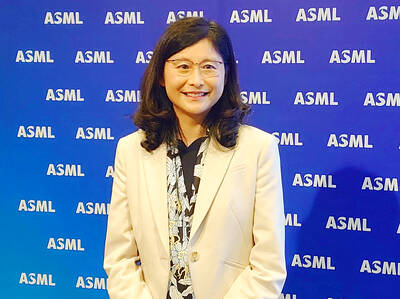
Netherlands-based semiconductor equipment supplier ASML Holding NV yesterday said that it is planning to hire an additional 1,000 people in Taiwan this year in response to growing demand from clients. ASML had previously planned to recruit 600 people this year, but that the plan has been adjusted upward, ASML vice president and ASML Taiwan general manager Grace Wang (汪佳慧) told reporters. ASML has a workforce of more than 4,500 in Taiwan, accounting for about 10 percent of its global total, Wang said. This year’s recruitment campaign would focus on adding people in the customer support, manufacturing and supply chain domains to assist ASML

UNDER MICROSCOPE: Taiwan detained three people who allegedly conspired to buy servers in Taiwan and export them using fraudulent documentation, prosecutors said Nvidia Corp chief executive officer Jensen Huang (黃仁勳) on Saturday urged Super Micro Computer Inc to tighten up on compliance after Taiwan detained three people this week for allegedly making fraudulent declarations about artificial intelligence (AI) servers made by its US partner. The development marked the nation’s first crackdown on semiconductor smuggling, which grew after the US slapped restrictions on exports of high-end chips such as Nvidia AI accelerators to China. Nvidia is “rigorous” in explaining regulations to all of its partners, Huang told reporters after arriving in Taipei. “Ultimately Super Micro has to run their own company,” he said in response to

Nvidia Corp yesterday announced that CEO Jensen Huang (黃仁勳) would attend an employee meeting in Taipei tomorrow to celebrate the launch of the company’s Taiwan headquarters project. Huang would attend a gathering at the site of Nvidia’s planned headquarters in Beitou Shilin Technology Park (北投士林科技園區), the company said in a statement. After arriving in Taiwan on Saturday last week, Huang told reporters that he plans to meet with Quanta Computer Inc (廣達) chairman Barry Lam (林百里) and Taiwan Semiconductor Manufacturing Co (TSMC, 台積電) chairman C.C. Wei (魏哲家), and would attend the groundbreaking ceremony for Nvidia’s Taiwan headquarters tomorrow. Nvidia has not yet applied


 RSS
RSS