


Citibank NA (花旗銀行) yesterday launched a new credit card in cooperation with China Metal Products Group (CMP, 勤美集團) to target buyers at the group's soon-to-be-opened Park Lane (勤美天地) shopping mall in Taichung.
The Park Lane co-branded card offers incentives and benefits such as a six-fold increase in card bonus points, shopping discounts and three-hour free parking at the mall, which is holding its grand opening on Saturday.
Pradeep Pant, director of the bank’s card business, told a media briefing yesterday that the company hoped to contribute to raising the city’s living standards with the inauguration of the new mall
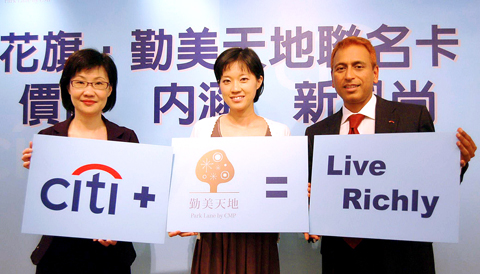
PHOTO: YANG YA-MIN, TAIPEI TIMES
The bank said that among the cities it covers, cardholders in Taichung had the highest frequency of card usage, with 88 percent having used them at least once over the past six months, said Rosy Tsai (蔡淑華), a senior vice president at the bank’s card marketing division.
She added that the bank’s Taichung cardholders ranked next only to Taipei in monthly average spending at NT$8,325 to NT$9,990 — almost three times higher than the industry average of spending per cardholder.
Tsai declined to give a growth estimate for the bank’s new co-brand card, but was upbeat about prospects given the region’s population of 6 million people and its exclusive partnership with CMP in Taichung, which plans to open another smaller mall nearby.
CMP spokesperson Ho Pei-fen (何佩芬) was also optimistic about potential business growth at Park Lane, which cost the firm NT$2.3 billion (US$75.4 million) to build.
“Our two major target customers are young people aged between 20 and 40 and rich, middle-aged women,” Ho said.
Park Lane is a 15-story building, with a floor space of 1,000 ping (3,300m²) per level. It has a four-story basement and parking for 1,100 cars.
CMP hopes to promote an eco-friendly environment through its green lane, which connects the National Museum of National Science and the National Taiwan Museum of Fine Arts. Other than Eslite Bookstore (誠品書店), the mall will also feature name brands such as Level 6ix and X-LARGE.

The domestic unit of the Chinese-owned, Dutch-headquartered chipmaker Nexperia BV will soon be able to produce semiconductors locally within China, according to two company sources. Nexperia is at the center of a global tug-of-war over critical semiconductor technology, with a Dutch court in February ordering a probe into alleged mismanagement at the company. The geopolitical tussle has disrupted supply chains, with some carmakers reportedly forced to cut production due to chip shortages. Local production would allow Nexperia’s domestic arm, Nexperia Semiconductors (China) Ltd (安世半導體中國), to bypass restrictions in place since October on the supply of silicon wafers — etched with tiny components to

Singapore-based ride-hailing and delivery giant Grab Holdings Ltd has applied for regulatory approval to acquire the Taiwan operations of Germany-based Delivery Hero SE's Foodpanda in a deal valued at about US$600 million. Grab submitted the filing to the Fair Trade Commission on Friday last week, with the transaction subject to regulatory review and approval, the company said in a statement yesterday. Its independent governance structure would help foster a healthy and competitive market in Taiwan if the deal is approved, Grab said. Grab, which is listed on the NASDAQ, said in the filing that US-based Uber Technologies Inc holds about 13 percent of

Taiwan Semiconductor Manufacturing Co (TSMC, 台積電) yesterday received government approval to deploy its advanced 3-nanometer (3nm) process at its second fab currently under construction in Japan, the Ministry of Economic Affairs said in a news release. The ministry green-lit the plan for the facility in Kumamoto, which is scheduled to start installing equipment and come online in 2028 with a monthly production capacity of 15,000 12-inch wafers, the ministry said. The Department of Investment Review in June 2024 authorized a US$5.26 billion investment for the facility, slated to manufacture 6- to 12nm chips, significantly less advanced than 3nm process. At a meeting with

Taiwan’s food delivery market could undergo a major shift if Singapore-based Grab Holdings Ltd completes its planned acquisition of Delivery Hero SE’s Foodpanda business in Taiwan, industry experts said. Grab on Monday last week announced it would acquire Foodpanda’s Taiwan operations for US$600 million. The deal is expected to be finalized in the second half of this year, with Grab aiming to complete user migration to its platform by the first half of next year. A duopoly between Uber Eats and Foodpanda dominates Taiwan’s delivery market, a structure that has remained intact since the Fair Trade Commission (FTC) blocked Uber Technologies Inc’s


 RSS
RSS