


The world's biggest observation wheel is ready to start up in Singapore tonight, with corporate clients paying thousands of dollars for the "inaugural flight," the company said.
At 165m, the Singapore Flyer will be 30m higher than Britain's London Eye, said Great Wheel Corp, which built the Singapore attraction.
"We're actually ahead of time and on budget," David Beevers, general manager of the Singapore Flyer, said from the waterfront site. "It's all systems go."
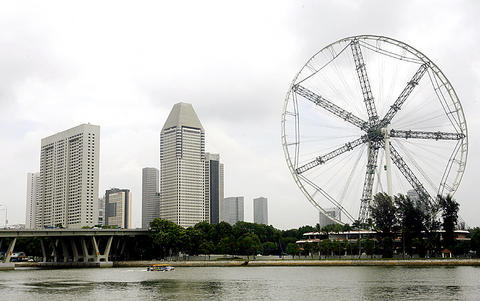
PHOTO: AFP
The wheel will start twirling just before dusk, organizers said.
The attraction's first three nights were sold out, Beevers said. Companies and individuals paid S$8,888 (US$6,271), considered an auspicious number, for the first rides.
"Through the month of February ... it's a whole series of private events each day that's going to allow us to ramp up to full opening March 1 for the public," Beevers said.
Groups of between 600 and 1,000 people were expected at the initial private events, Beevers said, with a formal opening to take place on April 15.
Unlike small Ferris wheel carriages that hang in the open air, the Singapore Flyer and other large observation wheels feature fixed "capsules."
The 28 capsules -- each about the size of a city bus -- are air conditioned and can hold up to 28 people each.
Among the first clients will be SG Private Banking. The French-based global private wealth manager has booked 11 capsules on Wednesday night for its annual staff celebration of the Lunar New Year, said Pierre Baer, the company's Singapore and South Asia chief executive officer.
Developers of the Singapore Flyer said there was no comparison between a giant, slowly rotating observation wheel and a Ferris wheel.
"We don't use the `F-word,'" Florian Bollen, the chairman of Singapore Flyer, told reporters during a preview of the attraction last year.
Bollen's Singapore-based company, Great Wheel Corp, is also building wheels in Beijing and Berlin which will edge out the Singapore Flyer as the world's biggest when they begin turning in about two years, he said.
Singapore's wheel is located across from the Marina Bay Sands casino complex set to open in 2009, and is near the pit area of a Formula One Grand Prix street race to be held for the first time in the city-state in September.
The Singapore Flyer project, worth about S$240 million, is a private venture backed mainly by German investors. But Bollen said it received strong marketing and other support from the city-state's tourism board.
Bollen said that his company was the only bidder for the project designed by Kisho Kurokawa Architects and Associates of Tokyo, along with Singapore's DP Architects.
The wheel was built by Mitsubishi Corp and Takenaka Corp of Japan.

SECOND-RATE: Models distilled from US products do not perform the same as the original and undo measures that ensure the systems are neutral, the US’ cable said The US Department of State has ordered a global push to bring attention to what it said are widespread efforts by Chinese companies, including artificial intelligence (AI) start-up DeepSeek (深度求索), to steal intellectual property from US AI labs, according to a diplomatic cable. The cable, dated Friday and sent to diplomatic and consular posts around the world, instructs diplomatic staff to speak to their foreign counterparts about “concerns over adversaries’ extraction and distillation of US AI models.” Distillation is the process of training smaller AI models using output from larger, more expensive ones to lower the costs of training a powerful new
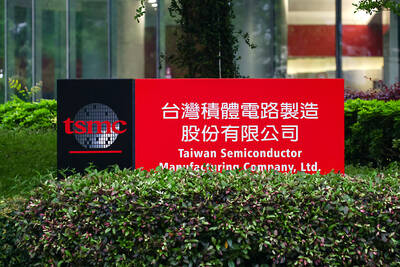
Shares of Taiwan Semiconductor Manufacturing Co (TSMC, 台積電) have repeatedly hit new highs, but an equity analyst said the stock’s valuation remains within a reasonable range and any pullback would likely be technical. The contract chipmaker’s historical price-to-earnings (P/E) ratio has ranged between 20 and 30, Cathay Futures Consultant Co (國泰證期) analyst Tsai Ming-han (蔡明翰) told Central News Agency. With market consensus projecting that TSMC would post earnings per share of about NT$100 (US$3.17) this year, supported by strong global demand for artificial intelligence (AI) applications, and the stock currently trading at a P/E ratio of below 25, Tsai said the valuation
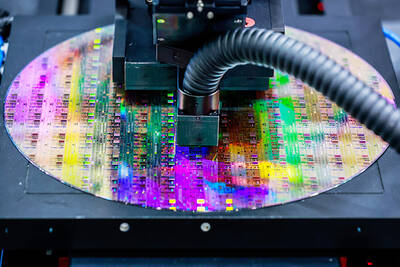
The artificial intelligence (AI) boom has triggered a seismic reshuffling of global equity markets, with Taiwan and South Korea muscling past European nations one by one. With its stock market now valued at nearly US$4.3 trillion, Taiwan surpassed the UK, Europe’s biggest market, earlier this month, data compiled by Bloomberg showed. South Korea is about US$140 billion away from doing the same. The tech-heavy Asian markets have shot past Germany and France in the past seven months. The shift is largely down to massive gains in shares of three companies that provide essential hardware for AI: Taiwan Semiconductor Manufacturing Co (TSMC, 台積電),
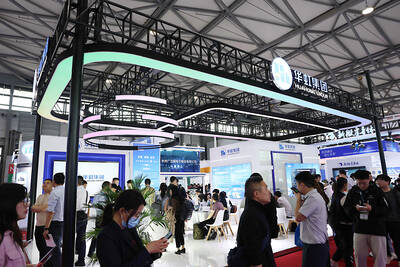
The US Department of Commerce last week ordered multiple chip equipment companies to halt shipments of certain tools to China’s second-largest chipmaker, Hua Hong Semiconductor Ltd (華虹半導體), its latest action to slow the country’s development of advanced chips, two people familiar with the matter said. The department sent letters to at least a handful of companies informing them of restrictions on tools and other materials destined for two Hua Hong facilities US officials believe make China’s most sophisticated chips, the people said. Top US chip equipment companies Lam Research Corp, Applied Materials Inc and KLA Corp, each of which has significant


 RSS
RSS