


Sanyo Electric Co said yesterday it was fully cooperating with an investigation by securities authorities into suspected window-dressing of earnings at the struggling Japanese electronics maker.
Company spokesman Ryo Hagiwara said an investigation was under way but declined to confirm a report yesterday in Japanese newspaper Asahi Shimbun that Sanyo may have falsified its fiscal 2003 earnings report. He would not elaborate.
The Asahi said Sanyo had written off losses of 190 billion yen (US$1.6 billion) at its subsidiaries, but reported the losses as 50 billion yen. The Osaka-based company may have falsely reported a profit when it was in the red, it said.
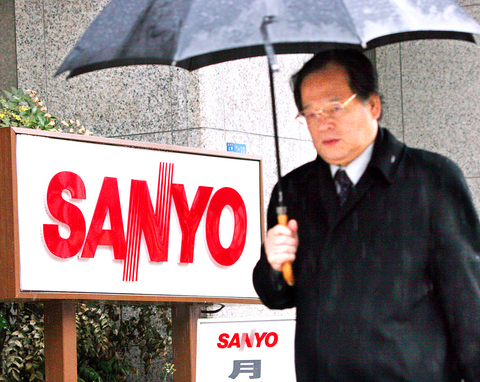
PHOTO: AFP
Such differences have been corrected over the years, and the company's recent earnings reports are not false, the report said.
Sanyo shares plunged 21 percent to close at 181 yen in Tokyo on the Asahi report.
If the report is true, "there is a possibility the company will be fined," Yuji Yamamoto, Japan's minister for financial services, told reporters in Tokyo yesterday after a Cabinet meeting.
The probe follows recent news of dubious accounting at some Japanese companies which raised questions about whether the world's second-largest economy is keeping pace with global market standards.
In a high-profile court case, former executives at Internet services company Livedoor Co are on trial on charges of falsifying earnings. Major Japanese brokerage Nikko Cordial Corp was fined by securities authorities in December for manipulating profits.
The latest investigation is a blow to Sanyo at a time when it has been struggling to turn around its business, trimming thousands of jobs, reducing factory space and dropping some businesses since announcing a restructuring plan in 2004.
It got a much-needed capital boost a year ago from a group of investors led by Goldman Sachs Group Inc, which became the company's top shareholders and took over the board, joined with Daiwa Securities SMBC Co and Sumitomo Mitsui Financial Group Inc to invest 300 billion yen in Sanyo in January last year in return for management control.
"Our support to Sanyo will remain the same," said Tetsu Morishima, a spokesman for Sumitomo Mitsui, which contributed 50 billion yen to Sanyo's bailout. He declined to comment on possible penalties.
Securities and Exchange Surveillance Commission spokesman Noboru Takayama declined comment, saying the watchdog does not comment on ongoing individual cases.
Sanyo is forecasting around a 50 billion yen loss for the fiscal year through next month.
Like other Japanese electronics makers, Sanyo has been battered in recent years by competition from cheaper Asian rivals. Its performance was also hurt by a 2004 earthquake near its chipmaking plant.
Sanyo has repeatedly promised a turnaround under what has been billed as innovative management headed by former journalist Tomoyo Nonaka, who became chairman and chief executive in 2005, one of a handful of star female chief executives at major Japanese companies.
Nonaka, who joined the company's board in 2002, was appointed with Toshimasa Iue, grandson of Sanyo's founder, who became president.

The domestic unit of the Chinese-owned, Dutch-headquartered chipmaker Nexperia BV will soon be able to produce semiconductors locally within China, according to two company sources. Nexperia is at the center of a global tug-of-war over critical semiconductor technology, with a Dutch court in February ordering a probe into alleged mismanagement at the company. The geopolitical tussle has disrupted supply chains, with some carmakers reportedly forced to cut production due to chip shortages. Local production would allow Nexperia’s domestic arm, Nexperia Semiconductors (China) Ltd (安世半導體中國), to bypass restrictions in place since October on the supply of silicon wafers — etched with tiny components to

Singapore-based ride-hailing and delivery giant Grab Holdings Ltd has applied for regulatory approval to acquire the Taiwan operations of Germany-based Delivery Hero SE's Foodpanda in a deal valued at about US$600 million. Grab submitted the filing to the Fair Trade Commission on Friday last week, with the transaction subject to regulatory review and approval, the company said in a statement yesterday. Its independent governance structure would help foster a healthy and competitive market in Taiwan if the deal is approved, Grab said. Grab, which is listed on the NASDAQ, said in the filing that US-based Uber Technologies Inc holds about 13 percent of

Taiwan Semiconductor Manufacturing Co (TSMC, 台積電) yesterday received government approval to deploy its advanced 3-nanometer (3nm) process at its second fab currently under construction in Japan, the Ministry of Economic Affairs said in a news release. The ministry green-lit the plan for the facility in Kumamoto, which is scheduled to start installing equipment and come online in 2028 with a monthly production capacity of 15,000 12-inch wafers, the ministry said. The Department of Investment Review in June 2024 authorized a US$5.26 billion investment for the facility, slated to manufacture 6- to 12nm chips, significantly less advanced than 3nm process. At a meeting with

Taiwan’s food delivery market could undergo a major shift if Singapore-based Grab Holdings Ltd completes its planned acquisition of Delivery Hero SE’s Foodpanda business in Taiwan, industry experts said. Grab on Monday last week announced it would acquire Foodpanda’s Taiwan operations for US$600 million. The deal is expected to be finalized in the second half of this year, with Grab aiming to complete user migration to its platform by the first half of next year. A duopoly between Uber Eats and Foodpanda dominates Taiwan’s delivery market, a structure that has remained intact since the Fair Trade Commission (FTC) blocked Uber Technologies Inc’s


 RSS
RSS