


Japan yesterday bade farewell to Momofuku Ando, known as the inventor of instant noodles that have become a global household product, after he died aged 96.
Ando died of acute heart failure on Friday, said Nissin Food Products Co, the company he founded in 1948 in the aftermath of World War II and built into a multi-billion dollar empire.
Japanese newspapers published lengthy obituaries of the businessman yesterday with the influential Asahi Shimbun praising him for bringing "instant noodles to the world and into space."
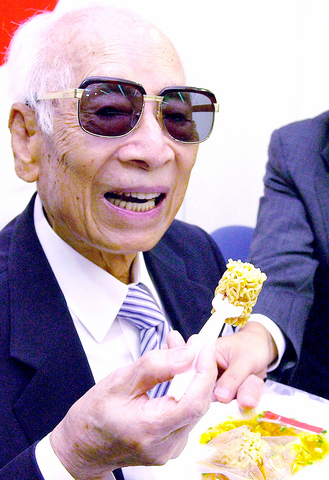
PHOTO: AP
The mass-circulation Yomiuri Shimbun said Ando started from scratch in developing an instant noodle which has "grown with the age of mass consumption" and added "a new chapter in the history of the world's food culture."
Born Wu Bai-fu (
After founding the precursor of Nissin, Ando put on the market "Chicken Ramen," the first instant noodle product, in 1958. The chicken-flavored dried noodle cake could be served in minutes by pouring hot water over it in a bowl.
He invented the product, which soon became a hit, at a time when his business ventures were in trouble. As managing director of a credit union that went bankrupt, he had given up his assets to cover the debt.
In his biography, Ando said he was inspired to develop the product when he saw a long line of people waiting to buy a steaming soup noodle at a black market stall in a war-ravaged city.
"Peace prevails when food suffices," he said.
Sales of Chicken Ramen rocketed after Japan's number-one general trading house Mitsubishi Corp was commissioned in 1959 to help promote the product as the country was taking off on its rapid post-war industrialization.
In 1970, Nissin established its US subsidiary, Nissin Foods (USA) Inc, and in the next year launched the "Cup Noodle," a pre-cooked slab of noodles in a waterproof styrofoam container.
Nissin has led the global instant noodle industry which sells 85.7 billion servings each year. Nissin's annual sales of instant noodles amount to 10 billion single servings in 10 countries.
Ando opened a museum of instant Ramen in Osaka in 1999 and retired from the chairman's post in 2005 to serve in an honorary role as founder-chairman.
In 2005, Nissin supplied a vacuum packed instant noodle or "Space Ram" to Japanese astronaut Soichi Noguchi aboard the US space shuttle Discovery.
"It is like a dream that people from rivaling countries can eat Ramen together in space," Ando told reporters at that time.
According to the Mainichi Shimbun, Ando was last seen in public on Wednesday when he made a New Year's speech at Nissin's head office in Osaka and had a lunch with executives, a bowl of Chicken Ramen with rice cake.

The domestic unit of the Chinese-owned, Dutch-headquartered chipmaker Nexperia BV will soon be able to produce semiconductors locally within China, according to two company sources. Nexperia is at the center of a global tug-of-war over critical semiconductor technology, with a Dutch court in February ordering a probe into alleged mismanagement at the company. The geopolitical tussle has disrupted supply chains, with some carmakers reportedly forced to cut production due to chip shortages. Local production would allow Nexperia’s domestic arm, Nexperia Semiconductors (China) Ltd (安世半導體中國), to bypass restrictions in place since October on the supply of silicon wafers — etched with tiny components to

Singapore-based ride-hailing and delivery giant Grab Holdings Ltd has applied for regulatory approval to acquire the Taiwan operations of Germany-based Delivery Hero SE's Foodpanda in a deal valued at about US$600 million. Grab submitted the filing to the Fair Trade Commission on Friday last week, with the transaction subject to regulatory review and approval, the company said in a statement yesterday. Its independent governance structure would help foster a healthy and competitive market in Taiwan if the deal is approved, Grab said. Grab, which is listed on the NASDAQ, said in the filing that US-based Uber Technologies Inc holds about 13 percent of

Taiwan Semiconductor Manufacturing Co (TSMC, 台積電) yesterday received government approval to deploy its advanced 3-nanometer (3nm) process at its second fab currently under construction in Japan, the Ministry of Economic Affairs said in a news release. The ministry green-lit the plan for the facility in Kumamoto, which is scheduled to start installing equipment and come online in 2028 with a monthly production capacity of 15,000 12-inch wafers, the ministry said. The Department of Investment Review in June 2024 authorized a US$5.26 billion investment for the facility, slated to manufacture 6- to 12nm chips, significantly less advanced than 3nm process. At a meeting with

Taiwan’s food delivery market could undergo a major shift if Singapore-based Grab Holdings Ltd completes its planned acquisition of Delivery Hero SE’s Foodpanda business in Taiwan, industry experts said. Grab on Monday last week announced it would acquire Foodpanda’s Taiwan operations for US$600 million. The deal is expected to be finalized in the second half of this year, with Grab aiming to complete user migration to its platform by the first half of next year. A duopoly between Uber Eats and Foodpanda dominates Taiwan’s delivery market, a structure that has remained intact since the Fair Trade Commission (FTC) blocked Uber Technologies Inc’s


 RSS
RSS