


Question: Do you plan to expand First Financial Holding Co (
Michael Chang (張兆順): We plan to beef up our share in the banking market by assets to 10 percent through organic growth and acquisitions over the next three years.
This means that we need to boost the bank's assets to NT$2.6 trillion (US$80.5 billion) from the current NT$1.7 trillion within the planned timeframe, and M&A is the best and fastest way to achieve it.
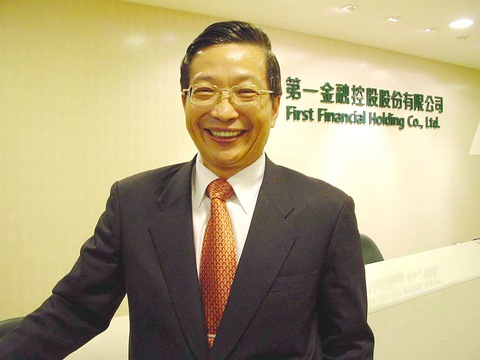
PHOTO: CHEN LI-CHU, TAIPEI TIMES
We conducted several acquisition evaluations this year and made preliminary contact with several consumer banking prospects.
But the talks did not go any further, as the prices and premium that they were asking for were too high, especially after Standard Chartered Bank acquired Hsinchu International Bank (新竹國際商銀) at NT$24.5 per share in September.
Even so, we will continue to look into M&A opportunities next year.
Taking over troubled banks is not an option, since we want to enhance our return on equity (ROE) to 15 percent from the current 13 percent. Our foreign investors have also expressed their concern in this regard.
We prefer targets of complementary strength in wealth management and the treasury marketing business, the two areas that we are eager to develop and are critical to our future growth. The market size of derivatives trading, for instance, is estimated to reach NT$7.3 trillion in Taiwan, while First commercial currently has only NT$90 billion in this business line. There is huge room for us to grow.
Q: First Financial is forming a joint venture with Aviva Plc, the biggest insurer in the UK, to enter Taiwan's bancassurance market by the end of this month. Will you extend the strategic alliance into equity investment in First Financial?
Chang: We are not in any equity investment talks at the moment. The alliance is simply designed to set up an insurance joint venture.
The startup is expected to help us break into the nation's life insurance market and further into the development of pension fund products that can enhance our wealth management business.
The potential for pension planning product business is massive, considering the fact that the scale of the nation's pension fund is increasing by NT$8 billion per month, or nearly NT$100 billion per year.
Q: Do you have any plan to introduce international strategic investors?
Chang: We welcome purely financial investors, either local or international, who are stable and not looking for speculative gains.
We will continue to lure foreign investors with our earnings performance and plan to boost their shareholding in the company from the current 15 percent.
I will go on my first overseas tour since taking over the helm last year in Hong Kong and Singapore next week.
First Bank has a solid performance compared to rivals, with net income reaching NT$9.9 billion for the first eleven months of this year and lending balance rising to NT$940.6 billion from NT$869.1 billion with a net interest margin of 2.05 percent.
Q: What are your overseas development plans?
Chang: We have obtained a green light from the Financial Supervisory Commission to set up our first branch in Australia where sees robust overseas Taiwanese investment. The bank will tender the application to the Australian regulator three to four months from now and we expect the branch to be opened next year or 2008.
We are also planning to get a foothold in Canada and India in the future. We have just sent two people to conduct an on-site evaluation in Mumbai and Delhi in India. Our US subsidiary is opening more branches next year on the top of the current five outlets across the country.
Our expansion of overseas networks is tied to providing our Taiwanese corporate clients with global financial services. We have seen decent returns from our overseas operations -- income increased 25.63 percent this year over last year.
Q: Since the bank has set up a representative office in Shanghai, what is your blueprint for China's market?
Chang: We do have a plan for the Greater Chinese markets that comprises Taiwan, Hong Kong and Vietnam, and have identified hundreds of key customers to be closely tracked in order to boost our business in this aspect.

Singapore-based ride-hailing and delivery giant Grab Holdings Ltd has applied for regulatory approval to acquire the Taiwan operations of Germany-based Delivery Hero SE's Foodpanda in a deal valued at about US$600 million. Grab submitted the filing to the Fair Trade Commission on Friday last week, with the transaction subject to regulatory review and approval, the company said in a statement yesterday. Its independent governance structure would help foster a healthy and competitive market in Taiwan if the deal is approved, Grab said. Grab, which is listed on the NASDAQ, said in the filing that US-based Uber Technologies Inc holds about 13 percent of

The domestic unit of the Chinese-owned, Dutch-headquartered chipmaker Nexperia BV will soon be able to produce semiconductors locally within China, according to two company sources. Nexperia is at the center of a global tug-of-war over critical semiconductor technology, with a Dutch court in February ordering a probe into alleged mismanagement at the company. The geopolitical tussle has disrupted supply chains, with some carmakers reportedly forced to cut production due to chip shortages. Local production would allow Nexperia’s domestic arm, Nexperia Semiconductors (China) Ltd (安世半導體中國), to bypass restrictions in place since October on the supply of silicon wafers — etched with tiny components to

Taiwan Semiconductor Manufacturing Co (TSMC, 台積電) yesterday received government approval to deploy its advanced 3-nanometer (3nm) process at its second fab currently under construction in Japan, the Ministry of Economic Affairs said in a news release. The ministry green-lit the plan for the facility in Kumamoto, which is scheduled to start installing equipment and come online in 2028 with a monthly production capacity of 15,000 12-inch wafers, the ministry said. The Department of Investment Review in June 2024 authorized a US$5.26 billion investment for the facility, slated to manufacture 6- to 12nm chips, significantly less advanced than 3nm process. At a meeting with

Taiwan’s food delivery market could undergo a major shift if Singapore-based Grab Holdings Ltd completes its planned acquisition of Delivery Hero SE’s Foodpanda business in Taiwan, industry experts said. Grab on Monday last week announced it would acquire Foodpanda’s Taiwan operations for US$600 million. The deal is expected to be finalized in the second half of this year, with Grab aiming to complete user migration to its platform by the first half of next year. A duopoly between Uber Eats and Foodpanda dominates Taiwan’s delivery market, a structure that has remained intact since the Fair Trade Commission (FTC) blocked Uber Technologies Inc’s


 RSS
RSS