


BenQ Corp (
This global dream remains elusive, though not for want of trying. Taking what seemed like a short cut by absorbing the loss-making mobile phone unit of well-known Siemens AG last October did not have the desired effect for BenQ. Instead, it has become a colossal burden to the company's operation, as most experts warned.
"The merger was doomed to be a flop," said Wang Deng-cheng (
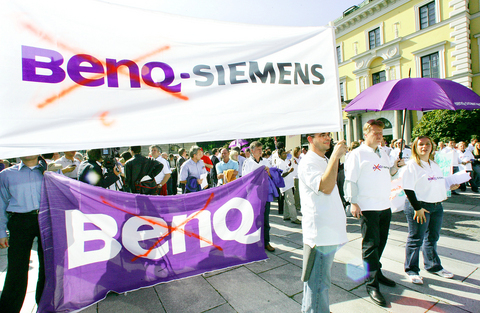
PHOTO: AP
Not a single company in the world, even century-old Siemens of Germany, would be able to revive a company with massive 150 million euros to 200 million euros (US$190 million to US$254 million) in quarterly losses as BenQ Mobile tried to do, Wang said.
The analyst's remark came a day after BenQ, Taiwan's top mobile phone maker, announced on Thursday night that it would file for insolvency protection for its German handset unit, BenQ Mobile GmbH & Co OHG, at the local court in Munich as the firm has no intention of injecting further capital into the unit.
Over the past three quarters, BenQ has booked a loss of about 600 million euros (NT$25.165 billion) resulting from BenQ Mobile, which is comparable to the company's total capital of NT$26.25 billion (US$794 million).
"It was a painful decision that had to be made to safeguard the interests of BenQ's shareholders and investors," Lee told reporters on Thursday in the company's Taipei headquarters, with the signs of both disappointment and regret written on his face.
"We have missed the targets we set previously and we don't expect it to be easy to limit the losses in the short term," Lee said, adding that the company's board believed it would be unlikely that the firm would break even in the middle of next year, as it forecast last month.
Lee blamed constant postponements in the launch of new products in the short life cycle handset industry, as well as an uncompetitive cost structure, as the main reasons behind the company's failure to rein in mounting losses.
The company's decision to sever its financial ties with the German handset unit to stem losses, as well as plans to review financial positions at its handset units in Brazil and other locations, received investors' support yesterday.
Shares of BenQ jumped to almost their 7 percent daily-limit to close at NT$19.45 on the Taiwan Stock Exchange, better than the decline of 0.03 percent in the benchmark TAIEX Index. Even so, the company's share price has been battered by nearly 45 percent so far this year.
Vincent Chen (陳豊丰), who tracks the handset sector for CLSA Ltd in Taipei, yesterday upgraded his rating on BenQ to "out-perform" from "under-perform."
"It sounds like a good exit plan leading to a fast turnaround," Chen said in a report released yesterday.
BenQ Mobile's plan to seek insolvency protection would help BenQ to turn around in the fourth quarter of this year, or the first quarter of next year, a year earlier than expected, Chen said.
Saying he agreed with BenQ's decision to put BenQ Mobile into the hands of the German government, Chen also raised the target price to NT$21.5 over the next 12 months from its previous NT$18.6, implying about an 11 percent upside from yesterday's closing price.
Taiwan Ratings Corp (
BenQ said the firm would continue to sell BenQ-Siemens brand cellular phones, but would divert its focus back to its familiar Asian markets. With the German handset operation possibly under receivership in the final quarter, the company expected the fourth-quarterly loss would improve significantly as the firm would not have to cope with a massive loss from BenQ Mobile.
"BenQ will go back to its previous operation pattern, in terms of balance sheet, [after fixing BenQ Mobile through legal action]," said financial executive Eric Yu (游克用).
Though BenQ would stop booking huge losses soon, the company would face many challenges in operating its own-brand business, Yuanta Pacific Securities' Wang said.
Wang said he was concerned about whether BenQ would have the right to sell phones under the BenQ-Siemens brand name as it claimed without breaking the takeover agreements with Siemens.
Besides, unions representing 3,000 workers in Germany could hold large-scale protests against any possible closure of factories after the court's receivership, Wang said.
According to BenQ, some 1,400 employees in Munich as well as 1,600 at the Bocholt and Kamp-Lintfort sites in North-Rhine-Westphalia would be affected by the insolvency protection action and protests were held yesterday.

Cairo’s new monorail slices across the city skyline, running above the familiar chaos of blaring horns and aging buses’ exhaust fumes that mark rush hour below. The US$4.5 billion monorail, opened this month, is among Egypt’s most prominent new transport projects, part of a debt-funded infrastructure drive criticized for sapping state finances while bringing limited benefits to most of the country’s 109 million people. “It feels like you’re in a different country,” said Ramy Sayed, a restaurant manager, aboard a driverless Innovia 300 train. “No noise, no traffic, we’re not used to this.” The eastern line runs 56km from the bustling middle-class

Taiwanese firms have increased investment in the Philippines in recent years as Manila’s ties with Washington deepen and global supply chains continue to shift away from China, an expert at the Chung-Hua Institution for Economic Research (CIER, 中華經濟研究院) said yesterday. The Philippines had not been among Taiwanese investors’ top choices in Southeast Asia, CIER Taiwan ASEAN Studies Center director Kristy Hsu (徐遵慈) said at a seminar in Taipei. However, Taiwan’s investment in the country has grown significantly since the COVID-19 pandemic, reaching US $257 million last year, a high in recent years, she said. Although Taiwan’s total investment in the Philippines still lags

Intel Corp regards Taiwan Semiconductor Manufacturing Co (TSMC, 台積電) as a longstanding partner, as the US chipmaker would continue outsourcing production of advanced chips to TSMC, Intel chief executive officer Lip-Bu Tan (陳立武) said yesterday. “I don’t look at people as competitors. I look at the collaboration... Nvidia is also, you know, a good friend,” Tan told a news conference following his keynote speech at the Computex trade show in Taipei. “It’s a very trusted partnership for us... We are a big, top customer for them, and we’re going to continue doing that,” he said, referring to TSMC, the world’s largest foundry

Artificial intelligence (AI) agents would supplant smartphones as the center of people’s digital lives, fundamentally reshaping personal devices and driving a major computing upgrade cycle, Qualcomm Inc CEO Cristiano Amon said yesterday. In his keynote speech for this year’s Computex trade show in Taipei, Amon said that the rise of "agentic AI" — AI systems capable of reasoning, planning and carrying out tasks autonomously — would transform how people interact with technology across phones, PCs, vehicles and wearable devices. Describing the technology as the next major evolution in computing, Amon said that "2026 is the year of agents.” For decades, smartphones have sat


 RSS
RSS