


Evergreen Aviation Technologies Corp (EGAT, 長榮航太) yesterday unveiled its first converted cargo jet for Boeing Co, marking a breakthrough in the nation's aviation industry.
"It was a tough task for us as the jet modifications involved a large number of components and there was a pressing timeline for completion," EGAT chairman David Wang (王宜恭) said in a rollout ceremony at CKS Airport in Taoyuan.
In February last year, EGAT signed a deal with the US aerospace giant to convert three Boeing 747-400 passenger jets into 747-400 Large Cargo Freighters, marking the first such contract for the local aviation industry.
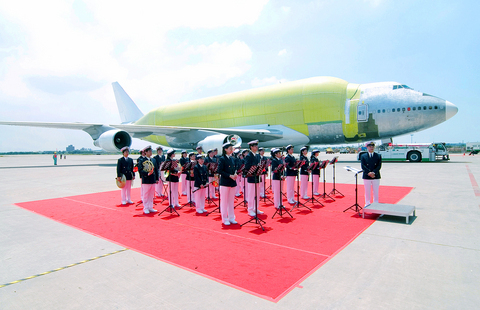
PHOTO: AP
Modifications for the second jet will be completed by the end of the year, while the third will be finished next year, according to Wang.
The converted cargo jets are said to be capable of carrying more cargo than other freighters, with a volume of 1,840m3, three times the size of the original Boeing 747-400 jet.
The modified jets also boast a unique "swing tail" design that allows fast, easy loading and unloading of the huge cargoes.
The aircraft will allow cargo delivery times to be drastically reduced, the companies said.
Over the next four years, the new cargo freighters will be used to transport to transport giant-sized Boeing 787 "Dreamliner" assemblages from around the world to the assembly site of the new aircraft in Everett, Washington.
Depending on the model, the mid-size Boeing 787s are able to carry between 210 to 330 passengers on routes of 5,000km to 16,000km.
The first Dreamliner -- which is competing with the delayed Airbus A350 -- will come out next year, with delivery and service expected in 2008.
Since the 787 program was launched in April 2004, 32 airlines have placed 424 orders with a value of US$59 billion, according to Boeing.
"This is the most successful and largest launch of a new commercial aircraft [in Boeing's history]," said Scott Strode, Boeing 787 vice president of airplane development and production.
He said the fleet of three cargo jets from EGAT will be able to meet supplies for the 787 during over the next few years, and the company will evaluate more possible orders depending on future demand for 787.

Singapore-based ride-hailing and delivery giant Grab Holdings Ltd has applied for regulatory approval to acquire the Taiwan operations of Germany-based Delivery Hero SE's Foodpanda in a deal valued at about US$600 million. Grab submitted the filing to the Fair Trade Commission on Friday last week, with the transaction subject to regulatory review and approval, the company said in a statement yesterday. Its independent governance structure would help foster a healthy and competitive market in Taiwan if the deal is approved, Grab said. Grab, which is listed on the NASDAQ, said in the filing that US-based Uber Technologies Inc holds about 13 percent of

The domestic unit of the Chinese-owned, Dutch-headquartered chipmaker Nexperia BV will soon be able to produce semiconductors locally within China, according to two company sources. Nexperia is at the center of a global tug-of-war over critical semiconductor technology, with a Dutch court in February ordering a probe into alleged mismanagement at the company. The geopolitical tussle has disrupted supply chains, with some carmakers reportedly forced to cut production due to chip shortages. Local production would allow Nexperia’s domestic arm, Nexperia Semiconductors (China) Ltd (安世半導體中國), to bypass restrictions in place since October on the supply of silicon wafers — etched with tiny components to

Taiwan Semiconductor Manufacturing Co (TSMC, 台積電) yesterday received government approval to deploy its advanced 3-nanometer (3nm) process at its second fab currently under construction in Japan, the Ministry of Economic Affairs said in a news release. The ministry green-lit the plan for the facility in Kumamoto, which is scheduled to start installing equipment and come online in 2028 with a monthly production capacity of 15,000 12-inch wafers, the ministry said. The Department of Investment Review in June 2024 authorized a US$5.26 billion investment for the facility, slated to manufacture 6- to 12nm chips, significantly less advanced than 3nm process. At a meeting with

Taiwan’s food delivery market could undergo a major shift if Singapore-based Grab Holdings Ltd completes its planned acquisition of Delivery Hero SE’s Foodpanda business in Taiwan, industry experts said. Grab on Monday last week announced it would acquire Foodpanda’s Taiwan operations for US$600 million. The deal is expected to be finalized in the second half of this year, with Grab aiming to complete user migration to its platform by the first half of next year. A duopoly between Uber Eats and Foodpanda dominates Taiwan’s delivery market, a structure that has remained intact since the Fair Trade Commission (FTC) blocked Uber Technologies Inc’s


 RSS
RSS