


Despite heavy rain last Tuesday afternoon, Taipei Harbor was bustling as staff from Ford Lio Ho Motor Co (福特六和) were busy entertaining more than 300 guests at its vehicle-export ceremony.
It was a big day for the nation's fourth largest automaker, as laid out on the harbor were nearly 500 Ford Escape and Mazda Tribute sports utility vehicles (SUVs) -- the company's first batch of locally assembled cars to be exported.
Ringo Lin (林棟樑), the vice president of Ford Lio Ho's manufacturing division, was one of the high-ranking company officials overwhelmed by congratulations from attendees.
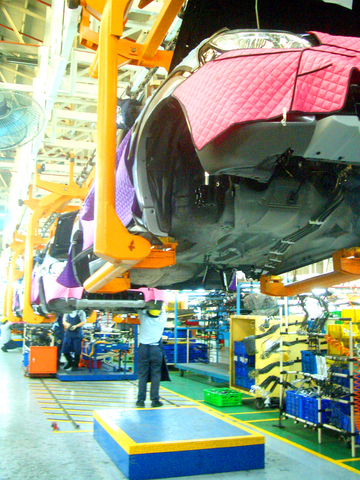
PHOTO: JASON TAN, TAIPEI TIMES
"Our efforts have finally borne fruit after 30 months of preparation," Lin later told the media during a tour of the Chungli City facility on Thursday to showcase the manufacturing process of the SUVs.
The export signified the first time made-in-Taiwan vehicles had entered the markets of developed countries including Japan, Australia and New Zealand, where much stricter car export regulations and evaluation procedures are imposed, he said.
Stringent standards
Exporting into these countries means that Ford Lio Ho's cars are on par with stringent international standards, Lin added.
With the first batch of SUVs shipped last week, the company said that it will send a total of 10,000 units to these markets within the next year.
Company president Jeffrey Shen (沈英銓) was also excited about the company's achievement.
"The export crowned our efforts at bringing Taiwan's auto industry into the world market," Shen said.
This will help raise the export values of the local auto industry, and increase its competitiveness on the global stage, he added.
The move also reflects Ford Lio Ho's ambition in playing an aggressive role in the Asia-Pacific auto industry, especially in view of rising threats from Chinese rivals.
There were 3.1 million new cars sold in China last year. In the first three months of this year, new car sales topped 890,000 units, a 74 percent increase over the first quarter of last year, China's Xinhua news agency reported.
Beijing wants local companies to fight for market share by developing their own designs, and to aggressively boost exports of cars and components by 40 percent annually to reach US$70 billion by 2010.
In contrast, the Taiwanese car market has shown signs of sluggishness.
Though the nation's market smashed a 10-year record last year to hit 514,626 new cars, sales for the first five months of this year plunged 24.5 percent over the same period last year to just 174,263 units, according to figures from the Ministry of Transportation and Communications.
"Moving into the Chinese market is not the only answer for us as every part of the region has its own role to play," Shen said.
Asian hub
Ford Lio Ho has therefore positioned itself as the Asian hub of its US partner Ford Motor Co, in terms of vehicle design, research and development (R&D) as well as manufacturing, he said.
Ford Lio Ho is 70-percent owned by Ford Motor, which also controls the Mazda brand along with Volvo, Land Rover and Jaguar.
To begin with, the design of the exported Escape SUVs borrowed some ideas from the Equator concept car.
The concept car, which was well received at the Tokyo Motor Show last year, was a product conceived by the design team at Ford Lio Ho's local design and R&D center, established in 2002.
Meanwhile, China Motor Corp (中華汽車), the nation's second largest automaker, has long acknowledged that export is the way to go if manufacturers intend to maintain profitability amid a saturated domestic market.
The company started to export its Veryca/Varica commercial trucks as early as 1994, which have shown steady sales in the Americas, Southeast Asia and Africa.
The trucks also gained a foothold in markets such as Saudi Arabia and Syria this year.
Simultaneously, the maker also sent 80 Mitsubishi Grunder large-sized sedans to the Philippines during the first quarter of this year, and there will be another 50 units exported in July, according to China Motor spokesman Hsu Li-min (許利民).
Around 600 units of the maker's Space Gear minivans have also been sold each year to the Philippines since 2004, he added.
Other markets
"We are now studying whether to expand exports of the Grunder and Space Gear to other markets including Russia, Middle East and South Americas," Hsu said.
He did not rule out the possibility that Town & Country minivans may be the next model to be exported.
Officially available this month, the minivan is the first locally assembled car from US maker Chrysler Group's partnership with China Motor, which has vowed to increase the revenue contribution of exports from its current 20 percent to 40 percent by next year to hit NT$20 billion (US$625 million).
Yulon Nissan Motor Co (
"Discussions with related partners have been ongoing for some time but it is not feasible for us in the near term," said the company's acting spokesperson Hsieh Ting-lin (謝汀麟).
Any exports will need to be tied in with the strategies of its Japanese partner Nissan Motor Corp, he added.
For now, Yulon Nissan -- whose Yulon Nissan Asian Design Center was established in 2003 and is one of Nissan Motor's seven global design centers -- will continue to leverage its role in its partner's worldwide design chain to increase the company's strategic positioning in Asia, he said.

Taiwanese firms have increased investment in the Philippines in recent years as Manila’s ties with Washington deepen and global supply chains continue to shift away from China, an expert at the Chung-Hua Institution for Economic Research (CIER, 中華經濟研究院) said yesterday. The Philippines had not been among Taiwanese investors’ top choices in Southeast Asia, CIER Taiwan ASEAN Studies Center director Kristy Hsu (徐遵慈) said at a seminar in Taipei. However, Taiwan’s investment in the country has grown significantly since the COVID-19 pandemic, reaching US $257 million last year, a high in recent years, she said. Although Taiwan’s total investment in the Philippines still lags
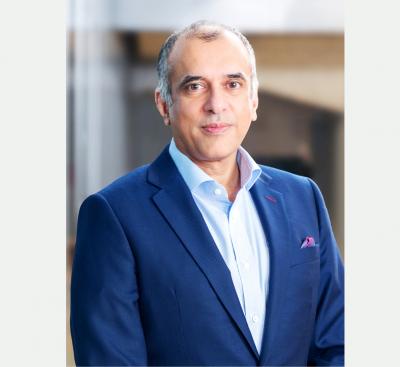
HSBC Holdings PLC is deepening its commitment to Taiwan as the economy emerges as one of the bank’s fastest-growing markets globally, driven by an artificial intelligence (AI) investment boom, expanding cross-border trade, and rising wealth creation. “The advantage that Taiwan has is a growth story linked to the semiconductor and broader AI industries, strong underlying corporate performance, and wealth creation,” said Surendra Rosha, HSBC’s co-chief executive for Asia and the Middle East, in an exclusive interview with the Taipei Times on June 2, during this year’s HSBC Taiwan Conference. That combination has helped HSBC cement its position as the most profitable international

Intel Corp regards Taiwan Semiconductor Manufacturing Co (TSMC, 台積電) as a longstanding partner, as the US chipmaker would continue outsourcing production of advanced chips to TSMC, Intel chief executive officer Lip-Bu Tan (陳立武) said yesterday. “I don’t look at people as competitors. I look at the collaboration... Nvidia is also, you know, a good friend,” Tan told a news conference following his keynote speech at the Computex trade show in Taipei. “It’s a very trusted partnership for us... We are a big, top customer for them, and we’re going to continue doing that,” he said, referring to TSMC, the world’s largest foundry
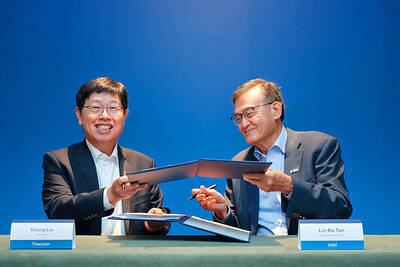
Hon Hai Precision Industry Co (鴻海精密) yesterday said it would work with US chipmaker Intel Corp to jointly develop and deploy next-generation artificial intelligence (AI) infrastructure and intelligent computing platforms in a move to capture booming demand for AI computing systems. Hon Hai, also known as Foxconn Technology Group (富士康), said in a statement that the partnership would combine its global manufacturing scale, system integration expertise and AI data center deployment capabilities with Intel’s strengths in processor architecture, silicon technologies and software ecosystem. The companies said they plan to work on equipment used in AI data centers, including server racks powered by


 RSS
RSS