


Her blog has received more than 24 million hits since its inception in October 2003. That makes Wan Wan (彎彎), the pen name by which she's known, one of the most famous blog writers in Taiwan.
Her real name is Wany Hu (胡家瑋), and she is described by her fans and media reports as the "little heavenly queen of blogs." The amusing cartoon figures she creates, known for their apt portrayal of office workers, have been widely circulated and downloaded by Internet users as MSN icons.
Hu, 24, has gradually risen to fame with a long line of products that now feature her innovative works. She recently inked a large-scale cooperation deal with the nation's second-biggest convenience store chain Taiwan FamilyMart Co (全家便利商店).
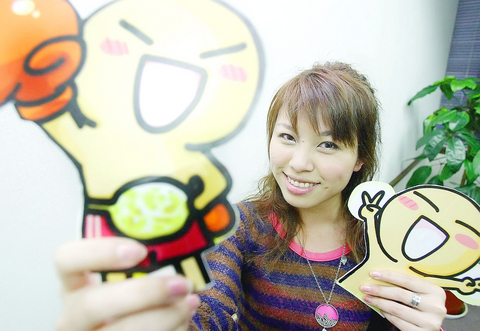
PHOTO: WANG YI-SUNG, TAIPEI TIMES
On the day of her interview with Taipei Times last week, she looked like a princess, in well-matched pink makeup, necklace and nails. She said that her meteoric rise to fame has come as a surprise, particularly since it all started with a humble online photo journal.
"When I started my blog in late 2003, I just thought it was an interesting idea because it offered a virtual space to show my photos," Hu said.
She began to post her original cartoons to the Internet, which she used to draw with pen and paper but now drafts with a digital pen.
Comic book fan
Wan Wan said she was born a comic-book freak. After spending much of her time in bookstores reading comics -- sometimes instead of going to her classes -- she started her own cartoon doodling. She tried to sell notebooks with her drawings to classmates for NT$5 each, but says she doesn't remember ever making a sale.
As the chief of arts and crafts in her class, she led classmates in decorating their classrooms for three years in junior-high school. After graduation, she was admitted into the Fu-Hsin Trade and Arts School, her top choice. That gave her a chance to pick up various techniques of oil painting, watercolor painting and sketching.
In the past six years since leaving that school, she has worked as a three-dimensional animation designer at an online game workshop and an overseer at an interior design company. Her most recent job as a designer of Web pages and advertising materials at a financial company ended two weeks ago.
Wan Wan's experience as an office worker helped her capture the feelings and daily moods of this working class. Hence the creation of her most famous works, characterized by figures with big heads facing a computer with different facial expressions, neatly described by one Chinese character shown on the top, such as jubilant (
"I started to create these pictures when I was working at an online game company, since I was felt bored and hot that summer. Then I put them on my MSN, where most people put their photos, to show my mood that day," she said.
These MSN icons are also posted on her blog, and an increasing number of Internet users have downloaded and circulated them -- with some having no idea where they came from.
Crisis and opportunity
Things changed for Hu last September when "big-head" figures similar to hers appeared on the official Web site of the popular boy band Mayday (五月天), without crediting her as the creator.
Feeling frustrated and depressed by the apparent plagiarism, Hu placed a "sorrow" (
Since then, the popularity of Wan Wan's comic blog, at www.wretch.cc/blog/cwwany, has shot up with the number of hits surging to 1 million last October from 100,000 in August and even breaking the 4 million mark last December.
A local publisher spotted her potential and offered to publish her works. Her first book I hate to work, but enjoy my life (
Wan Wan said the publisher told her before the interview that 100,000 copies of the book have been sold. She said the book will soon be published in China, Thailand and South Korea in local-language editions.
But her "dream readers" are Japanese, she said, as Japan's well-known cartoonists, especially Jyunji Ito, have greatly influenced her painting style.
With a second book expected to come out this summer, Wan Wan has now set her sights even higher, hoping to match the achievements of her Taiwanese idol.
"I'd like to learn from Jimmy (幾米) and not be restricted within the current frame so that more people can see my works," she said.
Renowned Taiwanese illustrator Jimmy's book series have been adapted to films, theater productions and images on mugs, photo frames, cards, plates and even toothbrush stands.
She's already moving closer to that goal, as her works have appeared on DVD disks and been used as image downloads on mobile phones and Internet portals.
Campaign
Now Taiwan FamilyMart, which operates more than 1,800 outlets nationwide, is trying to cash in on Wan Wan's appeal to computer-savvy youngsters, by launching a large-scale marketing campaign featuring stationery bearing her painting.
"I like my life now. At least within the next five years, I think I'll carry on creating cartoons and cultivating my blog. I love it," she said.

The domestic unit of the Chinese-owned, Dutch-headquartered chipmaker Nexperia BV will soon be able to produce semiconductors locally within China, according to two company sources. Nexperia is at the center of a global tug-of-war over critical semiconductor technology, with a Dutch court in February ordering a probe into alleged mismanagement at the company. The geopolitical tussle has disrupted supply chains, with some carmakers reportedly forced to cut production due to chip shortages. Local production would allow Nexperia’s domestic arm, Nexperia Semiconductors (China) Ltd (安世半導體中國), to bypass restrictions in place since October on the supply of silicon wafers — etched with tiny components to

Singapore-based ride-hailing and delivery giant Grab Holdings Ltd has applied for regulatory approval to acquire the Taiwan operations of Germany-based Delivery Hero SE's Foodpanda in a deal valued at about US$600 million. Grab submitted the filing to the Fair Trade Commission on Friday last week, with the transaction subject to regulatory review and approval, the company said in a statement yesterday. Its independent governance structure would help foster a healthy and competitive market in Taiwan if the deal is approved, Grab said. Grab, which is listed on the NASDAQ, said in the filing that US-based Uber Technologies Inc holds about 13 percent of
Taiwan Semiconductor Manufacturing Co (TSMC, 台積電) yesterday received government approval to deploy its advanced 3-nanometer (3nm) process at its second fab currently under construction in Japan, the Ministry of Economic Affairs said in a news release. The ministry green-lit the plan for the facility in Kumamoto, which is scheduled to start installing equipment and come online in 2028 with a monthly production capacity of 15,000 12-inch wafers, the ministry said. The Department of Investment Review in June 2024 authorized a US$5.26 billion investment for the facility, slated to manufacture 6- to 12nm chips, significantly less advanced than 3nm process. At a meeting with

Taiwan is open to joining a global liquefied natural gas (LNG) program if one is created, but on the condition that countries provide delivery even in a scenario where there is a conflict with China, an energy department official said yesterday. While Taiwan’s priority is to have enough LNG at home, the nation is open to exploring potential strategic reserves in other countries such as Japan or South Korea, Energy Administration Deputy Director-General Chen Chung-hsien (陳崇憲) said. While the LNG market does not have a global reserve for emergencies like that of oil, the concept has been raised a few times —


 RSS
RSS