


Despite tougher competition and unfavorable economic sentiment, Taiwan's electrical and electronics industries will still see improved prospects in the second half of the year over the first, several companies said yesterday.
"The notebook component segment this year will outperform last year," said Gary Lin (
His company is one of the 1,300 exhibitors taking part in the Taipei International Electronics Show "Taitronics Autumn 2005," which kicked off yesterday.
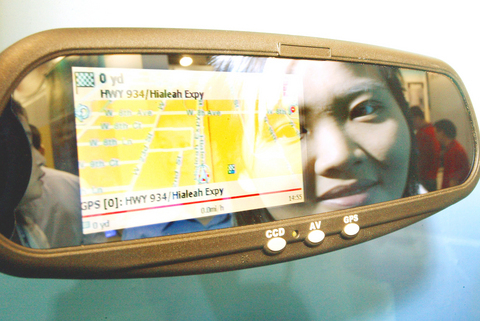
PHOTO: CNA
Excel Cell Electronic, which mainly supplies notebook components and industrial switches, will see a 30 percent rise in orders this year over last year, Lin said, since notebooks are fast becoming a more affordable commodity and are gradually replacing desktop computers for the general public.
Driven by the upcoming holiday season in the next two months, the company's notebook-component orders increased by 30 percent in the third quarter compared to the second, he said.
Meanwhile, Powertip Technology Co (
"We will be able to reach our goal of NT$3.4 billion by the end of this year," said Jason Wang (
The display-component segment is expected to record single-digit marginal growth this year due to the stiffer competition, he said.
To outperform rivals, firms now have to diversify their product portfolios into new application areas and launch more offerings to capture market share, he said.
Exports of electrical and electronics goods in the second half of the year are expected to grow 4 percent over the first six months, David Chen (陳文義), executive vice president of the Taiwan Electrical and Electronics Manufacturers Association (TEEMA, 電電公會), said last Wednesday.
The expansion is driven mainly by rising orders for components, especially semiconductors and thin-film-transistor liquid crystal displays, and due to the fact that around two-thirds of the entire year's exports will fall during the July-to-December period, he said.
The industry's exports amounted to US$40.54 billion for the first eight months of the year, up 1.3 percent over the same period last year, according to TEEMA's statistics.
Minister of Economic Affairs Ho Mei-yueh (
"We have only one way to retain the industry's competitiveness, which is to find niche markets to create more added value," Ho said at the opening of Taitronics Autumn 2005 yesterday.
These niches include automobile components, Internet protocol telecommunications and green solutions that comply with the EU's environmentally friendly regulations, Ho said.
The show runs until Saturday at Taipei World Trade Center Exhibition Halls I, II and III. The exposition is expected to attract more than 40,000 overseas and local buyers, up from 32,000 last year.
Even though local electronics companies face an increasing threat from cheaper Chinese competitors, many overseas buyers still prefer made-in-Taiwan products.
"Companies here know the European demand better than their Chinese counterparts," said Brian Dehlsen, a manager with the Danish firm Cabcon Electromechanical Design, was among the hordes of buyers at the expo yesterday.
"Although the components in Taiwan are priced comparatively higher, they [Taiwanese companies] have better quality control," he said.

The domestic unit of the Chinese-owned, Dutch-headquartered chipmaker Nexperia BV will soon be able to produce semiconductors locally within China, according to two company sources. Nexperia is at the center of a global tug-of-war over critical semiconductor technology, with a Dutch court in February ordering a probe into alleged mismanagement at the company. The geopolitical tussle has disrupted supply chains, with some carmakers reportedly forced to cut production due to chip shortages. Local production would allow Nexperia’s domestic arm, Nexperia Semiconductors (China) Ltd (安世半導體中國), to bypass restrictions in place since October on the supply of silicon wafers — etched with tiny components to

Singapore-based ride-hailing and delivery giant Grab Holdings Ltd has applied for regulatory approval to acquire the Taiwan operations of Germany-based Delivery Hero SE's Foodpanda in a deal valued at about US$600 million. Grab submitted the filing to the Fair Trade Commission on Friday last week, with the transaction subject to regulatory review and approval, the company said in a statement yesterday. Its independent governance structure would help foster a healthy and competitive market in Taiwan if the deal is approved, Grab said. Grab, which is listed on the NASDAQ, said in the filing that US-based Uber Technologies Inc holds about 13 percent of
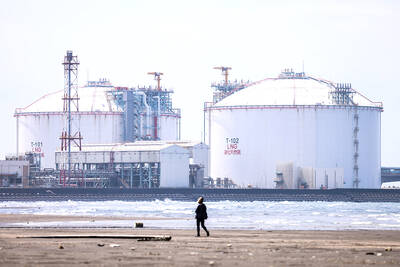
Taiwan is open to joining a global liquefied natural gas (LNG) program if one is created, but on the condition that countries provide delivery even in a scenario where there is a conflict with China, an energy department official said yesterday. While Taiwan’s priority is to have enough LNG at home, the nation is open to exploring potential strategic reserves in other countries such as Japan or South Korea, Energy Administration Deputy Director-General Chen Chung-hsien (陳崇憲) said. While the LNG market does not have a global reserve for emergencies like that of oil, the concept has been raised a few times —

Taiwan Semiconductor Manufacturing Co (TSMC, 台積電) yesterday received government approval to deploy its advanced 3-nanometer (3nm) process at its second fab currently under construction in Japan, the Ministry of Economic Affairs said in a news release. The ministry green-lit the plan for the facility in Kumamoto, which is scheduled to start installing equipment and come online in 2028 with a monthly production capacity of 15,000 12-inch wafers, the ministry said. The Department of Investment Review in June 2024 authorized a US$5.26 billion investment for the facility, slated to manufacture 6- to 12nm chips, significantly less advanced than 3nm process. At a meeting with


 RSS
RSS