


The nation's motherboard sector expects to see a rosy outlook for the upcoming July-September quarter, in the wake of the busy Computex Taipei 2005 Technology Show and healthy desktop computers demand worldwide, analysts said yesterday.
As the trade show entered its third day at the exhibition halls of the Taipei World Trade Center, expectations and confirmations of orders secured by local manufacturers appeared to boost the sentiment across the tech sector, market watchers said.
"We are optimistic about the motherboard sector in the third quarter after seeing a smooth seasonality in the current quarter, where shipments should decrease marginally by only 3 percent quarter-on-quarter -- much less than the average decline of 10 percent," Jenny Lai (賴惠娟), a hardware analyst at JP Morgan Chase & Co said in a phone interview yesterday.
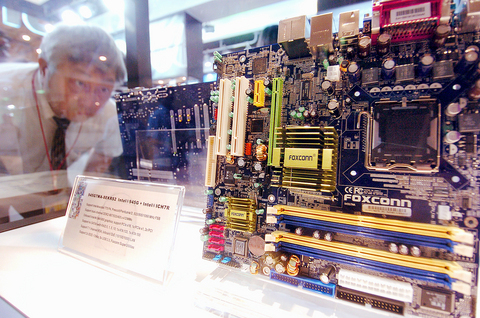
PHOTO: GEORGE TSORNG, TAIPEI TIMES
The total number of motherboards shipped by the nation's top four manufacturers, including Asustek Computer Inc (華碩電腦), Elitegroup Computer Systems Co (精英電腦), Gigabyte Technology Co (技嘉科技) and Micro-Star International Co (
She attributed the robust growth outlook to the busiest Computex trade show in the last four years, which also saw heavier visitor traffic.
According to the Taiwan External Trade Development Council (TAITRA, 外貿協會), the show attracted 23,309 visitors yesterday alone. For the first three days, it has attracted a total of 53,529 visitors, TAITRA said. Among that figure, 18,085 were foreign visitors, including foreign buyers and reporters, it said.
TAITRA expects to see 120,000 visitors with 28,000 from overseas this year.
Lai said the positive outlook is being partly boosted by a healthy demand for desktop computers worldwide, driven by a stable platform powered by Intel Corp's sufficient supply of affordable 915 chipsets.
Yet the eye-catching novel product of the dual-core microprocessor in the show may not become the market mainstream for the months ahead, as "CPU [central processing unit] availability and software optimization remain key issues to mass adoption, on top of pricing concerns," Lai said.
Meanwhile, JP Morgan recommended Asustek and Micro-Star as their overweight picks.
In contrast, Smith Barney equity research at Citigroup appeared to be less bullish about third-quarter prospects for the motherboard industry, citing concern on supply uncertainty.
The new Waste Electronics and Electrical Equipment (WEEE) and Restrictions on Hazardous Substances (RoHS) requirements, to take effect in the EU in August this year and July next year, will cost Taiwanese companies US$3 to US$4 more per board and reduce output speed by 10 percent to 20 percent, Kirk Yang (楊應超), said Smith Barney's head of Asia technology hardware research in a report released on Wednesday.
The potential chipset shortages from Intel Corp and the likely summer power shortages in China both cloud the third-quarter outlook, Yang said.
The researcher predicted the top four players plus the heavyweight newcomers Hon Hai Precision Industry Co (鴻海精密), the world's leading electronics manufacturing service (EMS) provider, to ship combined 134 million motherboards, accounting for 96.6 percent of forecasted global shipment of 138.7 million units this year.
Hon Hai this year will provide electronic components, primarily motherboards in the clone market under the brand name Foxconn, eying tech-savvy consumers who seek tailored PCs, Christin Wang (王文玉), Hon Hai's global marketing manager, told the Taipei Times in an interview last week.
"Hon Hai appears to be one of the most aggressive players this year," Yang said, adding that the EMS giant is aggressively building the clone motherboard business and showing some initial results, growing to estimated 6 million units this year from 1 million last year.
Hon Hai's total shipments are expected grow 25.7 percent year-on-year to 40 million motherboards, or 31.7 percent of global market, this year from 30 million, or 25.8 percent market share last year, the company said in a report.

The domestic unit of the Chinese-owned, Dutch-headquartered chipmaker Nexperia BV will soon be able to produce semiconductors locally within China, according to two company sources. Nexperia is at the center of a global tug-of-war over critical semiconductor technology, with a Dutch court in February ordering a probe into alleged mismanagement at the company. The geopolitical tussle has disrupted supply chains, with some carmakers reportedly forced to cut production due to chip shortages. Local production would allow Nexperia’s domestic arm, Nexperia Semiconductors (China) Ltd (安世半導體中國), to bypass restrictions in place since October on the supply of silicon wafers — etched with tiny components to

Singapore-based ride-hailing and delivery giant Grab Holdings Ltd has applied for regulatory approval to acquire the Taiwan operations of Germany-based Delivery Hero SE's Foodpanda in a deal valued at about US$600 million. Grab submitted the filing to the Fair Trade Commission on Friday last week, with the transaction subject to regulatory review and approval, the company said in a statement yesterday. Its independent governance structure would help foster a healthy and competitive market in Taiwan if the deal is approved, Grab said. Grab, which is listed on the NASDAQ, said in the filing that US-based Uber Technologies Inc holds about 13 percent of

Taiwan Semiconductor Manufacturing Co (TSMC, 台積電) yesterday received government approval to deploy its advanced 3-nanometer (3nm) process at its second fab currently under construction in Japan, the Ministry of Economic Affairs said in a news release. The ministry green-lit the plan for the facility in Kumamoto, which is scheduled to start installing equipment and come online in 2028 with a monthly production capacity of 15,000 12-inch wafers, the ministry said. The Department of Investment Review in June 2024 authorized a US$5.26 billion investment for the facility, slated to manufacture 6- to 12nm chips, significantly less advanced than 3nm process. At a meeting with

Taiwan is open to joining a global liquefied natural gas (LNG) program if one is created, but on the condition that countries provide delivery even in a scenario where there is a conflict with China, an energy department official said yesterday. While Taiwan’s priority is to have enough LNG at home, the nation is open to exploring potential strategic reserves in other countries such as Japan or South Korea, Energy Administration Deputy Director-General Chen Chung-hsien (陳崇憲) said. While the LNG market does not have a global reserve for emergencies like that of oil, the concept has been raised a few times —


 RSS
RSS