


Armed with a rich retail experience in Asia, seasoned hypermarket veteran Pascal Billaud returned to Taiwan two months ago with a mission to revamp the money-losing discount store chain Far Eastern Geant (
Billaud, who just celebrated his 47th birthday last week, has been in the retail sector for 25 years. He worked for the French retail giant Carrefour for 19 years -- including seven years in Taiwan between 1991 and 1997 -- before joining another retail group, Casino, two years ago.
After leaving Taiwan in 1997 he moved to Malaysia for three years, spent another three years in Thailand and then one year in China, helping him continue to grasp firsthand the fast changes in the behavior of consumers.
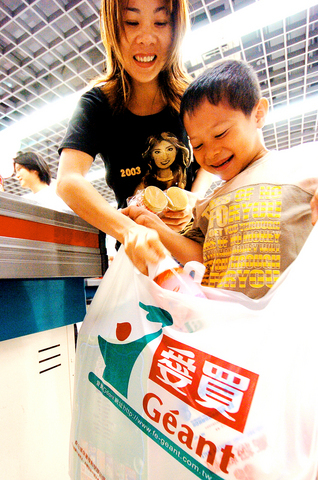
PHOTO: GEORGE TSORNG, TAIPEI TIMES
During an interview last week, the newly appointed president of Far Eastern Geant said that over the past 15 years, Taiwan, like all other nations around the world, had seen 70 percent of its retail products remain unchanged, including items such as toilet paper, food and milk powder. Two areas that have changed, however, are the non-food and leisure segments, the French executive said.
Competitive market
Citing the emergence of do-it-yourself (DIY) stores, second-hand auction Web sites, McDonald's and Starbucks, Billaud said he believes that the wide range of choices available for consumers has made the market more competitive and price-oriented.
With this in mind, Billaud unveiled the three main strategies he is currently implementing in the chain's 13 outlets nationwide to boost efficiency, cut costs and drive up profits.
As part of a review of its supply chain, Far Eastern Geant is now testing a new inventory control system, which allows suppliers to examine inventory in each store and replenish stock immediately, reducing shortages of goods and management costs.
Billaud expects this system to be installed nationwide by the year's end.
"We'll increase the number of suppliers because we can directly go to the supply chain, like in the fresh [foodstuffs]," Billaud said.
He has also restructured the business, appointing two regional assistant managers to take charge of northern and southern Taiwan. This way, the stores can get closer to customers and quickly respond to consumer needs, he said. As well, personnel training can be strengthened under the two regional chiefs to improve operational performance, he added.
The last part of his strategy is to remodel some stores, such as those in Taoyuan, Jingmei in Taipei and Kaohsiung.
Showing support for his predecessors' decisions, Billaud refuted criticism from competitors that Far Eastern Geant should close or relocate several stores, as only a limited number of branches make profits.
"I respect what they said because they might have some information, but I don't know. All of our locations are good to very good," he said.
Joint venture
Far Eastern Geant, the third-biggest hypermarket operator in Taiwan after Carrefour and RT-Mart (大潤發), is a joint venture between the nation's Far Eastern Group (遠東集團) and Casino Guichard Perrachon & Cie SA, the second-biggest supermarket company in France after Carrefour.
Both shareholders have extended their business activities into various distribution categories, ranging from department stores and supermarkets, to restaurants and telecommunications.
Despite the owners' solid capital and influence, Far Eastern Geant has been working to break even since the 50-50 venture was formed in 2000.
Acknowledging that his priority here is to make a diagnosis of problems with the company's performance, Billaud has decided to adopt a conservative expansion policy while making affordable investments to fight cut-throat pricing.
He said Far Eastern Geant will only open one new store this year, in Taipei's Dazhi, as well as another one next year. Any other forecasts cannot be provided because, "I have to respect the shareholders [both of which are listed companies] and I don't want to lie to you," he added.
Although the goal to break even can't be met this year, the hypermarket player has sacrificed NT$60 million (nearly US$2 million) in profits since last month to offer lower prices to consumers.
In light of a similar plan by Carrefour to take a NT$1 billion cut in profits this year to slash retail prices and RT-Mart's decision to sacrifice 2 percent of gross margin to do the same, Far Eastern Geant is facing a tough war.
"Taiwanese consumers are very demanding and critical. [If] they like, they come. If they don't like, they don't come. But the future belongs to innovative groups," Billaud said.

Cairo’s new monorail slices across the city skyline, running above the familiar chaos of blaring horns and aging buses’ exhaust fumes that mark rush hour below. The US$4.5 billion monorail, opened this month, is among Egypt’s most prominent new transport projects, part of a debt-funded infrastructure drive criticized for sapping state finances while bringing limited benefits to most of the country’s 109 million people. “It feels like you’re in a different country,” said Ramy Sayed, a restaurant manager, aboard a driverless Innovia 300 train. “No noise, no traffic, we’re not used to this.” The eastern line runs 56km from the bustling middle-class

Taiwanese firms have increased investment in the Philippines in recent years as Manila’s ties with Washington deepen and global supply chains continue to shift away from China, an expert at the Chung-Hua Institution for Economic Research (CIER, 中華經濟研究院) said yesterday. The Philippines had not been among Taiwanese investors’ top choices in Southeast Asia, CIER Taiwan ASEAN Studies Center director Kristy Hsu (徐遵慈) said at a seminar in Taipei. However, Taiwan’s investment in the country has grown significantly since the COVID-19 pandemic, reaching US $257 million last year, a high in recent years, she said. Although Taiwan’s total investment in the Philippines still lags

Intel Corp regards Taiwan Semiconductor Manufacturing Co (TSMC, 台積電) as a longstanding partner, as the US chipmaker would continue outsourcing production of advanced chips to TSMC, Intel chief executive officer Lip-Bu Tan (陳立武) said yesterday. “I don’t look at people as competitors. I look at the collaboration... Nvidia is also, you know, a good friend,” Tan told a news conference following his keynote speech at the Computex trade show in Taipei. “It’s a very trusted partnership for us... We are a big, top customer for them, and we’re going to continue doing that,” he said, referring to TSMC, the world’s largest foundry
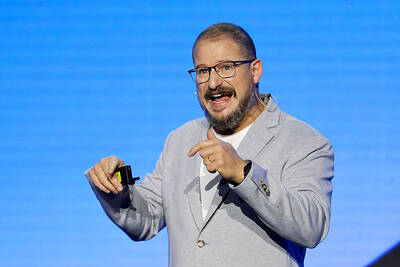
Artificial intelligence (AI) agents would supplant smartphones as the center of people’s digital lives, fundamentally reshaping personal devices and driving a major computing upgrade cycle, Qualcomm Inc CEO Cristiano Amon said yesterday. In his keynote speech for this year’s Computex trade show in Taipei, Amon said that the rise of "agentic AI" — AI systems capable of reasoning, planning and carrying out tasks autonomously — would transform how people interact with technology across phones, PCs, vehicles and wearable devices. Describing the technology as the next major evolution in computing, Amon said that "2026 is the year of agents.” For decades, smartphones have sat


 RSS
RSS