


Taipei Times: How would you rate your company's performance here last year with NT$7 billion (US$220 million) in sales created? What do you expect for 2005?
Richard Davies: We had good performances in quite a few categories that we operate. There is no doubt that last year was not the easiest year. But we had some good wins in key markets, like hair care, skin care, soups and food. The outlook for 2005 is good. We've got lots of new products across all of the categories that we're operating.
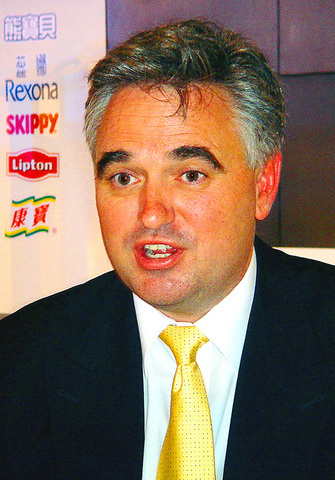
PHOTO: JACKIE LINE, TAIPEI TIMES
TT: Do you expect double-digit growth this year?
Davies: In this market, double-digit growth isn't easy. We had double-digit growth in the past, so there is no reason why we can't get it in the future.
TT: Will you introduce new brands or products into Taiwan on top of the nine brands currently marketed here?
Davies: I can't get into details as they're confidential, but we do have heavy innovation programs for this year. There is potential to bring in more brands given that we have more than 400 brands globally. But we'll only introduce the brands that we think are relevant to the market; make sure we do our homework, make sure that consumers are interested in the brand, the formulation is right, pricing and communication is right. Then we'll be successful.
TT: Can you elaborate on "heavy innovation" and specific methods to expand the market share and boost sales?
Davies: There is no doubt that Taiwanese people are very discerning and sophisticated consumers. The only way for businesses here to grow is to continuously deliver for them products that meet their expectations. That means we'll need to be able to take shares from competitors.
The other strategy is to develop new markets by introducing new segments, like the Snuggle spray. We also made it in the shape of small bags which you can hang in the car or wardrobe. This is how we can develop the market.
TT: You always say, "There are only globalized multinational companies, but no globalized consumers." How do you practice this corporate spirit and promote new products in this market?
Davies: First of all, we have to know what local consumers want. The Taiwanese consumers are different from those in China, Korea and Japan. I've worked in these markets and I know the differences sometimes are quite little, sometimes quite a lot. Taiwanese people have different requirements, say, in hair conditioning or moisturizer because the climate is different from that in Korea, Japan or China. So we have to understand those differences and make products that meet their expectations and needs.
One of the advantages Unilever has here is we have a laundry and personal care factory in Taoyuan, and a food factory in Hsinchu. This way, we are able to make products specifically for Taiwanese consumers. Some of our competitors think Taiwanese consumers are the same as those in Japan, Korea, Thailand and Europe. That just won't work.
TT: How would you operate the pricing policy to gain a bigger market share especially when P&G Taiwan has been your tough competitor?
Davies: We actually focus more on improving the quality of the goods we offer. Taiwanese consumers are very smart. They know what good value is and what bad value is. We don't believe competing just by reducing the price.
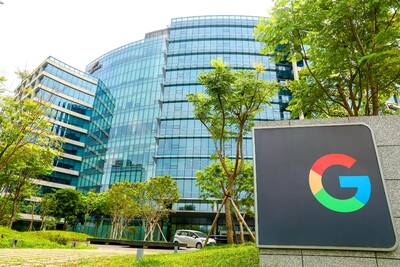
The government yesterday approved applications by Alphabet Inc’s Google to invest NT$27.08 billion (US$859.98 million) in Taiwan, the Ministry of Economic Affairs said in a statement. The Department of Investment Review approved two investments proposed by Google, with much of the funds to be used for data processing and electronic information supply services, as well as inventory procurement businesses in the semiconductor field, the ministry said. It marks the second consecutive year that Google has applied to increase its investment in Taiwan. Google plans to infuse NT$25.34 billion into Charter Investments Ltd (特許投資顧問) through its Singapore-based subsidiary Fructan Holdings Singapore Pte Ltd, and

SECOND-RATE: Models distilled from US products do not perform the same as the original and undo measures that ensure the systems are neutral, the US’ cable said The US Department of State has ordered a global push to bring attention to what it said are widespread efforts by Chinese companies, including artificial intelligence (AI) start-up DeepSeek (深度求索), to steal intellectual property from US AI labs, according to a diplomatic cable. The cable, dated Friday and sent to diplomatic and consular posts around the world, instructs diplomatic staff to speak to their foreign counterparts about “concerns over adversaries’ extraction and distillation of US AI models.” Distillation is the process of training smaller AI models using output from larger, more expensive ones to lower the costs of training a powerful new

Micron Technology Inc is a driving force pushing the US Congress to pass legislation that would put new export restrictions on equipment its Chinese competitors use to make their chips, according to people familiar with the matter. A US House of Representatives panel yesterday was to vote on the “MATCH Act,” a bill designed to close gaps in restrictions on chipmaking equipment. It would also pressure foreign companies that sell equipment to Chinese chipmaking facilities to align with export curbs on US companies like Lam Research Corp and Applied Materials Inc. The bill targets facilities operated by China’s ChangXin Memory Technologies Inc

Singapore-based ride-hailing and delivery giant Grab Holdings’ planned acquisition of Foodpanda’s Taiwan operations has yet to enter the formal review stage, as regulators await supplementary documents, the Fair Trade Commission (FTC) said yesterday. Acting FTC Chairman Chen Chih-min (陳志民) told the legislature’s Economics Committee that although Grab submitted its application on March 27, the case has not been officially accepted because required materials remain incomplete. Once the filing is finalized, the FTC would launch a formal probe into the deal, focusing on issues such as cross-shareholding and potential restrictions on market competition, Chen told lawmakers. Grab last month announced that it would acquire


 RSS
RSS